839
Introduction
Sterile pharmaceutical products are governed by stringent Good Manufacturing Practice (GMP) regulations designed to ensure product safety, efficacy, and quality throughout their lifecycle. Within the European regulatory framework, one of the cornerstone documents guiding the manufacture of sterile medicinal products is Annex 1 of the EU GMP Guidelines (1). The most recent revision of Annex 1 integrates modern pharmaceutical quality concepts, emphasizing the implementation of Quality by Design (QbD) and Quality Risk Management (QRM) principles. A central feature of this revision is the requirement to establish a Contamination Control Strategy (CCS)—a comprehensive, facility-wide approach to contamination prevention that encompasses process design, equipment, personnel, and environmental controls.
Recognizing the evolving complexity of sterile manufacturing, the European Commission issued a major revision to Annex 1 in 2022, introducing enhanced guidance on aseptic processing and a dedicated section addressing lyophilization processes (Clauses 8.121–8.126) (2). These new provisions outline detailed regulatory expectations for equipment qualification, environmental monitoring, process simulation, and personnel competency. The revision aligns European standards more closely with international regulatory expectations, reflecting an increasing emphasis on harmonization and risk-based oversight of sterile manufacturing technologies.
The updated Annex 1 came into force on 25 August 2023, with a deferred implementation date of 25 August 2024 for Clause 8.123, which pertains to lyophilizers operated without barrier separation. This phased implementation acknowledges the technical and infrastructural challenges manufacturers face when upgrading manual lyophilization systems to meet enhanced contamination control and sterilization requirements. Regulatory authorities have encouraged a risk-based, phased approach to compliance, allowing facilities to prioritize high-impact process modifications during the transition period.
Lyophilization, or freeze-drying, has become a critical unit operation in the production of modern sterile pharmaceuticals, including biologics, peptides, and vaccines—products often unstable in aqueous formulations, where degradation can exceed 90%. By removing water through sublimation under vacuum, lyophilization markedly improves product stability, shelf life, and transportability. However, the process introduces unique aseptic and contamination control challenges. During lyophilization, vials are typically open and partially stoppered, exposing product surfaces to potential microbial and particulate contamination. The transfer of vials between the filling line, lyophilizer, and stoppering system further increases risk, particularly during prolonged drying cycles that may extend beyond 48 hours. Consequently, regulatory agencies emphasize robust system design, closed handling, and barrier technologies to maintain aseptic assurance throughout lyophilization operations.
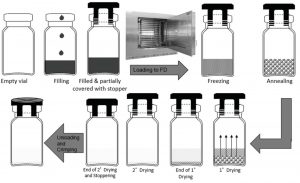
Figure 1. Various stages of a vial in Freeze-drying process.
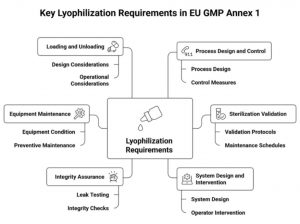
Figure 2. Key changes in Annex-1 for Freeze-drying process.
Key Lyophilization Requirements in the Revised EU GMP Annex 1:
The revised Annex 1 of the EU GMP guidelines introduces several enhanced requirements and expectations specific to lyophilization processes, reflecting a stronger focus on contamination control, system design, and sterility assurance. The key points are summarized below, with reference to the relevant Annex 1 sections:
- 8.121 – Design and Control of Lyophilization Processes
- 8.122 – Validation and Maintenance of Sterilization
- 8.123 – System Design, Operator Intervention, and Sterilization Frequency
- 8.124 – Integrity Assurance and Leak Testing
- 8.125 – Equipment Condition and Preventive Maintenance
- 8.126 – Design and Operational Considerations for Loading and Unloading
The following interpretation summarizes and explains the author’s perspective on the key section relevant to lyophilization:
8.121 – Design and Control of Lyophilization Processes:
Annex 1, Section 8.121 – Design and Control of Lyophilization Processes on Design and Control of Lyophilization Processes emphasizes that lyophilization is an extension of aseptic processing governed by strict contamination control principles.
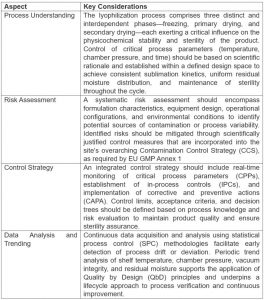
The critical aspects of lyophilization process design and control are summarized in Table 1:
Table 1. Scientific Overview of Critical Elements in Lyophilization Process Design and Control.
This comprehensive approach ensures lyophilization processes consistently deliver sterile, high-quality products by integrating detailed process understanding, risk-based controls, and data-driven monitoring aligned with Annex 1 GMP compliance.
8.122 – Validation and Maintenance of Sterilization
- Sterilization of the lyophilizer and its associated components such as trays, vial support rings, and other product-contact parts must be scientifically validated.
- The holding time between sterilization and use must be evaluated during Aseptic Process Simulation (APS).
- Sterilization frequency must be defined within the site’s Contamination Control Strategy (CCS).
- Post-sterilization protection requires maintaining closed or covered conditions and preventing exposure to non-sterile environments.
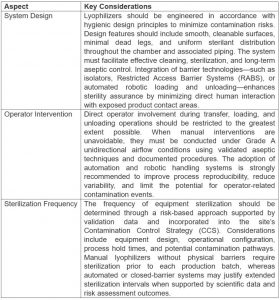
8.123 – System Design, Operator Intervention, and Sterilization Frequency
Annex 1, Section 8.123 reinforces the principle that system design should minimize operator intervention during lyophilization to reduce the risk of contamination. The frequency of sterilization must be defined through a risk-based approach and integrated into the site’s Contamination Control Strategy (CCS).
Re-sterilization must be performed following any maintenance, cleaning, or intervention that may compromise aseptic integrity. All sterilization activities should be comprehensively documented, independently verified, and routinely reviewed to ensure complete traceability and regulatory compliance.
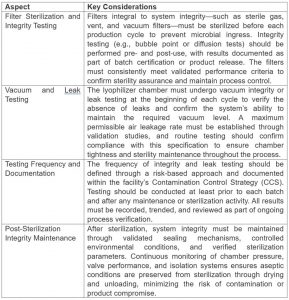
8.124 – Integrity Assurance and Leak Testing
Annex 1 section 8.124 emphasizes the importance of maintaining the integrity of the lyophilizer through proper sterilization and leak testing protocols.
8.125 – Equipment Condition and Preventive Maintenance
Annex 1 section 8.125 highlights the importance of regular inspection of lyophilization trays to ensure they remain flat, undamaged, and suitable for use. Tray deformation can compromise heat transfer efficiency and cause issues such as vial miss-stoppering.
8.126 – Design and Operational Considerations for Loading and Unloading
Annex 1 section 8.126 sets forth essential guidelines to maintain aseptic integrity during the loading and unloading of lyophilizers, particularly when containers are partially stoppered or unsealed.
Table 2. Overview of scientific and regulatory considerations governing lyophilizer design, operator involvement, and sterilization frequency in compliance with EU GMP Annex 1 (2022).
Table 3. Summary of regulatory and scientific principles governing integrity assurance, filter validation, and leak testing for lyophilization systems in alignment with EU GMP Annex 1 (2022).
Operational and Validation Considerations
Incorporating regulatory expectations into daily lyophilization manufacturing requires robust operational controls, especially when transferring partially stoppered vials, which represent a significant contamination risk.
Media fill validations must accurately replicate the entire lyophilization cycle, including freezing, primary drying, secondary drying, and stoppering under vacuum.
Critical to process control during lyophilization is continuous environmental monitoring of viable and non-viable particles.
Finally, container closure integrity (CCI) testing is integral to post-lyophilization validation.
Challenges and Technological Advances
Despite notable regulatory advances, lyophilization continues to pose significant operational challenges.
To address these challenges, the pharmaceutical industry is increasingly embracing automation, robotics, and isolator-based systems.
According to the PDA 2019 survey, 65.9% of facilities reported the use of fully automated lyophilizer loading systems with little to no human participation.
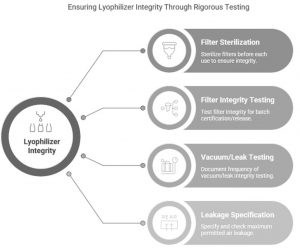
Figure 3. Schematic view of integrity testing and specifications for Lyophillizer (5).
These findings reflect a positive trend toward automation, demonstrating alignment with regulatory expectations for contamination control.
Overall Emphasis on Contamination Risk Mitigation
Annex 1 mandates that partially stoppered vials must be handled under strict Grade A conditions, preferably using validated closed transfer systems and clean devices.
Container closure integrity (CCI) testing is critical post-lyophilization to ensure product sterility and stability.
Conclusion
The manufacture of sterile pharmaceuticals is governed by stringent regulatory standards, where effective contamination control forms the foundation for ensuring product quality, safety, and therapeutic efficacy.
The 2022 revision of Annex 1 marks a significant evolution in regulatory expectations for lyophilization processes.
Ultimately, adherence to Annex 1 extends beyond regulatory obligation—it represents a commitment to safeguarding product integrity and protecting patient health worldwide.
References and notes
- European Union. EudraLex – Volume 4: Good Manufacturing Practice (GMP) guidelines. Annex 1: Manufacture of Sterile Medicinal Products. Brussels: European Commission; 2022.
- PHSS. Contamination Control Strategy Guidance. Swindon (UK): PHSS; 2023.
- Vijayakumar V. A regulatory perspective on hold duration of partially stoppered media-filled vials. Lyophilization World; 2023.
- PDA Research. 2019 Sterile Lyophilized Drug Product Loading Survey. Bethesda (MD): Parenteral Drug Association; 2019.
- Napkin AI. Image creation platform. Available from: https://www.napkin.ai
- U.S. Food and Drug Administration (FDA). Guidance for Industry: Sterile Drug Products Produced by Aseptic Processing – Current Good Manufacturing Practice. FDA; 2004.
- PIC/S. Recommendation on the Validation of Aseptic Processing. Geneva: PIC/S; 2011.
- Huang E. Lyophilization validation: A regulatory perspective. CASSS CMC Strategy Forum; 2016.

MAGAZINE
Vol. 44 | Vol. 44(1) - January / February 2026 | EDITORIAL
Sustainable Medicines Manufacturing

MAGAZINE
Vol. 44 | Vol. 44(1) - January / February 2026 | ARTIFICIAL INTELLIGENCE
2026 predictions: what are the operational priorities for late-stage p...

MAGAZINE
Vol. 44 | Vol. 44(1) - January / February 2026 | ARTIFICIAL INTELLIGENCE
What does agentic AI mean for pharma operations?

MAGAZINE
Vol. 44 | Vol. 44(1) - January / February 2026 | ADVERTORIAL
Angelini Pharma – High-Potent API: strategy and legacy

MAGAZINE
Vol. 44 | Vol. 44(1) - January / February 2026 | COLUMN: API of the Month
Overview of 2025 year

MAGAZINE
Vol. 44 | Vol. 44(1) - January / February 2026 | CMC
Accelerating the bioconjugate CMC journey from early discovery to the...

MAGAZINE
Vol. 44 | Vol. 44(1) - January / February 2026 | DIGITALISATION
From digital islands to integrated ecosystems: Envisioning the future...

MAGAZINE
Vol. 44 | Vol. 44(1) - January / February 2026 | COLUMN: Sustainabilty
Scope 3 and the chemical industry: a challenge with solutions

MAGAZINE
Vol. 44 | Vol. 44(1) - January / February 2026 | PANEL DISCUSSION