Introduction
On 29 September 2026, the broader phase of the Section 232 pharmaceutical tariff regime takes effect. Imported patented medicines and covered ingredients become subject to a baseline 100 percent rate, except where a country-specific rate, an approved onshoring plan, a company agreement, an applicable exclusion or zero-rate provision, or another tariff heading applies (1, 2).
Most of what has been written about this program concerns rates. Rates are the least interesting part of it. The more interesting question is how the location of substantial transformation along a chemical synthesis affects the applicable tariff, and what a company must prove about the steps that came before.
Three instruments, three theories of the problem
The proclamation of 2 April 2026 rests on a finding that import dependence threatens national security (1). Federal agencies agree that the United States is heavily dependent on foreign pharmaceutical manufacturing, but they do not measure that dependence the same way. Commerce reports that only 15 percent of patented APIs by volume for the US market are produced domestically (1). FDA’s April 2026 PreCheck page reports that 11 percent of API manufacturers are US-based (3); a separate FDA public-meeting page dated September 2025 reports 9 percent (4). Both are labeled as of 2025 and use the same country comparators.
An HHS analysis, citing the White House Quadrennial Supply Chain Review, puts the proportion of API manufacturing facilities for US-marketed drugs located in the United States at 24 percent as of August 2024 (5). A volume measure, a manufacturer count, and a facility count are not necessarily inconsistent, because their denominators differ. FDA’s own 11 percent and 9 percent figures, however, are presented under the same label, without enough methodological detail on those pages to reconcile the difference.
A facility count says little about output. A manufacturer count says little about the number or scale of its sites. A volume measure says little about which products are strategically indispensable. None of these three aggregate percentages identifies the provenance or substitutability of key starting materials.
The tariff is tiered. Annex I creates ten chapter 99 headings: a 100 percent baseline for patented pharmaceutical articles; 15 percent for products of Japan, the European Union, Korea, Switzerland, and Liechtenstein; ordinary duty plus 10 points for United Kingdom products, as originally proclaimed; and ordinary duty plus 20 points for approved onshoring plans, rising to 100 percent on 2 April 2030. Specified specialty products may avoid the additional duty only where Commerce determines they come from a jurisdiction with a qualifying trade-and-security framework or meet an urgent US health need; articles covered by both an onshoring plan and a most-favored-nation pricing agreement may also avoid it until 20 January 2029. Generics and biosimilars are exempt from this Section 232 measure at this time (1, 2). CBP’s July implementation guidance describes the UK and onshoring rates as additional duties and the 100 percent baseline and 15 percent country tier as combined column-one and Section 232 rates (21). Commerce subsequently reduced the additional Section 232 duty for covered United Kingdom products from 10 percent to zero, effective 31 July 2026; otherwise applicable duties remain payable (25).
BIOSECURE became law on 18 December 2025 (6). The enacted text names no companies. Its restrictions concern federal procurement and covered use of federal grant and loan funds, not all private dealings with a designated company. A company reaches the list through the Section 1260H route only if OMB also finds it involved in biotechnology equipment or services; OMB may separately designate entities under its own criteria and related-entity rules. The prohibitions are not yet in force: OMB must publish the initial list by 18 December 2026 and implementing guidance within 180 days after publication of the list, the Federal Acquisition Regulatory Council then has up to a year to revise the Federal Acquisition Regulation (FAR), and prohibitions follow 60 or 90 days later (6). Defense added WuXi AppTec to the 1260H list in June 2026 (7, 8); WuXi challenged the designation, and on 7 August 2026 the district court preliminarily enjoined the Department from enforcing, implementing, or giving effect to the designation (9).
That development does not eliminate OMB’s separate statutory designation pathway (6). A Section 1260H listing alone does not trigger the Act’s prohibitions.
FDA PreCheck treats the same problem as regulatory latency. Developed in response to Executive Order 14293 (10), it pairs pre-operational review with a facility-specific Type V drug master file used to evaluate facility-specific elements before, and in support of, a drug application (3). Seven participants were selected in June 2026 (11). So: a trade imbalance, an adversary dependency, and a queue. Three diagnoses, but the public materials reviewed do not establish a shared measure of the dependency.
Where origin is conferred
Under the customs marking regulations, origin is the country of manufacture, production, or growth unless later processing effects a substantial transformation (12). The fact-specific test asks whether the article acquired a new name, character, or use (13). In the cited rulings, CBP generally treated conversion of bulk API into dosage form as insufficient to confer a new origin (13). It has found transformation where extensive processing makes otherwise unusable material into a drug (14), or combines APIs into a product with additional medicinal benefits (15).
Neither the proclamation nor Annex I defines or alters that framework, although much of the regime turns on it. The country tiers set out above apply to articles that are products of the named jurisdictions, and a further heading depends on whether a dosage form is a product of the United States (2). Much depends on a phrase that neither document defines.
The consequence is visible in a ruling issued on 21 May 2026. A company asked CBP for the country of origin of candesartan cilexetil and hydrochlorothiazide tablets. One active ingredient was made in China, the other in India, and the two were combined into tablets in India. Because the combination offered a medicinal benefit beyond either ingredient alone, CBP found a substantial transformation, and the country of origin was India (16). A Chinese API can therefore enter the United States in a tablet treated as Indian origin. That classification does not itself establish whether the underlying API suppliers are concentrated or readily replaceable. Generics are exempt from this Section 232 measure for now, but similar origin reasoning could be relevant to patented fixed-dose combinations, depending on the manufacturing facts and applicable tariff rules. The ruling illustrates the problem one level above the key starting material: legal origin can shift while dependence on the underlying chemical supply is untouched.
In the hypothetical route shown in Figure 1, a key starting material made in China is carried to a regulated intermediate in India, then through its final synthetic step to the API in Ireland, and finally formulated into a finished tablet in the United States. Assume that the processing in Ireland substantially transforms the intermediate into the API. On that assumption, the imported API would have Irish origin and, if it is a covered patented article and no other preferential treatment applies, would fall within the 15 percent EU tier (2, 21). The API enters the United States before formulation into tablets. If supply is concentrated in the key starting material and intermediate, the constraint on resilience sits upstream. Origin determines the applicable country treatment; the duty is assessed when the covered article enters the United States.
Heading 9903.04.68 exposes a related problem. Although note 40 governs imported articles, the heading describes a dosage form that is a product of the United States. Unlike the other headings, its description contains no cross-reference to a subdivision of note 40, and the note provides no dedicated explanation of this category, leaving questions about the relevant entry scenario and application of the origin standard (2). Proclamation clause 11 nevertheless provides context by exempting imports of US-origin pharmaceutical products, and CBP’s July guidance expressly lists this heading and its zero additional duty rate (1, 21). Application to particular products requires a fact-specific origin determination. A later entry of a finished product must also be distinguished from an earlier entry of its API; subsequent US formulation does not itself undo duties assessed on that earlier entry. The procurement framework is distinct: in Acetris, the Federal Circuit held that API origin did not make US-manufactured tablets products of India under the Trade Agreements Act, and that Acetris’ products were US-made end products under the FAR (17).
It is worth separating three ideas the debate tends to merge. Country of origin is an administrative proxy, assigned by a legal test at a port of entry. Provenance is a traceability question, answered by records. Resilience is a property of a system: single sourcing, substitutability, inventory, allocation rights, and how readily a filing permits an alternate supplier. Knowing where a key starting material was produced does not establish whether it could be withheld or how quickly it could be replaced. Documentation is necessary. It is not sufficient.
PreCheck expressly reaches upstream. PreCheck’s selection criteria prioritize facilities that make finished dosage forms from domestic API or domestic API from domestic key starting materials (3). Commerce’s May implementation notice also requests manufacturing locations, production measures, onshoring commitments, and investment milestones, encourages onshoring of upstream ingredients, and allows applicants to explain dependencies on FDA approval (22).
The exemption that inverts the logic
Generic products and biosimilars are not subject to this Section 232 tariff (1). FDA reports that, as of 2025, approximately 69 percent of generic drug products are manufactured outside the United States, against 53 percent of branded products (3). An HHS analysis of FDA-listed product-level shortages beginning during 2018–2023 identified 1,391 generic and 600 brand product-shortage starts, using nine-digit National Drug Codes. These are not counts of distinct molecules, and the report notes that generics are more common in the market. Injectables accounted for half of the product-shortage starts, with an estimated median duration of 4.6 years, compared with 1.6 for oral products; survival analysis accounted for unresolved shortages. Drawing on earlier sources, the report also describes low generic profitability and facilities typically operating above 80 percent capacity, leaving little room to respond to disruptions (5).
The study’s brand and generic categories do not correspond exactly to the tariff’s patent-based definitions. Nevertheless, its findings underscore the vulnerability of the generic segment that is currently exempt from this Section 232 measure (2, 5).
There is a fair defense. Given the low profitability described in the HHS report, a duty could encourage market exit rather than investment for some generic products, worsening an already vulnerable supply chain (5). The proclamation does not purport to make the exemption permanent: within one year, clause 5 requires the Secretary to inform the President of any circumstances that may indicate a need to adjust imports of generics (1).
Generic manufacturers must now make multi-year capital decisions without knowing what action, if any, will follow the Secretary’s notification, due by 2 April 2027, to the President, and such uncertainty may discourage the investment the policy is meant to induce. A drug shortage is also not a harm anyone consented to. It falls on a population that took no part in the sourcing decision. Supply resilience has public benefits that may not be fully reflected in private sourcing decisions.
Why chemistry sets the pace
The preferential onshoring rate becomes 100 percent on 2 April 2030 (2). That tariff date is not a universal deadline for completing an onshoring project. Commerce’s May notice uses 20 January 2029 planning targets, with commitments and milestones determined through company-specific agreements (22). Those commitments have teeth: the proclamation empowers Commerce to reimpose tariffs retroactively on companies that engage in fraud or deliberately mislead the government about their onshoring commitments (1, 22).
For a complex chemically synthesized product, meeting an onshoring milestone may require more than constructing and qualifying a building. A manufacturer may need to select or transfer a synthetic route, characterize and control the impurity profile, satisfy the applicable expectations of ICH M7(R2) for mutagenic impurities (18), scale up, execute process performance qualification, and pass inspection. A route that does not transfer cleanly can create additional delays; the time required depends on the product, process, facility, and regulatory pathway.
Then there is the part trade commentary rarely mentions. Relocating API manufacture for a product approved under an NDA or ANDA is a regulated post-approval change. Depending on the application and the nature of the change, it may require data assessing the change’s effects on product quality and performance, as applicable, and a prior approval supplement (19, 23). Companies that agreed established conditions and reporting categories with the regulator or secured an approved post-approval change management protocol applicable to the proposed change under ICH Q12 (20) may execute the transition more predictably and with less regulatory delay. A decision taken years ago in a regulatory affairs department may determine whether an onshoring milestone can be met, and that is not always understood at board level.
The economics are a chemistry problem before they are a finance problem. The economics of domestic API production depend on the product, process, scale, and applicable tariff treatment. Intensified or continuous processes, telescoped steps, and biocatalysis may change production economics; modular plant designs and appropriate control strategies, including real-time release testing, may also affect feasibility. FDA’s Q13 guidance sets out scientific and regulatory considerations for continuous manufacturing, but does not establish cost savings for every process (24). PreCheck names modular construction and advanced automation among its criteria (3). Policy has created a large, time-limited incentive to solve a specific set of process engineering problems, and those problems belong to this readership.
What would connect the three programs is a common data model. Building on its May implementation requirements (22), Commerce should require approved onshoring plans to identify the registered API, the critical intermediates, and the key starting materials by manufacturing site and country; to disclose single-source nodes and realistic replacement lead times; and to state the regulatory changes needed to qualify an alternate supplier. OMB’s BIOSECURE guidance and FDA PreCheck should collect the same core fields. Provenance alone would not establish resilience. But a shared framework would at least let the three programs measure the same supply chain.
Implementation
Implementation now runs beyond the tariff’s effective date: OMB must issue the BIOSECURE list and guidance, the Secretary must notify the President on generics by 2 April 2027, the most-favored-nation-linked rate expires in January 2029, company-specific milestones govern onshoring commitments, and the onshoring tariff heading rises in April 2030. Implementation will determine whether the policy becomes real.
So, the useful question for anyone in a manufacturing, process development, or CMC role is not about the duty. Can you say today, without a three-week exercise, in which country the key starting material two steps upstream of your registered API was made? Can you prove it to an auditor? And if you can, do you know whether that supplier could be replaced, and how quickly?
The revolution is real, and it was forced. Whether it produces a more secure supply chain or merely a better-documented one will be settled several synthetic steps below where most policymakers are currently looking.
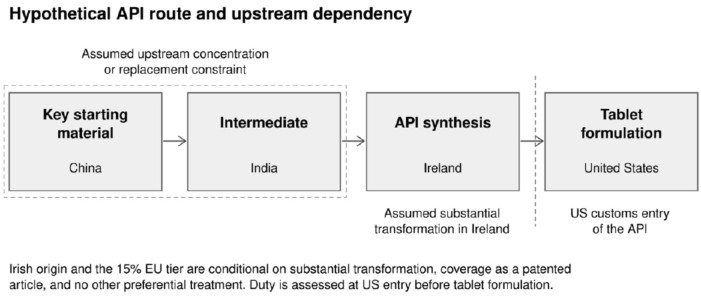
Figure 1. Hypothetical active pharmaceutical ingredient (API) route illustrating the distinction between origin, customs entry, and assumed upstream supply constraints. The origin and tariff treatment shown depend on the stated assumptions.
References and notes
- Proclamation 11020. Adjusting Imports of Pharmaceuticals and Pharmaceutical Ingredients into the United States. Washington (DC): The White House; 2026 Apr 2. Published in the Federal Register 2026 Apr 9;91:18183. FR Doc. 2026-06956. Available from: https://www.whitehouse.gov/presidential-actions/2026/04/adjusting-imports-of-pharmaceuticals-and-pharmaceutical-ingredients-into-the-united-states/
- Annexes I, II, III and IV to the Proclamation of 2 April 2026, Adjusting Imports of Pharmaceuticals and Pharmaceutical Ingredients into the United States. Washington (DC): The White House; 2026. Available from: https://www.whitehouse.gov/wp-content/uploads/2026/04/Pharmaceuticals-Imports-ANNEXES-I-II-III-IV.pdf
- US Food and Drug Administration. FDA PreCheck Pilot Program. Silver Spring (MD): FDA; content current as of 2026 Apr 10. Available from: https://www.fda.gov/industry/fda-precheck-pilot-program Accessed 2026 Sep 11.
- US Food and Drug Administration. FDA Public Meeting: Onshoring Manufacturing of Drugs and Biological Products – 09/30/2025. Silver Spring (MD): FDA; content current as of 2025 Sep 30. Available from: https://www.fda.gov/drugs/news-events-human-drugs/fda-public-meeting-onshoring-manufacturing-drugs-and-biological-products-09302025 Accessed 2026 Sep 11.
- McGeeney JD, McAden E, Sertkaya A. Analysis of Drug Shortages, 2018–2023. Data Brief. Prepared by Eastern Research Group, Inc. for the Office of the Assistant Secretary for Planning and Evaluation, US Department of Health and Human Services; 2025 Jan 8. Available from: https://aspe.hhs.gov/sites/default/files/documents/efa332939da2064fa2c132bb8e842bb5/Drug%20Shortages_Data%20Brief_Final_2025.01.10.pdf
- National Defense Authorization Act for Fiscal Year 2026, Pub. L. No. 119-60, sec. 851 (18 Dec 2025). Relevant provisions: sec. 851(a)–(c), (f), and (h). Available from: https://www.govinfo.gov/content/pkg/PLAW-119publ60/pdf/PLAW-119publ60.pdf
- US Department of Defense. Entities Identified as Chinese Military Companies Operating in the United States in Accordance with Section 1260H of the William M. (Mac) Thornberry National Defense Authorization Act for Fiscal Year 2021. Posted 2026 Jun 8. Available from: https://media.defense.gov/2026/Jun/08/2003945537/-1/-1/1/entities-identified-as-chinese-military-companies-operating-in-the-united-states-in-accordance-with-section-1260h.pdf
- Office of the Under Secretary of Defense (Acquisition and Sustainment), Department of Defense. Notice of Availability of Designation of Chinese Military Companies. Fed Regist. 2026 Jun 10;91:35189–35194. Document 2026-11571. Docket ID DOD-2026-OS-1288. Available from: https://www.govinfo.gov/content/pkg/FR-2026-06-10/pdf/2026-11571.pdf
- WuXi AppTec Co., Ltd. v. U.S. Department of Defense, No. 1:26-cv-02069 (JEB) (D.D.C. Aug. 7, 2026), memorandum opinion, ECF No. 25, at 35. Opinion available from: https://docs.justia.com/cases/federal/district-courts/district-of-columbia/dcdce/1:2026cv02069/293402/25
- Executive Order 14293, Regulatory Relief to Promote Domestic Production of Critical Medicines. 2025 May 5. Fed Regist. 2025 May 8;90:19615. Available from: https://www.whitehouse.gov/presidential-actions/2025/05/regulatory-relief-to-promote-domestic-production-of-critical-medicines/
- US Food and Drug Administration. FDA Selects Seven Participants for PreCheck Pilot Program to Advance U.S. Drug Manufacturing [press announcement]. Silver Spring (MD): FDA; 2026 Jun 29. Available from: https://www.fda.gov/news-events/press-announcements/fda-selects-seven-participants-precheck-pilot-program-advance-us-drug-manufacturing
- Country of Origin Marking, 19 C.F.R. § 134.1(b). Available from: https://www.ecfr.gov/current/title-19/section-134.1
- US Customs and Border Protection. Headquarters Rulings HQ 735146 (1993 Nov 15); HQ 561544 (2000 May 1); HQ 561975 (2002 Apr 3); HQ H233356 (2012 Dec 26); HQ H267177 (2015 Nov 5). Individual rulings available from: https://rulings.cbp.gov/ruling/735146; https://rulings.cbp.gov/ruling/561544; https://rulings.cbp.gov/ruling/561975; https://rulings.cbp.gov/ruling/H233356; https://rulings.cbp.gov/ruling/H267177.
- US Customs and Border Protection. Headquarters Ruling HQ 731731 (1989 Feb 23); see also HQ 563301 (2005 Aug 26). Available from: https://rulings.cbp.gov/ruling/731731; https://rulings.cbp.gov/ruling/563301.
- US Customs and Border Protection. Headquarters Ruling HQ 563207 (2005 Jun 1). Available from: https://rulings.cbp.gov/ruling/563207.
- US Customs and Border Protection. Ruling NY N361531: The country of origin of Candesartan Cilexetil and Hydrochlorothiazide Tablets USP, in dosage form. 2026 May 21. Available from: https://rulings.cbp.gov/ruling/N361531
- Acetris Health, LLC v. United States, 949 F.3d 719 (Fed. Cir. 2020). Relevant discussion: slip opinion pp. 18–22. Available from: https://www.cafc.uscourts.gov/opinions-orders/18-2399.opinion.2-10-2020_1529718.pdf
- International Council for Harmonisation. ICH M7(R2): Assessment and Control of DNA Reactive (Mutagenic) Impurities in Pharmaceuticals to Limit Potential Carcinogenic Risk. Geneva: ICH; 2023 Apr 3. Available from: https://database.ich.org/sites/default/files/ICH_M7(R2)_Guideline_Step4_2023_0216_0.pdf
- Supplements and Other Changes to an Approved NDA, 21 C.F.R. § 314.70(b). See also 21 C.F.R. § 314.70(a), (e), and § 314.97 (application to ANDAs). Available from: https://www.ecfr.gov/current/title-21/section-314.70
- International Council for Harmonisation. ICH Q12: Technical and Regulatory Considerations for Pharmaceutical Product Lifecycle Management. Geneva: ICH; 2019 Nov 20. Chapters 2–4. Available from: https://database.ich.org/sites/default/files/Q12_Guideline_Step4_2019_1119.pdf
- US Customs and Border Protection. CSMS #69395344: Guidance—Section 232 Duties on Imports of Patented Pharmaceutical Articles and Ingredients. 2026 Jul 30. Available from: https://content.govdelivery.com/accounts/usdhscbp/bulletins/422e390
- US Department of Commerce, Bureau of Industry and Security. Procedures To Apply for Company-Specific Onshoring Agreements To Obtain Tariff Adjustments for Pharmaceuticals and Pharmaceutical Ingredients Under Proclamation 11020. Fed Regist. 2026 May 13;91:26989. Document 2026-09489. Available from: https://www.federalregister.gov/documents/2026/05/13/2026-09489/procedures-to-apply-for-company-specific-onshoring-agreements-to-obtain-tariff-adjustments-for
- US Food and Drug Administration. Changes to an Approved NDA or ANDA. Guidance for Industry. CMC Revision 1. Rockville (MD): FDA, Center for Drug Evaluation and Research; 2004 Apr. Sections IV and VI. Available from: https://www.fda.gov/files/drugs/published/Changes-to-an-Approved-NDA-or-ANDA.pdf
- US Food and Drug Administration. Q13 Continuous Manufacturing of Drug Substances and Drug Products. Guidance for Industry. 2023 Mar. Available from: https://www.fda.gov/media/165775/download
- US Department of Commerce, Bureau of Industry and Security. Notice of Reduction of Tariffs on Patented Pharmaceuticals and Pharmaceutical Ingredients for Products of the United Kingdom Implemented by Presidential Proclamation 11020. Fed Regist. 2026 Aug 4;91:49406–49407. Document 2026-15799. Available from: https://www.govinfo.gov/content/pkg/FR-2026-08-04/html/2026-15799.htm

The return of the tool-building chemist

From Fermentation to High Containment: Indena’s Integrated European Pl...

Unlocking Innovation Through Industrial Photochemistry

From Trial and Error to Predictive Design: How AI Is Transforming Form...

APIs, HPAPIs and the Future of Pharmaceutical Development

The Importance of Occupational Health Expertise in HPAPI Manufacturing

GLOBAL REVOLUTION IN PHYTOPHARMACEUTICALS: How Melisa Farm Decoded Med...

Integrated potency strategy for CGT: Building a phase-appropriate anal...