Global: A Structural Shift and More Precise Capital Deployment
2025 was widely framed as a year in which chemical M&A would regain its footing and rebound to previous highs. However, this did not materialize; deal flow was steady rather than resurgent, and decision-making behind capital deployment took on a distinctive new direction.
With COVID-era supply disruptions largely in the rearview mirror, attention was shifted to persistent energy volatility, geopolitical friction, and a higher cost of capital. Risk appetite narrowed accordingly.
The issue was not a lack of capital, but its more selective deployment. Buyers approached acquisitions with less tolerance for ambiguity, favoring assets that strengthened long-term strategic positioning over those reliant on cyclical momentum. Supply-chain security, regulatory exposure, and operational resilience became central to investment committees and boardrooms. This produced a broadly subdued year for M&A in volume, but one defined by deliberation and intent.
United States: Domestic Control Drives Demand
In the United States, chemical investment continued to ride the tailwinds of reshoring. Tariff regimes and national-security considerations reinforced the push toward domestic control of critical inputs and technologies. While major greenfield projects drew attention, capital allocation focused on debottlenecking existing assets and securing domestic footprints.
This mindset carried into M&A markets. Even at modest scale, targets that improved customer proximity, strengthened supply security, or filled a specific portfolio gap attracted meaningful interest. The focus was less on expansion for its own sake and more on strengthening access into growing North American markets.
While a renewed emphasis on strategic self-sufficiency revived confidence in US industrials, strained international relations also created buyer uncertainty and prompted acquisition exploration elsewhere; namely in China, India, and Europe.
China: A Global Force with a Targeted M&A Program
In 2025, China further solidified its position as a leader in the global chemical value chain. Domestic chemical and pharmaceutical manufacturers continued advancing in technical sophistication, narrowing capability gaps in high value-added segments. China’s scale, stability, and technical maturation continued to strengthen the nation’s position as a leading supplier of chemical specialties.
Outbound M&A into the U.S. and Europe, however, remained constrained by heightened scrutiny of foreign equity investment and regulatory approvals. As a result, large acquisitions slowed relative to prior cycles and activity shifted toward smaller, targeted transactions. Even at this end of the market, cultural integration remained a common point of post-merger friction as counterparts worked to coalesce operations and cultures.
In parallel, many Chinese groups reassessed their exposure to Western markets and divested sizable US-based platforms where risk outweighed reward. Despite increasing operating complexity in the West, these markets remain attractive, and Chinese acquirers are likely to remain selectively acquisitive.
India: Realizing its Potential
India stood out as the clearest outperformer in 2025. Long viewed as a structural growth story in manufacturing and innovation, it delivered concrete advances across fine and specialty chemicals and along the pharmaceutical value chain.
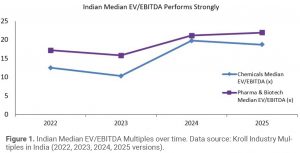
Valuations continued to reflect sustained confidence, with a large cohort of premium assets clearing peak cycle multiples of 20x EV/EBITDA and median figures rising consistently over the past few years (see Figure 1). Pricing reinforced the consensus around India’s scalability, technical depth, and deepening integration into global supply chains. As a primary beneficiary of China + 1 and US-driven diversification strategies, India attracted steady inbound interest that supported domestic expansion, infrastructure upgrades, and funded ambitious outbound growth by national champions.
Europe: Quality Assets, Muted Growth
Europe entered 2025 with no shortage of high-quality chemical businesses, but transaction momentum remained muted. Political uncertainty, regulatory burden (particularly ESG-related compliance), elevated energy costs, and softening end-markets weighed on strategic decision-making. For many European corporates, capital allocation prioritized maintaining competitiveness under these constraints. Interest in M&A persisted, but timelines stretched and risk tolerance narrowed.
As a result, Europe contributed fewer transactions by volume, despite its continued production of differentiated products and technologies with clear strategic relevance. Where larger transactions did materialize, they skewed toward divestitures where value creation hinged on cost restructuring and synergy capture. Marquee examples include BASF’s coatings business being acquired by Carlyle and ADNOC’s acquisition of Covestro.
Setting the Tone for the Year
Taken together, these regional dynamics shaped a market defined by prudence. Buyers remained active, but only where acquisitions strengthened long-term strategic positioning and execution risk was clearly understood. M&A activity also reflected shifting economic allegiances in global trade, as longstanding trade partners realigned amid a broader reshaping of the global economy.
These forces also expressed themselves differently across transaction sizes. In large-cap and upper middle-market deals, M&A activity was primarily catalyzed by portfolio rationalization. In the lower-middle-market (LMM), acquisitions were typically justified by the pursuit of new capabilities or greater organizational durability, with outcomes highly dependent on asset quality. The sections that follow explore these contrasts.
The Middle-Market and Large-Cap
How Buyer Thinking Changed
2025 marked a meaningful shift in how large-cap and middle-market chemical companies approached M&A. The market moved away from pursuing scale for its own sake and toward a more fundamental question: what do we actually need to own? This change was felt by strategics and financial sponsors alike, shaping both the businesses brought to market and the underwriting standards applied to them.
Portfolio Rationalization
One of the clearest developments in 2025 was the acceleration of portfolio rationalization. After years of building operational breadth, many groups initiated structured internal reviews. Legacy assets fell out of favor for tangible reasons, chiefly cost disadvantages linked to energy intensity and feedstock economics, as well as exposure to end markets that saw softening demand. In public markets, investors favored “pure-play” peers, widening valuation discounts for more diversified portfolios.
This preference sharpened operational focus and pushed many participants toward clearer pure-play strategies. Business units that once fit within diversified groups increasingly appeared dilutive, and better positioned under new ownership as standalone platforms. The result was a steady pipeline of divestments, carve-outs, and spin-offs, particularly where differentiation was limited and strategic coherence had weakened.
Capability Over Scale
With non-core assets often finding new homes under private equity ownership, strategic acquisitions in 2025 became more capability-driven than in prior cycles. Rather than pursuing incremental capacity or expansion, many Western buyers focused on closing specific techno-commercial gaps. This often meant acquiring formulation expertise, yield- and cost-improvement technologies, accelerated development and qualification pathways, and downstream targets that deepened customer integration and supported higher-margin sales.
In this environment, scale was not always the determinant of value. Smaller assets often carried outsized strategic importance, not because of volume, but because of what they enabled: customer credibility, faster qualification, proven application histories, and defensibility within targeted niches. These attributes remained central to LMM investment theses.
Supply-Chain Resilience
Supply-chain resilience became a key driver of capital allocation in 2025. Years of disruption, geopolitical friction, and recurring logistical bottlenecks made vulnerabilities difficult to ignore. In response, buyers favored assets closer to end markets and emphasized broader supplier diversification to reduce single-point-of-failure risk.
This move toward regionalization did not replace global trade, but recalibrated it. Volumes often remained comparable, yet increasingly flowed through shorter routes and new partners.
Private Equity’s Expanding Role
Private equity increasingly functioned as an industry-wide reset mechanism. Their competitive edge lay in a higher tolerance for transitional disruption, carve-out complexity, and the demands of executing operational improvement agendas.
Sponsors repeatedly stepped in as buyers of business units divested by large-cap and upper-middle-market strategics. This enabled conglomerates to sharpen their focus while providing stable ownership, renewed investment, and a defined path forward for legacy divisions and their workforces. In many cases, these assets were repositioned as standalone platforms, with the objective of re-entering the strategic universe once performance improved and strategic clarity returned.
Closing Perspective
Overall, large-cap and middle-market M&A in 2025 was defined by discipline. Value creation was pursued through focus, capability, and operational clarity rather than aggressive growth assumptions. This reset reshaped which assets changed hands and set the stage for the focused acquisition dynamics that took hold in the LMM.
The Lower-Middle Market
Quietly Active, Selectively Rewarded
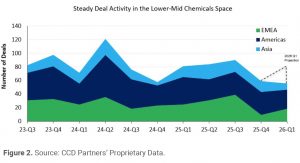
The LMM tells a more nuanced story. Despite a stutter in global deal flow, activity remained relatively steady (see Figure 2). Business owners in this segment are less influenced by geopolitics or macro narratives than their larger counterparts. Instead, the decision to sell is guided more by local conditions, succession dynamics, and individual timing. As a result, patterns in the LMM can diverge meaningfully from those observed in large-cap M&A (we explore this further in Part 4).
The Flight to Quality
However, some market characteristics do trickle down into the LMM, and in 2025 this was most evident in the flight to quality. Strategics and financial sponsors prioritized well-positioned businesses as a pathway to market entry, and sellers that enabled this were rewarded.
Differentiated, operationally resilient businesses continued to command strong multiples, in some cases approaching peak-cycle reference points. By contrast, weaker performers faced heavier discounts, if they sold at all. This produced one of the widest valuation spreads in recent memory.
Risk factors that were once tolerable faced increasing penalization, including customer concentration, aging assets, unclear differentiation, and key-man risk. This flight to quality was especially pronounced in North America and Western Europe, where buyers showed limited tolerance for avoidable risk and applied sharper valuation discounts when it appeared.
Private equity behavior reinforced this dispersion. In 2025, the interest-rate environment continued to limit debt financing capacity for sponsors, putting pressure on valuations and driving tighter underwriting standards for chemical acquisitions. The result was bifurcation: premium businesses ran highly competitive processes, while weaker assets faced thinner buyer sets, more constrained pricing, and heavier deal structuring designed to bridge expectation gaps.
Eastern Buyers: Smaller, Smarter, More Targeted
Chinese and Indian buyers remained active in Western LMM transactions, but with a noticeably different approach than prior cycles. Rather than pursuing headline acquisitions, activity skewed toward smaller, highly targeted deals that filled specific portfolio gaps while offering a measured steppingstone into foreign markets.
These transactions were typically pursued in order to preserve access to Western customers, manage tariff exposure, build regulatory credibility, or secure specific technologies and formulations. This approach reflected both regulatory realities and growing strategic maturity: smaller deals were easier to execute and oftentimes more effective.
Specialty Still Commands a Premium
As buyers became more selective, advantage accrued to value-added specialties. SMEs with proprietary formulations, application expertise, or meaningful regulatory barriers consistently commanded higher valuations than their more commodity-oriented peers. This mirrored the large-cap market, where buyers paid for capability and defensibility, not just earnings.
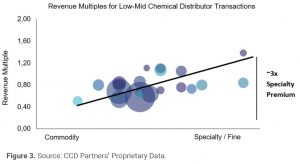
This dynamic was particularly pronounced in chemical distribution. At one end of the spectrum were commodity distributors competing primarily on price and scale. At the other were specialty distributors differentiated by formulation capabilities, in-house technical expertise, and applications support. As shown in Figure 3, highly specialized distributors commanded clearvaluation premiums relative to more commoditized assets.
Structural Realities of the LMM
The LMM operates under a distinct set of constraints relative to larger transactions, and these realities materially shaped deal flow in 2025. Longer timelines to sale were not a sign of inactivity, but rather a function of ownership structure, information asymmetry, and the human considerations inherent to this segment.
The “Silver Wave”
A growing share of family-owned chemical businesses are transitioning from baby-boomer founders to the next generation, making succession planning unavoidable. This is rarely straightforward. Questions around leadership continuity, reinvestment appetite, and family alignment often become catalysts for a transaction.
Common refrains include “I’d like to de-risk and take chips off the table”, “my children have no interest in the business,” and conversely, “I’m not interested in running my parent’s company”. These themes surface frequently and can prompt owners to explore a sale.
Longer Timelines, More Deliberate Outcomes
LMM owners have become more cautious. After a volatile period of record valuations in 2021 and relatively depressed valuations in the years that followed, many owners became acutely aware of the importance of timing and structure.
As a result, decision cycles lengthened. Owners took more time to evaluate options, align stakeholders and recalibrate expectations. While this slowed processes, it often produced more deliberate, better-aligned outcomes when deals did occur.
In the current M&A environment, anchoring valuation expectations to 2021 benchmarks has proven unrealistic and often sets the stage for a difficult process. Importantly, many owners are now internalizing this reality, and the bid-ask spread has begun to narrow between what buyers can underwrite and what sellers are willing to accept.
Closing Perspective
Taken together, these structural realities help explain why LMM transactions can often require as much time and nuance as their larger-cap counterparts. In many cases, pacing reflects the time required to craft an optimal succession plan, maximize value, and find the right home for the business.
Conclusion
A Measured Case for Optimism
Despite ongoing macro uncertainty, there are strong reasons to remain positive on LMM chemical M&A. Chemical intermediates serving C.A.S.E, personal care, life sciences, electronics, and aerospace & defense continue to exhibit durable growth. At the same time, recent disruption has driven strategic introspection across the industry, accelerating the need for innovation and differentiation. The result is a growing set of downstream opportunities, with smaller companies being sought to fill specific capability gaps and add strategic optionality.
This environment rewards selectivity, but it also rewards preparation. Looking ahead, the next upcycle in chemical M&A is more likely to be driven by strategic clarity than broad multiple expansion. Buyers who can articulate why they need to own an asset, and how ownership improves resilience, capability, or control, will continue to transact and grow in a selective market. Likewise, sellers who can position their businesses in those terms will stand out as higher-quality assets and be better placed to achieve superior outcomes.
The Key is a People-Based Approach
Structurally, fragmented markets lend themselves to consolidation and create attractive acquisition opportunities. However, the chemical LMM is particularly opaque, and identifying high-quality targets is often more challenging than in other similarly structured sectors.
Perhaps more than any other segment, this market is driven by people. Many of the most attractive businesses are local, operate below the radar, and do not surface cleanly in databases. Many are not technology or social-media savvy, but traditional family businesses with decades of legacy. Their differentiators are often embedded in customer trust, process know-how, and workforce experience, rather than in financial summaries.
Owners’ motivations are frequently shaped by family considerations, legacy, responsibility toward employees, and personal timing. These dynamics reinforce the importance of an advisor who can truly understand the business, not only for its chemistry, but its people as well.

The Algorithmic Antagonist: Why AI is Pharma’s Newest Competitor

THE INTEGRATION IMPERATIVE: ADVANCING TIDES MANUFACTURING THROUGH BIOC...

PEER REVIEWED – Scaling Mechanochemistry via Continuous Bead Mil...

Difamilast

The Role of Workers and their Management Teams in Establishing and Mai...

PEER REVIEWED – Crystallization and Particle Engineering – The H...

The evolving role of PGMs: sustainability in the market context

PEER REVIEWED – Catalytic Reactions in the Synthesis of Function...