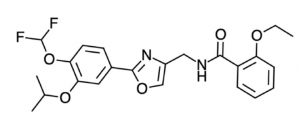
Difamilast’s story is a nice snapshot of how topical anti-inflammatory dermatology evolved in the post-steroid era: after decades where atopic dermatitis care leaned heavily on topical corticosteroids (and later calcineurin inhibitors), drug developers started hunting for “steroid-sparing” mechanisms that could be used chronically with acceptable tolerability. One of the big mechanistic bets was PDE4 inhibition, already validated systemically (but limited by GI side effects) and attractive topically because it could modulate multiple inflammatory signals locally. PDE4 inhibition increases intracellular cAMP in inflammatory cells, thereby dampening pro-inflammatory cytokine signaling and reducing tissue inflammation.
Against that backdrop, Otsuka synthesized and advanced difamilast under the development code OPA-15406, positioning it as a selective topical PDE4 inhibitor for atopic dermatitis. Early clinical work built enough confidence in both efficacy and safety to move into pivotal programs, and in March 2020 Otsuka publicly announced top-line Phase 3 results in Japan (one adult and one pediatric study). From there, the program converted into a national first: Japan’s regulator (PMDA) reviewed the dossier and difamilast was approved in Japan in September 2021, marketed as Moizerto® ointment, for adults and children ≥2 years—and PMDA’s review documents explicitly note that as of mid-2021 it had not yet been approved outside Japan.
The next chapter was about deepening the evidence base and broadening the addressable population. The Phase 3 adult trial was published in the Journal of the American Academy of Dermatology, reinforcing difamilast’s role as an effective, generally well-tolerated topical option. Longer-term and younger-age studies followed, including work aimed at infants.
Finally, difamilast’s “regional Japan success” transitioned into a broader commercialization pathway. In the United States it was approved in February 12, 2026 as Adquey™ (difamilast).
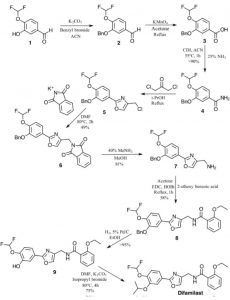
The synthetic strategy begins with O-Benzylation of 4-(difluoromethoxy)-3-hydroxybenzaldehyde (1) with benzyl bromide (PhCH2Br) in the presence of K2CO2 (MeCN) afforded 3-benzyloxy-4-(difluoromethoxy)benzaldehyde (2). Oxidation of the aldehyde function using KMnO4 in refluxing acetone delivered the corresponding carboxylic acid 3. Subsequent activation with CDI (MeCN), followed by aminolysis with 25% NH3 in MeOH, provided carboxamide 4 in 90% yield. Cyclocondensation of 4 with 1,3-dichloroacetone under reflux in i-PrOH furnished the oxazole derivative 5. N-Alkylation of chloro intermediate 5 with potassium phthalimide in DMF at 80 °C for 2 h gave tertiary amine 6 in 49% yield. Remove of the phthaloyl group to afford primary amine was achieved by deprotection using 40% MeNH2 in refluxing MeOH leading to 7 in 81% yield. Amide coupling of 7 with 2-ethoxybenzoic acid mediated by EDC/HOBt in refluxing acetone (1 h) yielded amide 8, which after hydrogenolysis of the benzyl ether (H2, 5% Pd/C, EtOH) produced phenol 9 in >95% yield. Finally, O-alkylation of 9 with 2-bromopropane in the presence of K2CO3 (DMF, 80 °C) delivered difamilast in 75% yield.

The Algorithmic Antagonist: Why AI is Pharma’s Newest Competitor

THE INTEGRATION IMPERATIVE: ADVANCING TIDES MANUFACTURING THROUGH BIOC...

PEER REVIEWED – Scaling Mechanochemistry via Continuous Bead Mil...

The Role of Workers and their Management Teams in Establishing and Mai...

PEER REVIEWED – Crystallization and Particle Engineering – The H...

A Bird’s-Eye View of Global Chemicals M&A

The evolving role of PGMs: sustainability in the market context

PEER REVIEWED – Catalytic Reactions in the Synthesis of Function...