Introduction
The pre-clinical development phase of a pharmaceutical drug candidate relies heavily on the Chemistry, Manufacturing and Controls (CMC) development process, when the manufacturing procedures for the drug candidate are enhanced, scaled-up and established for the early clinical phases, while also supplying material for studies such as toxicology, stability, and first-in-human clinical trials. The CMC process is complex and its timeline tends to be lengthy, especially for bioconjugates, often finding itself in the critical-path to regulatory submissions. It is imperative that all the CMC pieces are well planned and arrive at the right place, at the right time, providing high-quality material to studies and the clinic as expected, and are adequately documented for regulatory approvals. Failures and redirections often result in clinical delays, with major consequences for patients and critical impact on the company.
Starting in the discovery phase, a few practices can increase the efficiency and robustness of the CMC process and uncover opportunities to accelerate timelines.
Developability Assessments
For bioconjugates, manufacturing risks are high. In the microscale of the discovery phase, cell expressions may have decent yields, and conjugation reactions can work well, but it all can fall apart later, when the stakes are high and timelines don’t permit returning to the drawing board.
There are many reasons to include developability (or manufacturability) assessments during the discovery phase. These early analyses are increasingly frequent offerings from Contract Development and Manufacturing Organizations (CDMOs) as semi-standard / semi-tailored packages. Using analytical tools and the know-how of their expert teams to study molecules and their manufacturing processes, they offer complementary expertise to derisk the project from a technical standpoint, and to aid in the triaging of lead candidates. They can generate invaluable information on the drug candidates when the impact of changes to the project is most tolerable.
Formulation risks with biologic drugs are summarized beautifully by McDowell and Watts (1) in a recent volume of this journal. These and other risks, such as protein expression, structure, conjugation and stability risks, are specific to each molecule and can be best addressed by multi-expertise teams with process development and scale-up experience. These teams can help identify and manage risks early, preventing later complications and delays with a much greater impact on cost.
In addition, searching for an expert CDMO for an early developability assessment is a valuable exercise, providing early insights into the CDMO landscape, budgets and timelines. A strong manufacturing partner with a solid understanding of the project is key to entering the scale-up stage positioned to succeed.
Identifying Opportunities and Risks with Early Project Planning
To uncover CMC risks and opportunities, a visual diagram depicting the major milestones of the project, sequential steps and dependencies should be prepared – as early as possible. Typically, this is driven by the project management function and takes the shape of a timeline (also called a project plan). In one or two deep-dive meetings with the technical team, in an atmosphere of exchange and collaboration and where every member feels safe to share ideas, the details of each block of work should be reviewed through the lens of efficiency and risk, to identify opportunities to reduce timelines, minimize risks and decrease costs. These three elements – time, risk and cost – conflict with each other almost always in project planning. A knowledgeable and attentive team can identify opportunities, contingencies and risk-mitigations, and the executive team can evaluate and prioritize them strategically. An effective cross-functional assessment should also include a regulatory and clinical review, in addition to the technical CMC team and other stakeholders.
Case-study: ADC Timeline Acceleration
In this case-study, the CMC timeline of an Antibody-Drug Conjugate (ADC) was accelerated by many months through an opportunity found and implemented at the start of the development phase, supporting the smooth manufacture of the clinical lot and enabling a clinical trial in the hematologic malignancy space (2,3). The CMC team designed a formulation that was amenable to both frozen and lyophilized forms and used it for Drug Substance (DS) and Drug Product (DP), enabling an early insight into stability and moving the frozen form to the clinic on an accelerated path. The lower-risk lyophilized form was developed in parallel, slightly behind due to the extra studies required, as a contingency to the higher-risk frozen form (Figure 1).
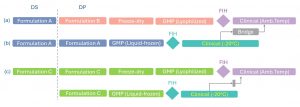
Figure 1. Example of a high-level plan for a project being optimized in early CMC development phase. (a) Traditional approach with different DS/DP formulations and DP lyophilized. (b) Improved approach with identical DS and DP formulations in liquid frozen form, with higher degradation risk and more complex clinical trial logistics. (c) Improved approach with a formulation amenable to both liquid and lyophilized forms, offering acceleration and risk management through a parallel path, creating a long-term opportunity to convert the DP into lyophilized form without the need for a formulation change. (Abbreviations: Amb.Temp – Ambient Temperature; CMC – Chemistry, Manufacturing and Controls; DP – Drug Product; DS – Drug Substance; FIH – First-In-Human; GMP – Good Manufacturing Practices)
Tools for a Smooth Execution
For bioconjugates, the CMC journey will likely be complex, multi-layered and on the critical path to the clinic, leaving the team with a high-risk project and a tight timeline. Some project management practices can increase the robustness of the project, manage risk and help secure a smoother execution.
A visual project plan in the form of a detailed timeline is the best starting point: it should be prepared early, with as much detail as possible and kept updated. It can be modified for simplicity as needed for certain high-level discussions. If certain parts of the project are not yet determined, it is still helpful to draw them with their associated ambiguity, as this can provide clarity to the team and provoke beneficial discussions. Maintaining an updated timeline of the project and reviewing it frequently with the internal stakeholders is an easy way to share a clear roadmap of the project and maintain everyone aligned on the deliverables and goals.
For projects with complex risks and contingencies, a decision tree can help with early alignment, especially at executive level. A schematic depiction of actions as a response to possible events is a good aid in early discussions and can enable a quicker pivot during execution under a tight timeline. A very simple example of a decision tree is presented in Figure 2.
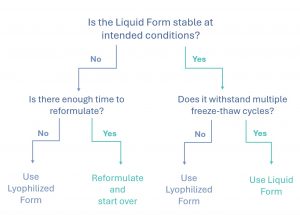
Figure 2. Example of a simple decision tree for the case-study reviewed previously.
For projects with a complex supply chain and multiple CDMOs, a detailed supply chain map can help identify new risks, extra costs and provide a quick reference for quality audits and logistics. One important aspect of the supply chain map is that it also provides an overview of the manufacturing and analytical testing process, presenting a visual aid for the cross-referencing of specifications along the manufacturing process. A simplified example of a supply chain map for a hypothetical ADC is presented in Figure 3.
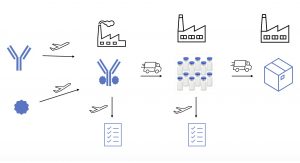
Figure 3. Example of a simplified supply chain map for a hypothetical ADC. It should be supplemented with CDMO names, locations, or any other information relevant to project discussions.
Complex projects and accelerated timelines present high risks during execution. In preparation for multiple and quick handoffs, it is vital to establish processes for adequate and frequent communications with the key internal and external stakeholders. A system for close monitoring and unexpected event reporting should be defined, including provisions for urgent communications outside of business hours, and confirming all stakeholder departments are informed as expected. The simplified stakeholder map in Figure 4 may be a starting point for a dynamic list of stakeholder departments and functions.
Team Structure
A robust CMC strategy involves continuous cross-functional interactions and handoffs, especially in the case of ADCs or bioconjugates, with their multifaceted range of manufacturing steps typically requiring multiple subject matter experts. In early startup companies with nimble resources, it is common to find that all questions lead to one or two individuals, often leaving highly capable scientists underutilized at times, while others are barely managing the juggle of competing priorities.
Defined responsibilities, accountabilities, delegation, escalation, and a cadence for adequate communications are all essential for an organization’s smooth operation and optimal resource utilization. A simple table of tasks and contributors is a great tool to align the team on responsibilities and accountabilities, predict resource constraints and provide justification for resource management decisions. Together with clear guidelines for delegation, expectations for escalation and efficient communication, these tools should leave the team leader with the time and peace-of-mind needed for strategic direction while still in the driver’s seat of the project.
Conclusion
ADCs and other bioconjugates present increased CMC challenges. Figure 5 summarizes some of the practices and tools that can support a more efficient and robust CMC journey from early discovery to IND.
Early interventions during the discovery phase can present invaluable opportunities to accelerate the time-to-clinic and reduce risk, while detailed planning and a controlled execution and a managed team are essential to maintaining the cadence of an accelerated timeline.
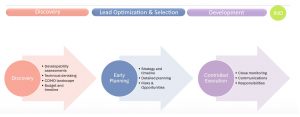
Figure 5. Summary of practices and tools leading to a more efficient and robust CMC journey from early discovery to IND.
References and notes
* This article and its images are the property of alismereTM (www.alismere.com) and may not be reproduced by third parties without written permission from the author. The author grants permission to TKS Publisher to publish and distribute the article and images on its website, social medias and on the journal Chimica Oggi – Chemistry Today.
The author thanks Dr. Raj Dua, Dr. Andreas Lerchen and Dr. Raquel Izumi, formerly from Vincerx Pharma, for their leadership and contributions to the case-study presented.
- McDowell B, Watts G. Concentration and complexity: how formulation is the lynchpin for biologic development. Chemistry Today. 2025 Mar/Apr; 43(2).
- Strickland S, Curran E, Jamy O, Percival M-E, Johnson AJ, Birkett J, Huang X, Frigault MM, Lerchen H-G, Stelte-Ludwig B, Navarro T, Peck J, Gross W, FORCED_LINE_BREAKIzumi R, Hamdy A, Daver N. An open-label, multicenter phase 1 study to characterize safety, tolerability, preliminary antitumor activity, pharmacokinetics, and pharmacodynamics of VIP943 monotherapy in patients with advanced CD123+ hematologic malignancies. J Clin Oncol 42, 2024 (suppl 16; abstr TPS3167).
- FDA Clinical Trial Study ID NCT06034275. Study of VIP943 in Subjects With Advanced CD123+ Hematologic Malignancies. https://clinicaltrials.gov/study/NCT06034275

Sustainable Medicines Manufacturing

2026 predictions: what are the operational priorities for late-stage p...

What does agentic AI mean for pharma operations?

Angelini Pharma – High-Potent API: strategy and legacy

Overview of 2025 year

From digital islands to integrated ecosystems: Envisioning the future...

Lyophilization in Sterile Pharmaceutical Manufacturing: Regulatory Per...

Scope 3 and the chemical industry: a challenge with solutions