674
Introduction
Biopharmaceutical manufacturing labs have steadily progressed from manual, paper-based environments to semi-automated digital systems. Tools like LIMS and ELNs have improved traceability, but many operations remain fragmented creating disconnected “digital islands” with limited scalability and coordination.
However, the global healthcare landscape is growing more complex both from the perspective of rise in complexity of disease, therapy and drug delivery. By 2060, serious health-related suffering is projected to affect 48 million people — an 87% increase from 2016 (1). Global cancer cases are expected to rise 47% by 2040 (2), These trends demand faster, more flexible and intelligent lab operations. Building on the foundation of Industry 4.0, Pharma 4.0 adapts technologies like AI, IoT, cloud computing and advanced analytics to the regulated, high-precision world of pharmaceutical manufacturing. This shift enables predictive insights, real-time optimization and end-to-end visibility across the lab ecosystem.
Early adopters are already seeing impact: up to 40% increased capacity, 20% shorter lead times and 15% lower conversion costs through data-driven operations (3).
This article explores how biopharma labs can move beyond fragmented systems to become integrated, intelligent ecosystems — leveraging digital twins and a phased, value-led approach to meet the demands of modern drug development.
The Case for Change: Rising Therapeutic Complexity Demands an Evolving Manufacturing Paradigm
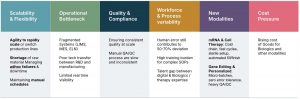
The rising disease burden is matched by a sharp increase in therapeutic complexity resulting in more adoption of biologics, cell & gene therapy. Over the last 20 years, cell and gene therapy (CGT) research in the U.S. has grown dramatically, reflecting major scientific and clinical advances (4). These therapies are inherently more sensitive to process variability, demanding rigorous quality control, cold chain infrastructure and modular manufacturing capabilities (Figure 1).
Figure 1. Representing the various challenges faced industry wide for drug manufacturing & delivery.
Where the industry is headed: Industry 4.0 and Pharma 4.0
In response to rising therapeutic complexity, operational strain and growing patient demand, the biopharmaceutical industry is moving toward a more connected, intelligent model of manufacturing guided by the principles of Industry 4.0.
Industry 4.0 introduced a new era of production, centered on real-time data, automation and system integration. Concepts like interoperability, virtualization and autonomous decision-making transformed traditional factories into adaptive, data-driven environments.
Pharma 4.0, as defined by ISPE (5), adapts these principles to the stringent, regulated world of pharmaceutical manufacturing. It leverages AI, IoT, cloud technologies and advanced analytics to improve compliance, ensure right-first-time execution and enable end-to-end visibility across labs and plants.
This shift marks a move beyond automation toward intelligent orchestration where people, systems and processes operate in sync. Labs are evolving from static, task-based environments to dynamic ecosystems capable of continuous optimization.
However, many organizations remain stuck in fragmented digital implementations, where siloed systems limit agility and insight. The next section outlines the path forward: how labs can transition from these digital islands to fully integrated digital ecosystems, with digital twins as a key enabler of transformation.
The way forward: From digital islands to an integrated digital lab ecosystem
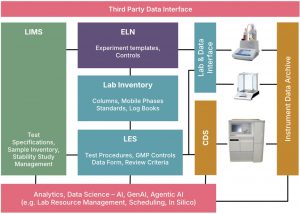
Biopharma labs must rethink their approach to digital transformation, moving away from isolated technology upgrades toward creating intelligent, interconnected ecosystems. While systems like LIMS, ELN, LES and CDS have structured individual processes, they often function in silos, limiting their full potential. These “digital islands” result in inefficiencies, reactive workflows and underutilized data at a time when the industry needs agility, precision and speed (Figure 2).
Figure 2. Individual blocks represent fragmented digital ‘islands,’ which, when interconnected, transform into a cohesive digital ecosystem with seamless data flow.
Therefore, comprehensive end-to-end digitization is essential for achieving operational efficiencies and optimizing business processes. Data should flow seamlessly from one process or system to another. Once fully digitized, this data can be leveraged for further optimization. Analytical use cases and AI-driven models can then be trained to enhance processes. With advanced AI capabilities, lab scheduling and predictive maintenance become possible, driving further improvements.
Real-world case studies with digital twins in action
The journey from digital islands to integrated lab ecosystems with AI driven models for optimization begins with focused, high-impact use cases that expose core inefficiencies and demonstrate early value. Two such examples illustrate how digital twins can be operationalized in biopharma labs to drive measurable improvements in reliability, efficiency and decision-making. While an organization cannot be transformed overnight and some areas may remain distant from experimentation small, well-designed pilots validated with users and built on real adoption can scale into feasible solutions.
These initiatives meaningfully streamline processes that currently add months to timelines through intelligent automation and data-driven optimization.
Case study 1: Predictive maintenance — From reactive to proactive reliability
Traditionally, lab equipment maintenance follows a fixed schedule or occurs reactively after failure, leading to either unnecessary downtime or costly disruptions. In a pilot implementation, a digital twin was created for critical assets across the selected lab site.
Real-time data from IoT sensors was continuously fed into machine learning models from the selected instruments capable of identifying wear patterns, anomalies and failure signals in advance. Gradually this was expanded to all critical instruments and in later phases to all instruments as operators adopted the process. The same process was repeated to other labs and the sites.
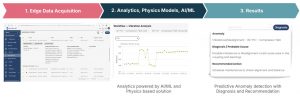
The alarm not only increases the life of the instrument but also helps scrapping the manufacturing batch that could be caused due to instrument break-down, leading to significant dollars and time savings. This shift enabled a predictive maintenance approach, where servicing was triggered only when performance data indicated risk. The impact was immediate: reduced unplanned downtime, extended asset life and improved resource planning. More importantly, it laid the foundation for a culture of proactive, data-driven operations (Figure 3).
Figure 3. Illustrating the convergence of physical systems, analytical models, and digital workflows to enable predictive maintenance in biopharma labs.
Case study 2: Intelligent assay scheduling — From manual planning to dynamic optimization
Building on this success, attention turned to another major bottleneck: scheduling assays in quality control labs. Analysts were relying on manual spreadsheets and supervisory experience to allocate tests, instruments and personnel often resulting in last-minute changes, wasted preparations and inconsistent throughput.
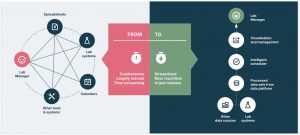
A digital twin was developed to model the lab’s operational landscape, incorporating assay types, analyst availability, equipment status, SOP requirements and due dates. AI-powered scheduling engines dynamically optimized test plans based on current capacity and priorities, generating real-time, conflict-free schedules (Figure 4).
Figure 4. Illustrating the shift from manual, fragmented lab scheduling to a streamlined, data-driven model enabled by intelligent algorithms and integrated systems.
The intelligent scheduler, built on a heuristic optimization algorithm, reduced scheduling time from hours to 5–10 minutes and enabled daily or on-demand updates with minimal human effort. By dynamically identifying bottleneck resources and simulating “what-if” scenarios, it supports adaptive planning through intuitive dashboards for data-driven decision-making.
This scheduler started as a small pilot experiment to address a specific bottleneck evolved into a validated solution for one lab, refined through iterative feedback. Its proven impact enabled confident scaling across additional labs, demonstrating how value-first experimentation can de-risk innovation and accelerate enterprise-wide transformation.
Secret to large-scale transformations: Start small, prove value, scale confidently
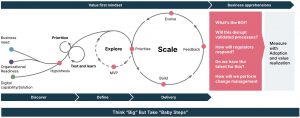
Successful digital transformation in biopharma labs is rarely linear; it requires a mindset shift from top-down implementation to value-first experimentation. As shown in Figure 5, the journey begins by aligning a clear business need with organizational readiness and available digital capabilities. From there, a focused hypothesis is shaped into a test-and-learn pilot to explore feasibility with minimal risk.
Figure 5. Depicting a phased adoption journey—aligning business needs, readiness, and digital capabilities to drive value realization while addressing common transformation apprehensions.
Starting small helps overcome common apprehensions — such as concerns around ROI, regulatory disruption, change management and workforce capability — by proving tangible value early. Demonstrating outcomes in a controlled setting builds confidence, enables stakeholder alignment and creates momentum for broader adoption.
Critically, success is not defined by technology deployment alone but by measurable value realization and adoption. Prioritizing user engagement, workflow integration and continuous feedback ensure solutions are both practical and scalable.
Large-scale transformation is as much about mindset and change management as it is about technology. Most of the experiments fail because inadequate change management effort and business buying in. By starting small and scaling with purpose, labs can modernize with confidence ensuring agility, compliance and sustained value without disrupting core operations.
Conclusion: Toward a responsive, human-centered lab of the future
As biopharmaceutical labs confront rising disease burdens, complex therapies and growing operational pressures, the need for intelligent, connected systems has never been more urgent. Digital twins, AI and Pharma 4.0 principles offer a path forward, enabling labs to move beyond reactive workflows and fragmented tools toward coordinated, adaptive ecosystems.
The transformation is not solely technological; it is also cultural. By starting small, proving value and scaling deliberately, organizations can build trust, reduce risk and ensure alignment across teams and functions. The result is a lab that is not just faster or more efficient, but more resilient, transparent and human-centered.
In this new paradigm, scientists are empowered by intelligent tools, decisions are informed by real-time insights and processes adapt dynamically to shifting demands. The lab of the future isn’t a destination — it’s a responsive, learning system that continuously evolves to meet the needs of patients, products and people.
References and notes
- Sleeman KE et al. The escalating global burden of serious health-related suffering. Available from: https://www.thelancet.com/journals/langlo/article/PIIS2214-109X(19)30172-X/fulltext
- Sung H et al. Global Cancer Statistics 2020. Available from: https://acsjournals.onlinelibrary.wiley.com/doi/10.3322/caac.21660
- Future of biopharma manufacturing | McKinsey. Available from: https://www.mckinsey.com/industries/life-sciences/our-insights/reimagining-the-future-of-biopharma-manufacturing
- Hilas O. The Rise of Cell and Gene Therapies. Available from: https://www.uspharmacist.com/article/the-rise-of-cell-and-gene-therapies
- Pharma 4.0™ | ISPE. Available from: https://ispe.org/initiatives/pharma-4.0

MAGAZINE
Vol. 44 | Vol. 44(1) - January / February 2026 | EDITORIAL
Sustainable Medicines Manufacturing

MAGAZINE
Vol. 44 | Vol. 44(1) - January / February 2026 | ARTIFICIAL INTELLIGENCE
2026 predictions: what are the operational priorities for late-stage p...

MAGAZINE
Vol. 44 | Vol. 44(1) - January / February 2026 | ARTIFICIAL INTELLIGENCE
What does agentic AI mean for pharma operations?

MAGAZINE
Vol. 44 | Vol. 44(1) - January / February 2026 | ADVERTORIAL
Angelini Pharma – High-Potent API: strategy and legacy

MAGAZINE
Vol. 44 | Vol. 44(1) - January / February 2026 | COLUMN: API of the Month
Overview of 2025 year

MAGAZINE
Vol. 44 | Vol. 44(1) - January / February 2026 | CMC
Accelerating the bioconjugate CMC journey from early discovery to the...

MAGAZINE
Vol. 44 | Vol. 44(1) - January / February 2026 | PHARMACEUTICAL TECHNOLOGIES
Lyophilization in Sterile Pharmaceutical Manufacturing: Regulatory Per...

MAGAZINE
Vol. 44 | Vol. 44(1) - January / February 2026 | COLUMN: Sustainabilty
Scope 3 and the chemical industry: a challenge with solutions

MAGAZINE
Vol. 44 | Vol. 44(1) - January / February 2026 | PANEL DISCUSSION