The development pipeline for precision medicines is driving sustained demand for highly potent active pharmaceutical ingredients (HPAPIs), particularly in oncology. ADC payloads and selective small-molecule therapies often require occupational exposure limits (OELs) in the low-nanogram-per-cubic-meter range. At this level of potency, manufacturing performance depends on more than isolated pieces of equipment. It requires an integrated containment strategy, process safety, analytical control, and a credible path from route development to GMP commercial supply.
This changes what pharmaceutical and biotechnology companies need from a CDMO. Capacity remains important, but so do supply-chain control, technology-transfer discipline, and the ability to combine fermentation, complex chemistry, purification, particle engineering, and analytics within a common quality system.
Founded in 1921, Indena first built its scientific reputation on medicinal-plant-derived active ingredients. That heritage has developed into a broader platform for complex natural, fermentation-derived, semisynthetic, and fully synthetic molecules. At its Settala site near Milan, Indena handles HPAPIs with OELs as low as 1 ng/m³ and supports programs from process development through clinical and commercial manufacturing.
FOUR CAPABILITIES EXTENDING THE PLATFORM
An integrated European route to maytansinoid payloads
ADC developers are looking for more secure and transparent supply chains for critical payloads and payload-linker intermediates. Indena manufactures the maytansinoid payloads DM1 and DM4 in Europe, integrating microbial fermentation with downstream synthesis and high-containment processing. The platform includes in-house production of the fermentation-derived ansamitocin intermediate and reduces the number of external hand-offs across the manufacturing route.
Process validation for DM1 and DM4 is under completion. Together with Indena’s payload-linker development capabilities, this backward-integrated model offers sponsors a single European manufacturing interface for complex, highly potent ADC components.
Scaling cytisine through a traceable botanical supply chain
Cytisine, a smoking-cessation API derived from Laburnum anagyroides Medik., combines natural-product sourcing with pharmaceutical-grade process control. Indena manages a defined, controlled, and fully traceable biomass supply chain based on sustainable wild harvesting in Eastern Europe, using renewable parts of the plant.
Indena has scheduled the validation of its industrial-scale manufacturing process begin of 2027.
Extending spray drying into ultra-high containment
Indena already operates development- and commercial-scale spray-drying technologies for APIs and pre-formulated APIs, including systems designed for organic solvents. The next step is to bring particle engineering into an ultra-high-containment environment.
A glovebox-integrated GMP spray dryer is planned for commissioning by end 2027 to support commercial-scale HPAPI production, with containment designed for OELs as low as 1 ng/m³. This investment connects two capabilities, already established for Indena, at a scale and containment level that remain uncommon in the market. The result will be a more direct route from HPAPI process development to particle-engineered commercial supply.
QS-21: combining current supply with a scalable biomass strategy
QS-21 is a highly purified triterpenic saponin fraction obtained from Quillaja saponaria. It is a component of adjuvant systems used in FDA-approved vaccines and is being studied in more than 120 clinical trials. A 2026 review estimates current global GMP capacity at about 10 kg per year and uses 50 kg per year as the benchmark for one billion 50-μg doses.
Indena’s partnership with Desert King combines complementary capabilities: Desert King supplies the Quillaja-derived precursor and upstream botanical expertise, while Indena provides downstream purification, chromatographic isolation, analytical control, and final lyophilization of the bulk QS-21. The current pathway is based on sustainably managed Chilean biomass. The longer-term strategy is to qualify material from clonal plantations within the same downstream platform, increasing supply resilience while reducing dependence on wild-forest bark.
This “dual-horizon” approach—strengthening today’s supply while preparing a scalable future source—offers vaccine developers a robust route to GMP QS-21.
THE INDENA CDMO ADVANTAGE: INTEGRATION ACROSS TECHNOLOGIES
At Settala, R&D, analytical development, and GMP manufacturing are closely connected. Co-location reduces the number of technology transfers and helps preserve process knowledge as a molecule moves from route scouting and laboratory development to scale-up, validation, and commercial supply.
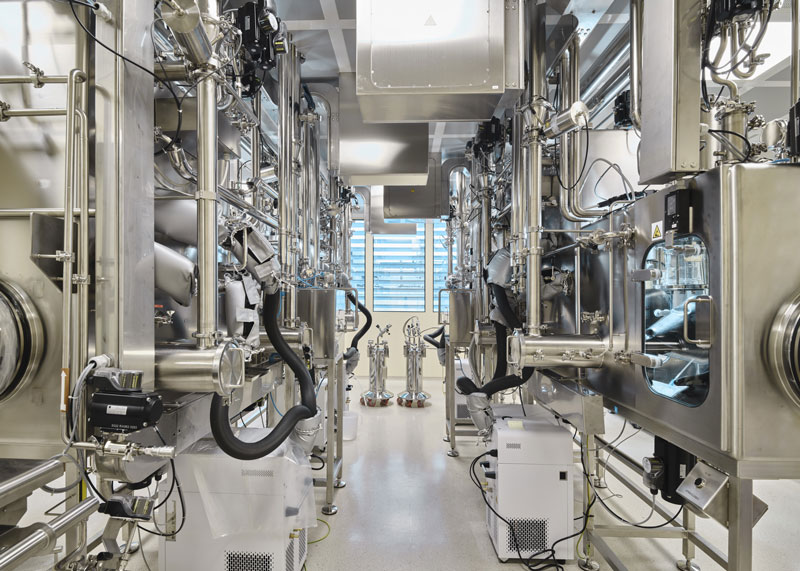
The high-potency infrastructure includes:
- dedicated HPAPI kilolabs with containment down to 1 ng/m³;
- expanded GMP synthesis and isolation capacity, including contained charging, centrifugation, and filter drying;
- preparative HPLC and low- to medium-pressure chromatography, including large-scale columns;
- tangential-flow filtration;
- particle-engineering capabilities, including spray drying from organic solvents;
- glovebox-integrated lyophilization; and
- analytical development, impurity characterization, method validation, and GMP testing.
Indena’s differentiation is not any one asset but the combination of:
- modern synthetic organic chemistry and semisynthesis;
- microbial fermentation and biotransformation up to 20,000 L, including toxic compounds;
- botanical extraction and complex natural-product chemistry;
- high-containment downstream purification and isolation; and
- Integrated analytical support throughout development and GMP manufacturing.
For fermentation-derived ADC payloads and other structurally complex HPAPIs, this combination can materially simplify the supply chain. Sponsors can keep critical steps within one organization rather than transferring processes among unrelated fermentation, chemistry, purification, and high-containment providers.
A PRACTICAL PLATFORM FOR NEXT-GENERATION THERAPIES
Indena’s investment program is expanding capacity in synthesis, isolation, lyophilization, spray drying, fermentation, and analytical science. These additions strengthen an existing base of more than 30 years of high-containment experience and a portfolio spanning both clinical-stage and commercial HPAPIs.
For pharmaceutical and biotechnology companies, the value proposition is practical: fewer supply-chain interfaces, robust containment, an integrated European manufacturing platform, and the flexibility to tailor equipment and development pathways to the molecule. From early route design to commercial GMP supply, Indena offers a single technical and quality framework for complex HPAPI programs, including the fast-evolving field of ADCs.
Bernard Vianes
Global Director CDMO Business Development
Indena SpA
www.indena.com

The return of the tool-building chemist

Navigating Pharma’s Forced Supply Chain Revolution
Unlocking Innovation Through Industrial Photochemistry

From Trial and Error to Predictive Design: How AI Is Transforming Form...

APIs, HPAPIs and the Future of Pharmaceutical Development

The Importance of Occupational Health Expertise in HPAPI Manufacturing

GLOBAL REVOLUTION IN PHYTOPHARMACEUTICALS: How Melisa Farm Decoded Med...
Integrated potency strategy for CGT: Building a phase-appropriate anal...