Advances in chemistry have often been tied to the development of new tools. The chemist was often the tool builder, inventing instruments to advance the field. Alchemists, natural philosophers and then chemists shaped glass to probe the transformations and separations of matter. The first half of the twentieth century was a golden age of chemistry instrument builders. Arnold Beckman designed the pH meter to measure the acidity of citric acid solutions. Richard Perkin manufactured IR spectrometers. Keene P. Dimick developed a gas chromatography instrument to analyze strawberry oil. These chemists, and many others, professionalized and commercialized chemical instrumentation, founding name-brand companies like Waters, Varian, Bruker, and Agilent (1). These tools focused on a specific capability or unit operation in a self-contained platform.
In the generations that followed, the chemistry labs were stocked with high-quality standardized instruments, glassware and other tools supplied by specialized companies. Each instrument was designed to operate stand-alone and provide a narrowly defined piece of data. Researchers used one tool after another and aggregated the results in a workflow that ranged from ad hoc to highly routinized, depending on the nature of the inquiry. Chemistry had seemed to move into an age where the chemist used standardized commercial equipment to perform experiments and gather data (2).
Our industry, drug substance process development, saw a slow but significant evolution in the way we do research. Tools continued to improve in precision and capabilities and data moved from paper notebooks to electronic notebooks. But for the most part, the chemist still carried out research as a series of disconnected operations, performing experiments and analyzing results one at a time.
Automated high throughput experimentation (HTE) was developed as a tool to perform multiple experiments in parallel (3), in support of combinatorial approaches to drug and material discovery. In 1970, J. J. Hanak at RCA labs proposed an integrated synthesis and testing workflow for materials discovery – an early example of HTE but lacking the automation to fully realize the goal. Peter Schultz and coworkers at Berkeley published one of the first modern examples, a materials discovery platform using parallel synthesis of spatially addressable arrays (4). The technology was patented and assigned to Symyx, which commercialized purpose-built parallel reaction instruments. By the 2000s the hardware and software to connect and orchestrate true HTE workflows finally existed, but at a cost that put the technology out of reach of all but the largest corporations. In 2003, ExxonMobil and Symyx entered a five-year alliance reported to be worth more than $200 million to deliver HTE tools (5).
Throughout the 2010s, automating chemical discovery continued to attract large investments; Lilly (6) and IBM (7), among others, extended HTE to multi-step synthesis and more recently, closed-loop “self-driving laboratories” have sought to automate the entire design-make-test-analyze cycle. What these efforts share is the scale of investments required to build, automate, and orchestrate a scientifically useful workflow. The effort required deep expertise across chemistry, software development, and engineering.
While fully autonomous self-driving laboratories may be beyond the reach of most research organizations, today the widespread availability of technologies such as AI, 3D-printing, CNC machining and low-cost components is enabling a renaissance of the tool-building chemist.
Tool building today carries both a lower cost barrier and a lower skill barrier. From their desktop, the chemist tool-builder can now access the skills of highly trained machinist and emulate an experienced software developer.
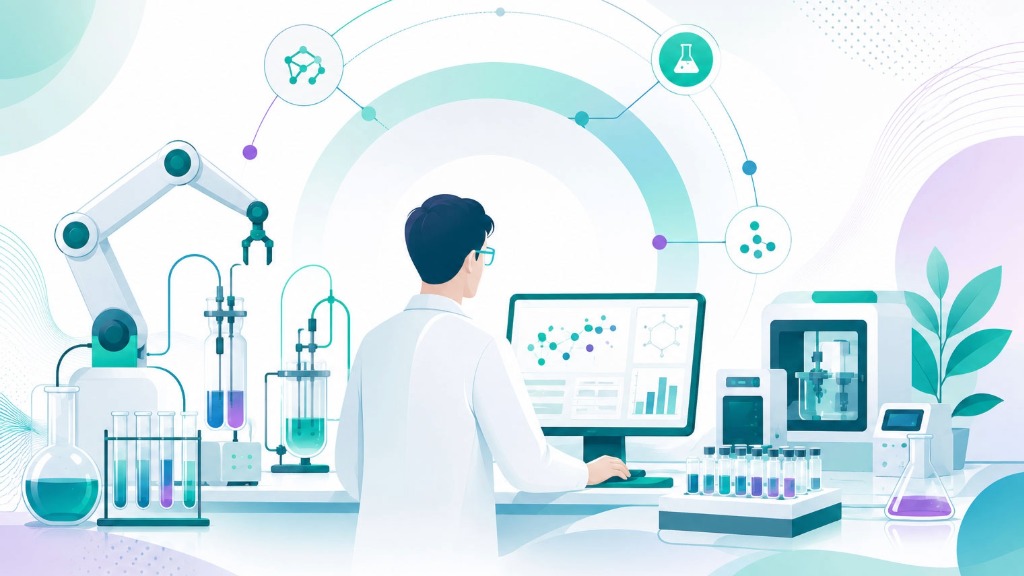
The goal has shifted from building standalone analytical instruments, or automating individual unit operations, to designing connected systems that carry out complex sequences of operations; work now achievable by generalists. A small team with a modest budget can design and build automated workflows that integrate off-the-shelf and custom equipment, orchestration software, and optimization algorithms to accomplish advanced R&D goals. Parts that cannot be bought can be 3D printed or ordered from low-cost, online prototyping services. Inexpensive single board computers and microcontrollers can replace traditional hardware for automation and data handling. Establishing connectivity and coordination once demanded deep software expertise, but in the last year, AI coding assistants have democratized that too, to the point that even a novice can achieve sophisticated automation. Open-source optimization algorithms are freely available online. Nearly any chemist who wishes to build a new tool or automate a workflow now has all the components within reach.
Professor Timothy Noël and co-workers at University of Amsterdam exemplify the modern chemist tool-builder with their RoboChem (8) and RoboChem-Flex (9) platforms, which are capable of closed-loop optimization and can be replicated in labs with even the most modest budget.
From the start of the automation drive, and in the examples above, the target has been discovery. Discovery is wide work; to arrive at one valuable molecule, thousands of candidates must be made and screened, and that is precisely where parallelization and high-throughput automation make sense. A large, expensive platform is easy to justify when its cost is spread across tens of thousands of experiments. Late-stage process development is different in kind; the hedgehog to the discovery fox, deep rather than wide. It requires interrogation of a single process until it is efficient, safe, robust, and ready to scale. What has changed is not the value of automating development, which was always high, but its cost and skill requirements. With those barriers lowered, the opportunity is no longer simply to make more molecules faster; it is to understand each process more deeply, and even to design new ways of manufacturing.
Screening that supports route and process selection is usually well served by standard HTE setups, but downstream process development is often a poor fit for discovery platforms. The process lab contends with far greater diversity of unit operations (e.g. distillation, aqueous workup, purification, crystallization) across scales that range from milligrams to multi-gram demonstrations. Andrew Cooper and co-workers at University of Liverpool have tackled that diversity with a mobile robot that brings ultra-flexible automation to the process lab (10). The robot deploys in the existing lab designed for humans and operates existing equipment as a person would. It is noteworthy that the Cooper paper highlights the critical role of the human in the loop; catching an incorrect structure assignment made by the robot researcher.
The application of a range of automation tools to development is highlighted in a recent paper by teams at Takeda and MIT (11). Aimed at the optimization of a hydrogenation reaction, they used an HTE platform to select catalyst, solvent, and additives. With the categorical variables fixed, they moved to a custom-built, flexible flow reactor able to accommodate different reactor types and multiple process analytical technologies. The platform coupled automated DoE, dynamic parameter control, and algorithm-directed self-optimization. The data generated was used to develop a detailed model of the process that could be used for process control: a model predictive controller (MPC). A central aim of process research is a process that runs reproducibly, with the lowest possible sensitivity to variation in its parameters. Process robustness sometimes comes at the expense of optimization. The MPC approach let the team design to the optimal operating point, then use automation to hold the process within a narrowly defined control window. MPC has long been used in bulk chemical manufacturing, but the investment required made it impractical for application to the broad-scope, short-cycle, and high attrition type of manufacture typical of pharmaceuticals. That is no longer the case.
After the field of chemistry’s origin with tightly coupled tool-building and fundamental research, we have seen several generations of chemists focusing on molecular phenomena while serving primarily as a skilled user of instruments others designed. That is changing. The chemist is a builder again, not of glassware, but of integrated workflows of sensors, robots, code, and algorithms that reveal how a process behaves before it reaches the plant. The reward is not merely speed, it is understanding. These tools are not autonomous, the chemist asks the questions, designs the way to answer them and distills analysis to understanding. Deep understanding at a faster pace promises to deliver medicines to patients faster than ever before.
References and notes
- “Makers of Modernity: Members of the Pittcon Hall of Fame” 2005, Chemical Heritage Foundation, Philadelphia, PA.
- At least for synthetic chemists. During my PhD I had a classmate in physical chemistry who spent many years of his PhD studies building a room filling molecular beam system.
- For a review of HTE in organic chemistry see; Nsouli, R., Galiyan, G., Ackerman-Biegasiewicz, L. K. G., Angew. Chem. Int. Ed. 2025, 64, e202506588.
- Xiang, X. -D., Sun, X., Briceno, G., Lou Y., Wang, K.-A., Chang, H., Wallace-Freedman, W. G., Chen, S.-W., Schultz, P. G., Science, 1995, 268, 1738-1740.
- Chemical & Engineering News, 2003, 81(30), 11. DOI: 10.1021/cen-v081n030.p011a.
- Godfrey, A. G., Masquelin, T., Hemmerle, H. Drug Discovery Today, 2013, 18(17/18), 795-802
- Chemical & Engineering News, 2020, 98(34). https://cen.acs.org/business/informatics/IBM-debuts-chemical-synthesis-robot/98/i34. Accessed August 9, 2026.
- Slattery, A., et al., Science, 2024, 383, eadj1817. DOI: 10.1126/science.adj1817.
- Pilon, S., Savino, E., Bayley, O.M. et al. Nat. Synth. 2026. https://doi.org/10.1038/s44160-026-01053-0
- Brass, E. J. et. al. Digital Discovery, 2026, 5, 1363-1371. DOI: 10.1039/d5dd00563a.
- Sagmeister, P., et. al. Org. Process Res. Dev. 2026, 30, 2008-2018. DOI: 10.1021/acs.oprd.6c00149.

From Fermentation to High Containment: Indena’s Integrated European Pl...

Navigating Pharma’s Forced Supply Chain Revolution

Unlocking Innovation Through Industrial Photochemistry

From Trial and Error to Predictive Design: How AI Is Transforming Form...

APIs, HPAPIs and the Future of Pharmaceutical Development

The Importance of Occupational Health Expertise in HPAPI Manufacturing

GLOBAL REVOLUTION IN PHYTOPHARMACEUTICALS: How Melisa Farm Decoded Med...

Integrated potency strategy for CGT: Building a phase-appropriate anal...