Four years of Horizon Europe research bring an integrated thermochemical and bio-electrochemical pathway towards carbon-negative sustainable fuels closer to deployment.
BOLOGNA, 31 AUGUST 2026 — The NET-Fuels project is approaching completion, consolidating four years of research and innovation across technology development, sustainability assessment, regulations and markets analysis, and stakeholder engagement.
What if biomass residues could be converted into several useful products while also helping to remove carbon dioxide from the atmosphere?
This is the challenge addressed by NET-Fuels, a four-year project funded by the EU’s Horizon Europe programme and coordinated by the University of Bologna, under the scientific guidance of Prof. Diego Marazza from the Centre for Research in Environmental Studies (CIRSA).
NET-Fuels develops and validates an integrated thermochemical process for converting secondary biomass into advanced biofuels, synthetic fuels and biochar.
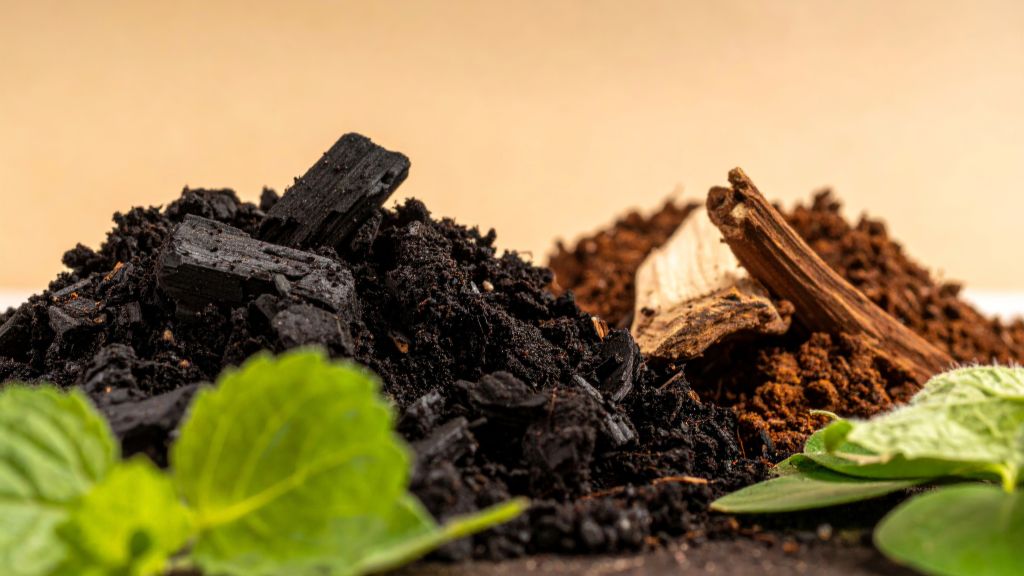
Biochar is a carbon-rich material produced from biomass such as pruning residues, digestate and other agroforestry residues, already used in agriculture as a soil amendment. Because the carbon contained in biomass has been taken from the atmosphere through photosynthesis, NET-Fuels also investigates how part of this biogenic carbon can be kept out of the atmosphere for long periods rather than rapidly returned through combustion or decomposition. Stable biochar provides one such carbon removal route. Carbon removal does not replace emissions reduction: it represents an additional climate function where durable storage, lifecycle performance and verification can be demonstrated.
An integrated approach to biomass and carbon
The NET-Fuels process starts with low-value biogenic residues—including pruning residues, digestate, manure and calamity wood—which are processed through Thermo-Catalytic Reforming (TCR®), developed by Fraunhofer UMSICHT. TCR produces three main outputs: biochar, TCR-Oil and TCR-Gas. TCR-Oil is a biofuel intermediate that can be used directly as a drop-in marine fuel or further upgraded into transport fuels. Hydrogen is recovered from TCR-Gas through vacuum pressure swing adsorption, while the remaining tail gas is combusted in an oxyfuel combustion unit to generate renewable process heat and a concentrated stream of biogenic CO₂. The heat is recycled to support biomass drying and the TCR process, while the CO₂ is converted into synthetic methane through Bio-Electrochemical Methanation (BEM), developed by Leitat.
This integrated architecture also makes carbon management a system-level choice. The biogenic carbon entering the process is distributed among stable biochar, renewable fuels and gaseous streams, including a concentrated biogenic CO₂ stream. Different future configurations can therefore direct different carbon fractions towards energy and fuel production, durable carbon storage or further CO₂ utilisation and storage routes.
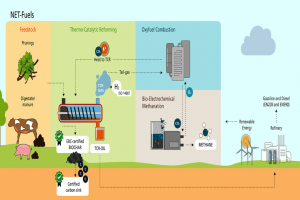
The integrated NET-Fuels pathway links Thermo-Catalytic Reforming, oxyfuel combustion and bio-electrochemical methanation to maximise the valorisation of biogenic carbon.
The project brings together seven partners from six European countries, combining engineering, environmental science, agronomy, economics, policy, and communication. The University of Bologna coordinates the consortium and leads the assessment of regulatory and policy frameworks and the environmental, economic, and social sustainability of the integrated system. Fraunhofer UMSICHT leads the thermochemical and oxyfuel components; Leitat develops BEM; the Silesian University of Technology carries out modelling and life cycle assessment; Ithaka Institute investigates the agronomic and carbon-removal value of biochar; REACH Innovation leads market analysis and exploitation; and WRG Europe coordinates communication, dissemination, and stakeholder engagement.
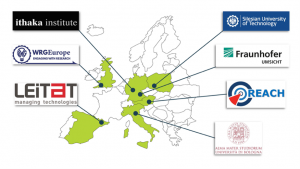
The NET-Fuels consortium brings together seven partners from six European countries.
Project results
As NET-Fuels approaches completion in October 2026, the project’s results span the entire innovation chain, from pilot-scale technology and carbon accounting to regulation, markets, and public engagement.
University of Bologna (UNIBO)
As project coordinator, the University of Bologna has provided consortium management throughout NET-Fuels, supporting scientific and administrative coherence and monitoring project risks. UNIBO also led the regulatory assessment of the overall NET-Fuels approach, developing a framework covering technology, process and product requirements, including feedstock and end-of-waste constraints, emission limits, product-quality standards for hydrogen and biochar, and jurisdiction-specific legislation. This work identified regulatory barriers and enabling conditions relevant to future scale-up.
In parallel, UNIBO worked with the Silesian University of Technology (SUT) to establish common system boundaries, reference technologies, functional units and datasets for life cycle assessment (LCA). SUT subsequently developed the attributional LCA of the integrated system, while UNIBO led dynamic GHG modelling and environmentally extended input-output analysis to explore how environmental and socio-economic performance may change across feedstocks, deployment conditions, and future energy-transition scenarios. Together with Ithaka Institute, this work also addressed the durability of the carbon stored in biochar.
Fraunhofer UMSICHT (FRA)
Fraunhofer UMSICHT established a pilot-scale infrastructure for producing biochar, bio-oil, hydrogen, carbon dioxide, and process heat from biogenic residues. The infrastructure combines pyrolysis, oxyfuel combustion, gas cleaning, and pressure swing adsorption. Upstream pyrolysis gas cleaning and flameless combustion allow the oxyfuel unit to produce a highly pure CO₂ stream, which can be used directly in downstream carbon capture and utilisation processes such as bio-electrochemical methanation.
The integrated system was tested with feedstocks of varying quality, including digestate, vine pruning, and spent hops. The results demonstrate the flexibility of the technology with respect to the range of biomass that may be available in real-world applications.
Leitat (LEITAT)
Leitat successfully developed, optimised, and validated the BEM technology for converting CO₂ into CH₄, progressing from laboratory experiments to a pilot-scale system. The work established robust operating strategies, including automated CO₂ feeding, and demonstrated stable methane production using both pure and industrial CO₂, providing evidence of the technology’s tolerance to real-gas impurities.
Based on the laboratory results, a pilot BEM plant was designed, constructed, and operated, reaching Technology Readiness Level 5 (TRL5). In the final phase of NET-Fuels, the pilot was transferred to Fraunhofer UMSICHT and integrated with the TCR and oxyfuel processes. This integration provides an important step towards validating the complete technology chain and the future coupling of BEM with biomass conversion for renewable methane production.
Silesian University of Technology (SUT)
The Silesian University of Technology performed an attributional LCA of the NET-Fuels TCR–BEM system, considering digestate, pruning, and wood as feedstocks and methane, biochar, oil, oxygen, and hydrogen as products. Both a process-oriented assessment per tonne of biomass and a product-oriented assessment focused on methane were conducted, including the influence of durable biochar carbon storage.
The results show how strongly the assessment perspective shapes the environmental interpretation. In the process-oriented assessment, pruning had the highest processing energy demand and the highest Climate Change and Resource use (fossils) impacts but also produced the highest methane yield—211 kg per tonne (kg/t), compared with 174 kg/t for wood and 153 kg/t for digestate. In the product-oriented assessment, digestate therefore showed the highest impacts per unit of methane. Climate change and fossil resource use together accounted for approximately 72.1–73.5% of the weighted Environmental Footprint 3.1 results. The analysis also found that biochar storage substantially improves the climate balance and may enable net-negative emissions.
Ithaka Institute (ITHAKA)
Ithaka Institute delivered three key results concerning the agronomic and climate value of TCR biochar. First, the project demonstrated that TCR biochar meets the requirements of the EU Fertilising Products Regulation (EU 2019/1009) for use as a fertilising input, and that its application to soil can be certified as a carbon removal under the EU Carbon Removals and Carbon Farming Regulation (CRCF, EU 2024/3012). Second, TCR biochars produced from nutrient-rich feedstocks were shown to return plant-available potassium and phosphorus to the soil, opening a route towards closed-loop K/P recycling. Third, the project developed an allocation method for the multi-output pyrolysis system that distributes process emissions across biochar, bio-oil, and pyrogas, supporting a robust calculation of the net carbon-sink benefit attributable to the biochar fraction.
REACH Innovation (REACH)
REACH Innovation conducted a comprehensive Market and Competitive Research Analysis based on a database of more than 200 identified and filtered competing projects. The analysis assessed the strengths, opportunities and risks associated with the project’s key exploitable results and informed business models for biochar, synthetic methane, hydrogen, biofuel, oxygen-enriched gas, and heat.
The work also developed four business-case configurations of the NET-Fuels technologies, a business plan for the main integrated solution and an exploitation roadmap for the project results. It further addressed intellectual property, including joint-ownership agreements for selected key exploitable results, and established a community of stakeholders interested in following the project’s future development. Project outputs and publications were managed according to Open Science principles.
WRG Europe (WRG)
WRG Europe developed a suite of digital and visual communication materials—including the project website, social media content, videos, and printable media—to document NET-Fuels and make its results accessible to wider audiences. Engagement activities, including conferences and trade exhibitions, have supported the dissemination of results while also helping to build pathways for their future exploitation and sustainment.
NET-Fuels2026: research, industry and institutions meet in Ravenna
From 23 to 25 June 2026, the University of Bologna hosted the NET-Fuels2026 conference at Palazzo Rasponi dalle Teste in Ravenna (Italy), bringing the project’s technological work into dialogue with regional stakeholders and the wider scientific community.
The three-day event combined the NET-Fuels semestral Project Meeting, a regional Stakeholder Workshop and an international Scientific Symposium. It provided a shared forum for project coordination, scientific exchange and dialogue with industry and institutions, bringing together researchers, industry representatives, policymakers and regional stakeholders to discuss the role of biomass-based carbon removal in accelerating sustainable agro-industrial transition.
The conference also offered an opportunity to connect the technical results of NET-Fuels with questions of implementation, value creation and governance. By combining scientific exchange with stakeholder engagement, the event reflected the project’s broader ambition: to assess not only whether an integrated biomass-conversion system can work, but also how its environmental, economic, regulatory, and social dimensions shape the prospects for its future use.
The final phase
NET-Fuels will reach completion in October 2026. Before the project concludes, WRG Europe will host the final Project Meeting and Stakeholder Workshop in London from 21 to 22 October 2026. The meeting will provide a final opportunity for partners and stakeholders to reflect on the project’s results and their pathways towards future exploitation.
| ABOUT NET-FUELS
NET-Fuels — Increasing Biomass Conversion Efficiency to Carbon-Negative Sustainable Biofuels by Combination of Thermochemical and Bio-Electrochemical Processes — is a four-year project funded by the European Union’s Horizon Europe programme (Grant Agreement No. 101083780). The consortium comprises seven partners from six European countries. Further information: netfuelsproject.org |