
LONDON (ICIS)–A joint US-Israel attack on Iran struck military and government targets across the country on Saturday morning Tehran time.
An attack was expected as US military forces had built up in the Gulf region for some time. While the impact on energy facilities was unknown at publication time, ICIS analysts and experts have explained the potential impact, depending on the extent of production and supply-chain disruption.
Chief among energy traders’ concerns will be the potential closure of the Strait of Hormuz, a route used by 20% of global LNG trade and 25% of sea-borne oil trade. Iran’s Revolutionary Guards, a week before Saturday’s attack, had started drills in the Strait of Hormuz, already testing a temporary blockage of the sea passage.
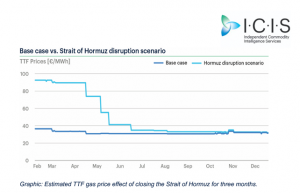
ICIS analysts ran model-based scenarios as recently as Wednesday 25 February to test repercussions of a three-month Strait of Hormuz closure for supply-demand dynamics in European gas markets. An immediate price impact of the Dutch TTF front-month soaring above €90.00/MWh “seems realistic if removing direct Qatari LNG exports to Europe, considering the tightening global LNG balance,” wrote ICIS gas analytics head Andreas Schroeder. To put the magnitude of this potential price rise in context, the TTF April price – the new front-month when European gas trade opens early on Monday 2 March – was assessed on Friday’s close by ICIS price reporters at just under €32.00/MWh.
A potential three-fold increase could be seen.
IMPACT
ICIS analysts investigated the impact of a three-month closure of the Strait of Hormuz on European gas markets using the Gas Foresight modelling suite, running a Hormuz disruption scenario alongside a base case. The Hormuz scenario assumed no contracted Qatari LNG imports to Europe until end of May, combined with a 131TWh reduction in spot LNG volumes over a 90-day blockade period, both effective immediately. On the demand side, combined demand and storage needs totalled about 2,600TWh between April and November. Analysts assumed a 90/365-day rolling-horizon setup, meaning the model optimized 365 days ahead and then advanced in 90-day steps, mimicking any trading desk’s imperfect understanding of real-world markets beyond the near term. The impact on global LNG trade would be profound. A temporary restriction of LNG exports from the Gulf region would tighten the global LNG supply–demand balance and trigger a pronounced increase in spot LNG prices. But even after reopening, a period of fierce competition for flexible cargoes would arise between the main importing regions of Asia and Europe. In the disruption scenario, the TTF front-month immediately jumps to €92.00/MWh, with an average price of roughly €86.00/MWh during the 90-day blockade period. The magnitude of this increase “highlights the systemic importance of Gulf LNG supply for the European market balance,” Schroeder said. As Qatari export volumes return, prices decline over the course of summer 2026. Monthly average TTF prices reach about €65.00/MWh in May and €40.00/MWh in June before easing somewhat to €34.00/MWh in July – still 10% above the base case. Over the autumn, trajectories in the disruption and base cases converge as the global LNG balance normalizes.
EUROPE’S EXPOSURE
Europe’s energy system has made remarkable progress since 2022 in diversifying supply routes and building new import infrastructure. But as noted by ICIS editor Ghassan Zumot writing on 13 February (paywall): “Europe has simultaneously allowed strategic buffers like gas storage levels to erode to dangerously low levels at a critical moment in global affairs.” Europe’s increasing reliance on LNG leaves it exposed, as Zumot said: “Critically, 2024 numbers show 83% of Hormuz LNG flows to Asia, as China, India, and South Korea alone take 52%. Any disruption would force Asian buyers to compete with Europe for remaining non-Hormuz supplies from the US and Australia.” ICIS editor Gretchen Ransow confirmed on Friday 27 February that low European gas storage stocks already present a “refilling challenge” (paywall). In light of the fundamental picture, Zumot said, even back in early-February: “The [European gas] market has little buffer for a significant supply shock.” The EU does have binding gas storage requirements in place. But even at elevated prices, not all demand could be easily met. ICIS analysts said that, under the disruption scenario conditions, “a temporary relaxation of storage targets would likely become a relevant policy option to alleviate market stress”.