Introduction
According to the United Nations (UN), the world population is around 8 billion and is expected to reach 9.7 billion by 2050. Population aging is the most significant social transformation of the 21st century (1). This fact is a serious public health problem, since it transcends borders and hinders the economic and social progress of the population, as it involves issues of climate change, human rights, food security, health and well-being (2).
In healthcare, it is estimated that in 2028, the global pharmaceutical sector will spend around US$2.3 trillion on medicines (3). The World Health Organization (WHO) has declared organ transplantation a key issue for the 21st century. This is because intervention and treatment in this area increases human longevity and restores essential functions, as there are no alternatives of comparable effectiveness (4). Organ, tissue, and cell transplantation have become successful global practice. Advances in organ procurement, preservation, surgery, and immunosuppression techniques have improved the efficacy, cost-effectiveness, and cultural acceptability of transplants (5). However, to meet the growing demand and keep pace with scientific and technological advances in therapeutic chemicals”— known as ’pharmochemicals’ –“. It is necessary to monitor technological trends to inform decision-makers’ investment in research, development, and innovation. Furthermore, contributing to reducing transplant costs with safer pharmochemicals that provide longer life expectancy is crucial (6,7) education level, and health insurance affect the use of health services among the adult Brazilian population with chronic noncommunicable diseases (NCD.
Methodologies
The study is exploratory, qualitative and quantitative in nature, as it seeks to obtain the state of the art scenario and interpret facts (8). The period analyzed in the study considered a 20-year time span (2003-2022). Regarding scientific trends, the databases used were those that presented the highest results in the area in question. They are Scopus, PubMed and Web of Science databases were used, using terms associated with “transplant” associated with the most transplanted solid organs in the world: “kidney”, “liver” and “heart”, and also associated with the descriptors of the Science and Health portal (DeCS)/Medical Subject Headings (MeSH) (https://decs.bvsalud.org/) (9), being: a) Condition/disease: “Kidney Transplantation” OR “Kidney Grafting” OR “Kidney Transplantations” OR “Renal Transplantation” OR “Renal Transplantations” OR “Liver Transplantation” OR “Hepatic Transplantation” OR “Hepatic Transplantations” OR “Liver Grafting” OR “Liver Transplant” OR “Liver Transplantations” OR “Liver Transplants” OR “Heart Transplantation” OR “Cardiac Transplantation” OR “Cardiac Transplantations” OR “Heart Grafting” OR “Heart Graftings” OR “Heart Transplantations”. The data was extracted into Excel spreadsheets and then processed using the free software VOSViewer®.
Regarding technological trends, the methodology involved identifying and mapping the technological landscape through patent searches using the ORBIT Intelligence® platform. The same search string (without quotation marks) was applied to the fields “title,” “abstract,” “claims,” and “priority country,” considering a 20-year time frame (2004–2023). Only patent documents that were still in force were extracted. Each document was then individually analyzed by reviewing its title, abstract, and claims to confirm its relevance to the scope of the study.
Results and discussions
According to the Global Observatory on Donation and Transplantation, there has been a worldwide increase in organ transplant activity. In 2023, 172,409 patients were transplanted, 68,591 of whom were from the Americas (10). In the United States, there are more than 106,000 candidates on the waiting list for solid organ transplants. The Organ Procurement and Transplantation Network (OPTN) periodically publishes the growing waiting list for organ donation. (11). According to the European Directorate for the Quality of Medicines and Healthcare, in 2022, an average of 39,000 patients received a transplant, and 48,000 new patients were registered on waiting lists in the European Community (EU). On average, 19 deaths occur per day on the EU waiting list. (12).
The development of antibody induction therapies has expanded the possibilities for preventing rejection during the most critical periods post-transplant. Agents such as antithymocyte globulin (ATG) and monoclonal antibodies (e.g., basiliximab) have been integrated into induction strategies, personalizing the immunosuppressive approach from the outset of treatment. Innovative drugs, such as belatacept—a T costimulation blocker—and imlifidase, act by cleaving IgG antibodies for desensitization. This trend has shown potential to offer regimens even more tailored to individual patient needs (13).
In this context, the technological focus in question is centered on the International Patent Classification (IPC) A61P and A61K. As for the technological domain category, it is centered on “Pharmaceutical” and “Medical Technologies”. Finally, it is configured as trends in pharmaceutical chemical products that have antioxidant anti-inflammatory modulating compounds, pharmaceutical composition, as well as their use.
Pharmacological advancement in transplantation has evolved to include pharmacokinetic models and individualized dosing strategies, aiming to optimize the benefit-risk ratio. This is achieved by adjusting the dosage based on patients’ inter- and intra-individual variability and the complexity of the polypharmacy regimen required by transplantation (14).
Figure 1 presents a timeline of the main immunosuppressive agents used in transplantation, highlighting the therapeutic evolution between 1950 and 2010: it began with corticosteroids and azathioprine, followed by the introduction of polyclonal preparations such as ATG/ALG, and the revolution brought by cyclosporine (1983), which marked the beginning of more selective immunosuppression. Subsequently, monoclonal antibodies (1986) were introduced, followed by more potent calcineurin inhibitors (tacrolimus, 1994), modern antimetabolites (mycophenolate mofetil, 1995), and anti-CD25 antibodies for induction therapy. Finally, the incorporation of mTOR pathway inhibitors (sirolimus, 1999; everolimus, 2010) completed this progression. These advances illustrate the transition from broadly nonspecific agents to increasingly targeted strategies aimed at optimizing rejection prevention while reducing toxicity and improving graft survival (15).
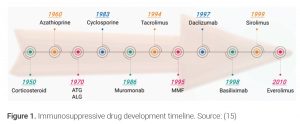
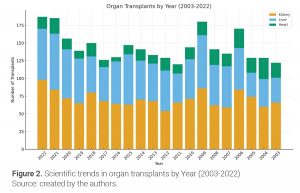
Figure 2 illustrates the scientific trends in organ transplants over the last 20 years, with 2,983 publications, of which 1,414 were kidney, 1,132 liver and 347 heart.
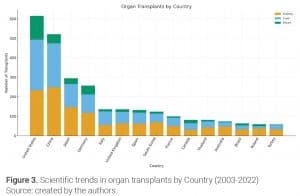
The top 5 countries with publications in this field are the United States, China, Japan, Germany, and Italy (Figure 3). The analysis confirms that the kidney is the most researched organ, followed by the liver and heart. Considering the sum of the three organs, these top 5 countries have 615, 521, 295, 257, and 136 manuscripts, respectively.
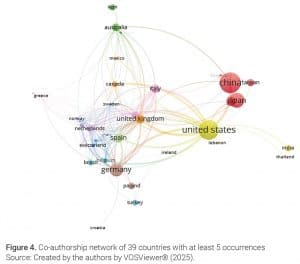
Regarding the scientific cooperation network among experts and researchers, the strong relationship between the TOP 5 countries in publications is evident. However, co-authorship among the 94 countries identified, with at least five interactions, formed 11 clusters. Of these, the strongest collaborative correlations were among the United States, China, Japan, Germany, and the United Kingdom (Figure 4).
Following review of the 67 initially identified documents, those falling outside the study’s scope were excluded, yielding a final corpus of 47 relevant patents (Supplementary material). Regarding technological trends, measured by patent documents filed according to the methodology and in the countries analyzed, the United States leads with 35 patents, followed by Japan (6), and then China and South Korea with 5 each. Next are Australia (3), New Zealand, and Brazil with 2 documents, and Canada, the United Kingdom, Ireland, France, and Italy with 1 patent. It is worth noting that the countries with the highest number of filings reflect the greatest investments in Research, Development, and Innovation (RD&I).
Patent documents are classified by the International Patent Classification (IPC). Each patent office in each country assigns the IPC codes valid at the time of publication of the invention application by the patent holder (16). The IPC, in addition to facilitating access to technological information, also serves as a tool for orderly arrangement of patent documents. This criterion facilitates research into the state of the art in each technological field. Once the group(s) to which the patent refers has been identified, it becomes possible to identify other related applications in patent families that have the same purpose. Figure 5 shows the predominant IPC of the filings made during the period analyzed. The larger the geometric shape, the greater the number of patents in that IPC, that is, in the technological domain.
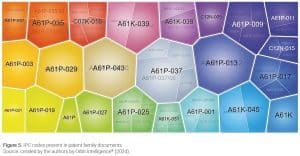
Most patents belong to IPC subclass A61P. This subclass addresses “specific therapeutic activity of chemical compounds or medicinal preparations.” The 10 IPC codes most frequently found in the patent documents analyzed are: IPC A61P 13/12, referring to “Drugs for the treatment of disorders of the urinary system/kidneys”; A61P 37/06, referring to “Drugs for the treatment of immunological or allergic disorders/immunosuppressants, e.g., drugs for graft rejection”; and A61P 43/00, referring to “Drugs for special purposes not covered by groups A61P 1/00-A61P 41/00,” all with 19 patents each.
In this context, the pharmaceutical chemicals that comprise the final drug were identified in the patent descriptions, namely: Envarsus XR (extended-release tacrolimus); Tacrolimus; Everolimus; Mycophenolate mofetil (MMF); Basiliximab; Rabbit antithymocyte globulin (rATG); Imlifidase; Belatacept; Equivalent Drugs (drug grouping): Envarsus XR and other forms of Tacrolimus as a single group. Analyzing clinical studies, there is a trend toward increasing efficacy and decreasing toxicity of drugs by using an immunosuppressive approach in solid organ transplants, that is, with an emphasis on increasingly individualized treatments.
Conclusions
The pharmaceutical market continues to grow its global market share and maintains a strong presence in R&D&I. Immunosuppressive drugs are increasingly promising for organ transplants—especially kidney, liver, and heart transplants.
Scientific and technological trends reveal a multifaceted and dynamic panorama of R&D&I in this area, highlighting the leading role of the United States, China, Japan, Germany, and the United Kingdom, with their centers of excellence and significant network interactions with several other countries around the world. It is noteworthy that the systemic analysis of emerging trends is an important tool for decision-making by managers.
In this sense, the integrated analysis of data from scientific and technological prospecting projects a technological horizon. Given the vast amount of data, which is growing rapidly, a multifaceted and dynamic panorama of the field of research and development in immunosuppressants for organ transplantation in Brazil and worldwide is revealed. The organ most researched and receiving the most attention regarding immunosuppressants is the kidney. The promising trend identified is incremental innovation to optimize the use of calcineurin inhibitors (Tacrolimus), such as obtaining new formulations using the sustained-release immunosuppressant tacrolimus. These new therapeutic approaches demonstrate robust potential to combat graft rejection, providing more effective treatments for patients, contributing to improved survival rates and quality of life for patients.
References and notes
- ONU. Nações Unidas – ONU Portugal. 2019 [cited March 30, 2025]. Envelhecimento. Available from: https://unric.org/pt/envelhecimento/
- ONU. World Population Prospects 2022: Summary of Results. [Internet]. 2022 [cited August 10, 2022] p. 54. Available from: https://www.un.org/development/desa/pd/es/content/World-Population-Prospects-2022
- IQVIA. Global Use of Medicines 2024: Outlook to 2028. Institute for Human Data Science; 2024. Available from: https://www.iqvia.com/-/media/iqvia/pdfs/china/viewpoints/iqvia-institute-general-use-of-medicines-2024-for-print.pdf
- OMS. Transplantation [Internet]. 2022 [cited October 3, 2022]. Available from: https://www.who.int/health-topics/transplantation
- OPAS. Diretrizes para uma política de doação e transplante de órgãos humanos [Internet]. 49o Conselho Diretor da OPAS, 61a Sessão do Comitê Regional da OMS para as Américas. Washington (DC) [Internet]. 2009 [cited February 21, 2024]. Available from: http://www1.paho.org/hq/dmdocuments/2009/CD49-14-p.pdf
- Malta DC, Bernal RTI, Lima MG, Araújo SSC de, Silva MMA da, Freitas MI de F, et al. Noncommunicable diseases and the use of health services: analysis of the National Health Survey in Brazil. Rev Saúde Pública [Internet]. 2017 [cited October 17, 2022];51(suppl 1). Available from: http://www.scielo.br/scielo.php?script=sci_arttext&pid=S0034-89102017000200306&lng=en&tlng=en
- OPAS. Pan American Health Organization / World Health Organization. 2019 [cited February 21, 2024]. OPAS/OMS | 57o Conselho Diretor. Available from: https://www3.paho.org/hq/index.php?option=com_content&view=article&id=15326:57th-directing-council&Itemid=0&lang=pt#gsc.tab=0
- Proetti S. AS PESQUISAS QUALITATIVA E QUANTITATIVA COMO MÉTODOS DE INVESTIGAÇÃO CIENTÍFICA: UM ESTUDO COMPARATIVO E OBJETIVO. Revista Lumen – ISSN: 2447-8717 [Internet]. 2017 [cited April 15, 2025];2(4). Available from: https://www.periodicos.unifai.edu.br/index.php/lumen/article/view/60
- Alves B/ O/ OM. Sobre o DeCS/MeSH – DeCS [Internet]. 2024 [cited April 1, 2024]. Available from: https://decs.bvsalud.org/sobre-o-decs/
- GODT. Reports [Internet]. GLOBAL OBSERVATORY ON DONATION AND TRANSPLANTATION. 2023 [cited February 23, 2024]. Available from: https://www.transplant-observatory.org/wp-content/uploads/2025/02/2023-data-global-report-20022025.pdf
- OPTN. Organ Procurement and Transplantation Network. 2022 [cited August 18, 2022]. Data – OPTN. Available from: https://optn.transplant.hrsa.gov/data/
- EDQM. European Directorate for the Quality of Medicines & HealthCare. 2023 [cited April 11, 2024]. Search – European Directorate for the Quality of Medicines & HealthCare – EDQM. Available from: https://www.edqm.eu/en/search-edqm
- Abuazzam F, Dubrawka C, Abdulhadi T, Amurao G, Alrata L, Alsabbagh DY et al. Emerging therapies in immunosuppression: Belatacept and imlifidase. 2010. Available from: https://pdfs.semanticscholar org/0178/223ab9702a284033a53e7fc7becc4f0435ae.pdf
- Kirk AD, Gregori S, Wood KJ. The evolution of immunosuppression in solid organ transplantation. Nature Reviews Nephrology. 2018;14:692–706.
- Parlakpınar H, Gunata M. Transplantation and immunosuppression: a review of novel transplant-related immunosuppressant drugs. Immunopharmacology and Immunotoxicology [Internet]. 2021 [cited April 3, 2025];43:651–65. Available from: https://consensus.app/papers/transplantation-and-immunosuppression-a-review-of-novel-parlakp%C4%B1nar-gunata/f29058782ac6572196171146862490d1/
- Espacenet. Espacenet – Classificação Internacional de Patentes (CIP) [Internet]. 2017 [cited April 20, 2023]. Available from: https://lp.espacenet.com/help?locale=pt_LP&method=handleHelpTopic&topic=ipc

The Algorithmic Antagonist: Why AI is Pharma’s Newest Competitor

THE INTEGRATION IMPERATIVE: ADVANCING TIDES MANUFACTURING THROUGH BIOC...

PEER REVIEWED – Scaling Mechanochemistry via Continuous Bead Mil...

Difamilast

The Role of Workers and their Management Teams in Establishing and Mai...

PEER REVIEWED – Crystallization and Particle Engineering – The H...
A Bird’s-Eye View of Global Chemicals M&A

The evolving role of PGMs: sustainability in the market context