Introduction
Small molecule active pharmaceutical ingredients (APIs) are typically synthetic organic compounds with crystalline ingredients (1). Since bioavailability—especially for oral drugs—depends heavily on solubility and dissolution rates of solid forms, their properties are central to drug development (2). In fact, many API candidates fail due to poor solubility (3,4), which is why research of solid forms and crystallization is an essential step in API development and manufacturing.
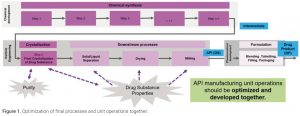
Particle engineering enables the enhancement of solubility and formulation performance of an API by fundamentally understanding the solid forms, and the interacting mechanisms (5). Early-stage support to synthesis development projects (Figure 1) involves solid-state characterization and the application of crystallization strategies to guide development. Particle properties also impact key manufacturing operations, including impurity rejection, filtration, and drying—factors critical to commercial viability (6).
Contract Development and Manufacturing Organizations (CDMOs) should integrate particle engineering capabilities with interdisciplinary expertise in analytics, material science, regulatory compliance, and process equipment. This enables the development of robust unit operations—crystallization, solid/liquid separation, drying, and milling—while collaborating closely with chemical development and purification teams (7). Figure 1 shows how final processes and unit operations can be optimized for an API development project.
Crystallization and Particle Engineering Projects
At a CDMO, crystallization projects often begin with incomplete or variable data from Tech-packages. While late-phase APIs may include detailed solid form screening data, early-phase compounds or intermediates typically lack comprehensive information.
In the initial phase of a particle engineering project, we define the problem and success criteria. This is followed by a thorough assessment of existing thermodynamic and solid-state data, including the stability and solubility of known crystal forms, how they can be obtained, and which solvents can be used as solvents or anti-solvents. As development progresses, focus shifts to process optimization—crystallization, filtration, and drying—with attention to yield and impurity control (6, 8).
A structured approach helps identify data gaps, experimental needs, and constraints related to equipment, regulations, and process robustness. Once the foundation is established, targeted development ensures alignment with both customer expectations and internal processing requirements.
At Evonik, particle engineering experts are involved from project initiation, integrating seamlessly into development and tech transfer workflows. The following sections describe our tailored approach to crystallization, separation, and drying, adapted to each substance and its specific data landscape.
Understanding the Development Workflow
In the early-stage development of a new chemical entity, the focus is on identifying solid forms and evaluating their stability, how they are obtainable, and potential for interconversion. The term “crystal form or “solid form” includes polymorphs of the chemical entity, but also multi-component solid forms with solvents such as solvates or hydrates, and salts or co-crystals (with solid co-formers) (8,9).
Ideally, at this early stage, a form is selected for later development, that is the most stable under ambient conditions, along with a suitable solvent system. The selection process follows a structured approach (see Figure 2). Multiple samples are prepared by mixing the substance with various solvents until fully dissolved. Suspensions are then equilibrated over days or weeks at typical temperatures of 20°C, 50°C, or 70°C, and prepared for X-ray diffraction (XRD) measurements using 48/96 well plates (10).

This initial dataset forms the basis for solid form selection and process development. Later stages involve confirming and refining the data using larger quantities of the substance and more precise measurements.
As development progresses, the focus shifts towards obtaining higher-accuracy data, enabling the development of a robust, scalable process. This includes gaining a clear understanding of the right crystallization pathway throughout the phase diagrams and stability domains, and how the particles can be separated, washed, dried and further processed, within the known stability domains of the phase diagram (11).
At this stage, screenings are performed at a slightly larger scale (2–30 mL), increasing accuracy and allowing broader analytical purposes requiring larger substance quantities. Parallel systems are used to support various studies, including equilibration, solubility curves, metastable zone determination, solvent and salt screening, phase diagrams, and design of experiments (DOE). The development approach using this equipment is illustrated in Figure 3.
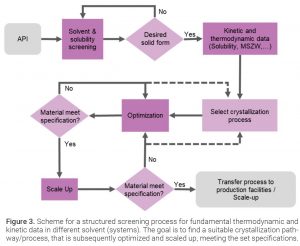
Once a suitable solid form and solvent system have been identified, the focus shifts to the development of a robust crystallization process. This includes understanding key kinetic parameters such as nucleation and growth rates, as well as obtaining accurate thermodynamic data—particularly solubility in the selected solvent system. These insights are essential for choosing the appropriate crystallization technique before moving into process optimization.
At this stage, the goal is to enhance process performance by achieving high yield, target purity, and the desired particle size distribution. Common crystallization methods include:
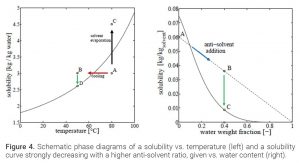
- Cooling crystallization, where supersaturation is induced by lowering the temperature below the solubility limit (Figure 4, red arrow),
- Anti-solvent addition (Figure 4, blue arrow),
- Concentration increase by evaporation of the solvent (Figure 4, black arrow),
- pH-shift crystallization, and
- Salt formation.
Mechanisms in a crystallization process
Crystallization development involves managing a complex interplay of mechanisms that influence particle size, shape, purity, and bulk properties. Key mechanisms include:
- Nucleation vs. Dissolution
- Growth vs. Partial dissolution
- Ostwald Ripening
- Agglomeration
- Breakage
- Solid phase transformation, e.g. polymorph changes
Nucleation, growth, and ripening are primarily driven by supersaturation, temperature, and the chemical environment. In contrast, agglomeration, breakage, and phase transitions are more affected by hydrodynamics, stirring, and reactor design, though solvent and temperature also play roles.
Controlling nucleation is especially critical. Because primary nucleation is often unpredictable, seed crystals of known size are introduced at low supersaturation to guide particle growth. Supersaturation is then gradually increased via cooling, anti-solvent addition, or pH adjustment to achieve the desired size distribution.
Process design aims to produce the target solid form with consistent particle properties. For process design and optimization, we consider:
- Control of particle properties – stirrability/sedimentation time, agglomeration, attrition/breakage
- Bulk properties – bulk density, flowability, caking, compressibility/tabletability
- Downstream processibility – filtration time, drying time
- Control of phase transitions – polymorphic transition, salt/co-crystal formation, desolvation/dehydration
Understanding Impurity Incorporation
During crystallization process optimization, unforeseen challenges often emerge that were not evident during initial screening. A common issue is impurity incorporation, which can be difficult to eliminate through crystallization alone. Another frequent challenge are phase transformations between different solid forms, often solution mediated by dissolution, nucleation, and growth possibly incorporating defects and impurities. (12)
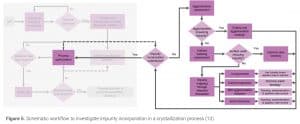
To better understand how impurities are incorporated into the crystal lattice, a structured approach – illustrated in Figure 5 – is used. This schematic helps identify the root cause of impurity inclusion. The insights gained from this analysis are then applied to refine or modify the process during the optimization phase.
Determining these properties requires significant analytical effort, outlined in the next section before addressing scale-up from laboratory to pilot or production scale.
Analytical Technologies and expertise
Crystallization is a key unit operation for controlling purity and impurity rejection, adding complexity to process development. This section outlines core analytical techniques used to characterize crystal and bulk powder properties (see Table 1).
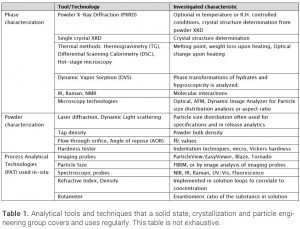
To monitor changes directly within a crystallization system, specialized analytical methods are essential in a particle engineering laboratory. The particle engineering group at Evonik collaborates with analytical and materials science teams for off-line techniques such as X-ray crystal structure analysis and imaging. In-situ monitoring during crystallization relies on Process Analytical Technologies (PAT), including turbidity probes for solubility and supersaturation, Raman spectroscopy for detecting nucleation and solid form changes, and Focused Beam Reflectance Measurement (FBRM) for real-time particle size and shape analysis via laser scattering.
The most used analytical tool is the stereo microscope, followed by Differential Scanning Calorimetry (DSC) for melting point, desolvation, and dehydration analysis, and X-ray Powder Diffraction (XRPD) for identifying distinct crystal structures. XRPD is especially valuable when multiple forms are present, as theoretical reflection angles help distinguish them.
Dynamic Vapor Sorption (DVS) is used to study hydrate transformations and assess hygroscopicity, informing drying and storage decisions. Long-term stability is evaluated under controlled humidity and temperature using climate chambers or specialized ovens.
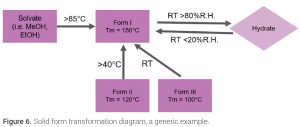
The crystallization development team plays a key role in contextualizing analytical results within the framework of temperature, pressure, and solvent conditions to define the stability domains of solid forms (see Figure 6).
Understanding Crystal Phase Transformations
A key goal in crystallization development is consistently producing the desired solid form. When multiple polymorphs (e.g., Form I, II, III) exist, it is essential to understand their relative stability, formation conditions, and potential for transformation (1). The presence of solvates, hydrates, or amorphous material adds complexity to phase stability.
Phase transformations—solid–solid or solution-mediated—depend on factors such as temperature, solvent, and relative humidity. To incorporate this knowledge into crystallization, separation, drying, and milling processes, solid form transformation diagrams are used to map observed transitions and the conditions under which they occur (14). This diagram (Figure 6) maps observed polymorphic and hydrate transformations and the specific conditions under which they occur.
Selecting the right Laboratory equipment for early investigations and successful scale up
Particle engineering labs use a range of crystallization equipment, from automated systems for solvent and solubility screening (1–20 mL, enabling 8–16 parallel experiments) to reactors for up to 10 liters. Parallelization and automation help ensure no critical data is missed.
As projects advance, intermediate-scale reactors (100–500 mL) with integrated thermostats, stirrers, pumps, and analytical tools support detailed process development. For scale-up and validation—especially for sensitive or complex systems—jacketed glass reactors (1–10 liters) simulate mixing conditions, bridging lab and production scales.
Understanding process scale-up in crystallization
Once thermodynamic understanding is established and initial trials succeed, focus shifts to production-scale implementation—often in multi-purpose plants without product-specific equipment. The main challenge is preserving lab-scale product properties during scale-up (see Figure 3).
Early alignment with production equipment is ideal and requires access to scaled-down lab tools like pressure filtration tubes, centrifuges, and paddle dryers. Sound engineering principles are critical, as equipment size affects stirring, heating/cooling rates, and particle behavior. These changes can be particularly problematic in particulate processes, where increased attrition may occur at larger scales, or where lab-scale heating rates cannot be replicated in production.
Key factors that require careful consideration include:
- Temperature gradients and holding times
- Stirring efficiency
- Addition rates of antisolvents or pH-adjusting agents (e.g., acids or bases)
- Mixing dynamics
- Centrifugal forces and resulting compaction behavior of the product
To anticipate production conditions, lab-scale experiments often simulate extreme stirring rates, antisolvent addition rates, centrifugal forces, or filtration pressures. This proactive approach helps identify potential issues early, facilitating a smoother transition to full-scale manufacturing.
Principles for scale up:
Stirring Parameters: In particulate processes, maintaining constant tip speed preserves stirrer-particle interactions. However, achieving this at lab scale often requires impractically high RPMs, making direct scale-up from 0.5 L to 6 m³ unreliable. Lab reactors of 3–10 L are recommended for more representative results.
Heating and Cooling Rates: Production-scale cooling is typically limited to ≤10 K/h due to lower surface-to-volume ratios, which slow heat transfer and create temperature gradients. These can cause product buildup on reactor walls—issues that may be missed in small-scale tests. Crash cooling in lab trials helps evaluate product behavior in cooler zones, beyond just nucleation studies.
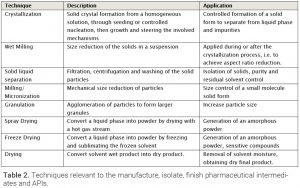
Particle engineering involves designing or modifying the solid form of a chemical entity—either by crystallizing from solution or altering an existing solid. For small molecule APIs, crystallization is the primary method to achieve desired purity and physical properties, while also enabling impurity rejection and isolation.
In some cases, techniques like freeze drying or spray drying are used to produce amorphous solids. Large crystals aid isolation, but fine particles often improve dissolution, requiring size reduction through milling or micronization. An overview of the most relevant particle engineering techniques is provided in Table 2.
Solid/liquid Separation
For particles with challenging shapes, pre-scale-up testing is essential to select suitable filter cloths and assess filter cake compressibility. Lab-scale pressure filtration at 0.5, 1, and 2 bar—ideally in transparent tubes—allows observation of sedimentation and collection of filtrate data over time. This enables evaluation of cake compressibility, resistance, and identification of issues such as cracking, funneling, or washing-related changes.
Drying
Production drying technologies—such as tumble, filter, paddle, and conical screw dryers—differ significantly from lab-scale tray vacuum ovens due to mechanical forces present at larger scales. To bridge this gap, mechanical stress tests or scale-up trials using lab-scale versions of production equipment are conducted to not miss out on residual solvent specifications (15). At Evonik, the Chemical Engineering group provides access to small scale equipment, like paddle dryers or agitated dryers at scales <50 L, enabling realistic evaluation of drying behavior under scaled down conditions.
Size Reduction Through Milling
Milling technology is selected based on particle size requirements, energy input, temperature control (including cryogenic conditions), throughput, and containment needs—especially the API’s occupational exposure limit (OEL). A broad range of milling options is available at both lab and production scale, allowing flexible adaptation to material and process demands.
Case Studies
Case Study 1: Formation of a Low Solubility Salt
Poor filterability is a common challenge in process R&D at CDMOs. Crystal shape and size can increase cake resistance, leading to long filtration times and poor impurity rejection—issues that often escalate at manufacturing scale.
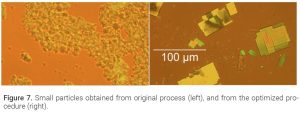
In one case, isolating an amine as a salt from the crude stream produced fine particles with slow filtration (Figure 7, left). Attempts to improve crystal size via seeding and adjusting addition rates failed. A breakthrough came by forming the salt from a purified free base solution, which enabled better crystal growth.
Further analysis showed impurities in the crude stream were inhibiting crystallization. Reversing the addition order—adding the crude base to the salt former solution—diluted impurities and allowed proper crystal formation (Figure 7, right), cutting filtration time by 50%.
Case Study 2: Hair-Like Particles Impede Filtration and Product Isolation
While small crystals can hinder filtration, thin, hair-like particles pose even greater challenges for isolation. In one case, a reactive crystallization at elevated temperature produced such particles, making centrifuge-based isolation impractical (Figure 8, left).
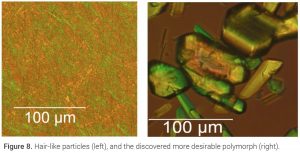
Polymorph screening identified a more favorable form (Figure 8, right), but conversion at temperatures down to 5 °C was too slow. Lowering the temperature below 0 °C significantly accelerated transformation. Aging the mixture under these conditions yielded large, filterable crystals, enabling efficient isolation and washing at production scale.
Case Study 3: Needle-like Particles in Cooling Crystallization
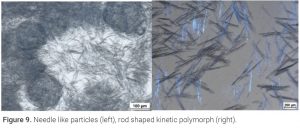
In this case study, cooling crystallization followed by aging at 5–10 °C produced needle-like particles with poor filtration and washing performance (Figure 9, left). Scaling the process required technical adaptations to maintain acceptable cycle times.
During process transfer, a rod-shaped kinetic polymorph was identified (Figure 9, right). It formed early in cooling but rapidly converted to the undesired needles below 40 °C. The preferred form showed fewer impurities and a flat solubility curve below 50 °C, prompting a process change: filtration was performed at 40–50 °C. This adjustment improved robustness and significantly enhanced filtration efficiency.
Summary
Crystallization and particle engineering are critical to the success of small molecule APIs, directly impacting solubility, bioavailability, and therapeutic efficacy. Overcoming challenges like poor solubility and filtration requires a deep understanding of particle properties and targeted engineering strategies.
This article highlights the interplay between solid form selection, crystallization techniques, and particle characteristics, emphasizing the value of a structured development workflow. Techniques such as crystallization and milling help tailor solid forms to meet performance and manufacturing requirements.
Advanced analytical tools enable precise monitoring and control, ensuring quality and consistency. In the case studies we have outlined real-world challenges and how these can be addressed. Success in particle engineering depends on cross-functional collaboration supported by the right analytical tools and expertise. As APIs become more complex, embracing these approaches will be essential for driving innovation and delivering high-quality therapies.
References and notes
- Bernstein J., Polymorphism in Molecular Crystals. Oxford University Press, New York, 2002, ISBN 0198506058.
- Chen J., Sarma B., Evans J.M.B., Myerson, A.S., Pharmaceutical Crystallization, Crystal Growth & Design, 2011: 887-895(11), doi: 10.1021/cg101556s
- Wu K, Kwon SH, Zhou X, Fuller C, Wang X, Vadgama J, Wu Y. Overcoming challenges in small-molecule drug bioavailability: a review of key factors and approaches. Int J Mol Sci. 2024;25(23):13121. doi:10.3390/ijms252313121.
- Singh D, Bedi N, Tiwary AK. Enhancing solubility of poorly aqueous soluble drugs: critical appraisal of techniques. J Pharm Investig. 2018;48:509–526. doi:10.1007/s40005-017-0357-1.
- Rate controlling processes in solvent-mediated phase transformations, Davey, R. J.; Cardew, P. T.; McEwan, D.; Sadler, D. E., Journal of Crystal Growth (1986), 79 (1-3, (Pt. 2)), 648-53CODEN: JCRGAE; ISSN:0022-0248.
- Myerson, Erdemir, Lee, Black, Crystallization in the pharmaceutical industry. Handbook of Industrial Crystallization 3rd Edt., 2019, 380-413, ISBN 9780521196185.
- Tung, H.H., Paul, E.L., Midler, M. and McCauley, J.A. (2009) Crystallization of Organic Compounds: An industrial Perspective. John Wiley & Sons Publishers, Hoboken. https://doi.org/10.1002/9780470447796
- Hilfiker, R., Raumer, M., Polymorphism in the Pharmaceutical Industry: Solid Form and Drug Development, 2018, VCH, DOI:10.1002/9783527697847
- Cruz-Cabeza A.,Lusi A., Wheatcroft H.P., Bond A.D., The role of solvation in proton transfer reactions: implications for predicting salt/co-crystal formation using the ΔpKa rule, Faraday Discuss., 2022,235, 446-466 doi:10.1039/D1FD00081K
- Brittain, H.G. (Ed.). (2009). Polymorphism in Pharmaceutical Solids (2nd ed.). CRC Press. https://doi.org/10.3109/9781420073225
- J. W. Mullin, “Crystallization,” 4th Edition, Butterworth- Heinemann, Oxford, 2001
- Cardew, Peter T. and Roger J. Davey. “The kinetics of solvent-mediated phase transformations.” Proceedings of the Royal Society of London. A. Mathematical and Physical Sciences 398 (1985): 415 – 428.
- Agrawal P, Rawal SH, Reddy VR, Viswanath SK, Merritt JM. Case studies in the application of a workflow-based crystallization design for optimized impurity rejection in pharmaceutical development. Org Process Res
- Dev. 2023;27(3):678–690. doi:10.1021/acs.oprd.2c00346
- Price, S.L., Reutzel-Edens, S.M., The potential of computed crystal energy landscapes to aid solid-form development, 2016, Drug Discovery Today, https://doi.org/10.1016/j.drudis.2016.01.014
- International Council for Harmonisation of Technical Requirements for Pharmaceuticals for Human Use (ICH). ICH Q3C(R8): Impurities: Guideline for Residual Solvents. Geneva: ICH; 2021. Available from: https://database.ich.org/sites/default/files/ICH_Q3C-R8_Guideline_Step4_2021_0422_1.pdf.

The Algorithmic Antagonist: Why AI is Pharma’s Newest Competitor

THE INTEGRATION IMPERATIVE: ADVANCING TIDES MANUFACTURING THROUGH BIOC...

PEER REVIEWED – Scaling Mechanochemistry via Continuous Bead Mil...

Difamilast

The Role of Workers and their Management Teams in Establishing and Mai...
A Bird’s-Eye View of Global Chemicals M&A

The evolving role of PGMs: sustainability in the market context

PEER REVIEWED – Catalytic Reactions in the Synthesis of Function...