
Introduction
Catalytic reactions play a crucial role in modern synthetic organic chemistry, particularly in the construction of π-conjugated frameworks for functional materials. These methodologies enable the efficient formation of carbon–carbon (C–C) and carbon–heteroatom (C–X) bonds under relatively mild conditions, offering broad functional group tolerance and high synthetic versatility (1–4). In the field of optoelectronics, including organic light-emitting diodes (OLEDs), organic photovoltaics (OPVs), and organic field-effect transistors (OFETs), precise molecular design is essential for tuning electronic structures, optical bandgaps, and charge-transport properties (5). Consequently, catalytic coupling reactions have become indispensable tools for tailoring donor–acceptor architectures, extending π-conjugation, and modulating frontier molecular orbitals to meet device-specific performance requirements (5).
This paper provides a comprehensive overview of key catalytic methodologies, including Suzuki–Miyaura, Buchwald–Hartwig, Sonogashira, Stille, Kumada–Tamao–Corriu, and Ullmann reactions, that are essential for the synthesis of optoelectronic materials (2,5). Selected recent studies demonstrate how these approaches enable precise control over molecular architecture and device-relevant properties. In addition, to highlight synthetic advances, this review briefly considers the practical challenges associated with translating these catalytic methodologies from laboratory-scale synthesis to industrial production of semiconductor-grade materials.
Suzuki–Miyaura Cross-Coupling
The Suzuki-Miyaura Coupling (SMC) stands as a foundational reaction in the field of synthetic organic chemistry, holding exceptional significance in the development of materials for optoelectronic devices (5). Its importance stems from its capacity to form robust C−C bonds between various aryl and heteroaryl moieties, typically mediated by transition metal catalysts such as palladium, sometimes under relatively mild conditions, exhibiting remarkable tolerance for diverse functional groups (6,7). In optoelectronic applications, SMC is mainly used to extend π-conjugation, which controls the electronic and optical properties of the materials. It also allows easy tuning of these properties by coupling different boronic acids or esters with various aryl halides. In addition, SMC enables the introduction of electron-donating or electron-withdrawing groups at a late stage, which is important for adjusting HOMO and LUMO energy levels to meet device requirements. Finally, this reaction helps control molecular shape and solid-state packing, both of which affect device performance (5).
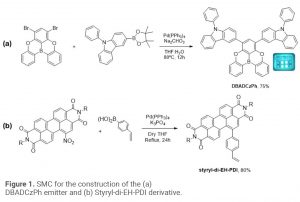
Early in 2025, Barman and coworkers made use of this reaction to design an extended multi-resonance charge-transfer (MRCT) emitter, DBADCzPh, with thermally activated delayed fluorescence (TADF) properties (8). The key synthetic step involved a highly efficient, late-stage Suzuki-Miyaura cross-coupling reaction. This reaction used a dibromo-substituted core and phenylcarbazole boronic pinacol ester. The C−C bond formation was achieved using Pd(PPh3)4 and Na2CHO3, in a THF:H2O solvent system at 80 °C over 12 hours. This final step yielded the DBADCzPh emitter in a 75% yield (Figure 1(a)). The compound exhibited exceptional electroluminescence performance in OLED devices, achieving a record-high External Quantum Efficiency (EQEmax) of 42.5%, a very high maximum luminance (Lmax) of 101,000 cd m−2, and pure sky-blue emission (8). Despite these promising results, the use of silica gel chromatography with a hexane/dichloromethane eluent system to purify the emitter, represents a potential limitation for large-scale production. Chromatographic purification is rarely compatible with industrial manufacturing due to its high solvent consumption, operational cost, and the generation of significant volumes of hazardous waste.
The potential of SMC for the synthesis of organic electronic molecules was also explored by Aivali and co-workers, who demonstrated a synthetic strategy to develop versatile perylene diimide (PDI) building blocks, including the derivative styryl-di-EH-PDI (9). The authors implemented a non-conventional Suzuki-Miyaura cross-coupling where a nitro group at the bay position of the PDI core acted as the leaving group, replacing traditional halides. This transformation involved the use of Pd(PPh3)4, K3PO4 and anhydrous THF under reflux for 24 hours. The C–C bond was successfully formed with a satisfactory yield of 80% (Figure 1(b)). The resulting styryl-di-EH-PDI serves as a versatile building block and a functional small molecule for OPVs. It exhibits a low-lying LUMO level of −3.84 eV and broad visible light absorption, making it a promising non-fullerene acceptor (NFA) for high-efficiency solar energy conversion (9). Precipitation-based isolation was used to obtain styryl-di-EH-PDI, representing a more scalable and practical alternative to chromatographic purification from an industrial perspective. This approach can significantly reduce solvent consumption and simplify downstream processing. However, simple filtration through celite may not fully remove soluble palladium species, and additional purification strategies may therefore be required to minimize residual metal impurities in the final semiconductor material. Various industrial methods exist, like the use of scavenger resins (see below).
Buchwald–Hartwig Amination
The Buchwald–Hartwig Amination (BHA) is a powerful palladium-catalyzed cross-coupling strategy used to form C–N bonds between aryl halides and primary or secondary amines (10). Unlike traditional nucleophilic aromatic substitution, BHA operates under broader conditions and exhibits high tolerance for diverse functional groups, making it indispensable for the construction of nitrogen-containing π-conjugated systems (10). In the field of optoelectronics, BHA is the premier method for introducing arylamine moieties. These units are critical for enhancing the hole-transporting capabilities of materials and fine-tuning the HOMO levels (5). Furthermore, BHA is frequently utilized to develop donor–acceptor architectures, which are essential for achieving TADF and high-efficiency charge transfer in organic devices (5,11).
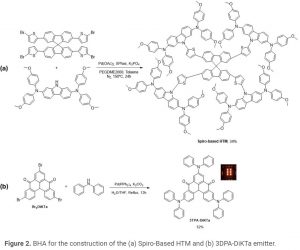
In 2022, Ghiglietti and colleagues demonstrated the power of the BHA in creating advanced hole-transporting materials (HTMs) for perovskite solar cells (12). The synthesis of the Spiro-based HTM, which proved to be the most effective derivative in the study, relied on a highly efficient, final-stage palladium-catalyzed amination of a 2,2’,7,7’-tetrakis(5-bromothiophen-2-yl)-9,9’-spirobifluorene core, using Pd(OAc)2 and XPhos to facilitate the coupling of the sterically hindered thiophene-substituted spiro-core with the carbazole donor units. By performing the reaction with K3PO4 and a PEG 2000 dimethyl ether/toluene mixture as the solvent system at 150 °C, the group successfully achieved the target compound with an isolated yield of 34% (Figure 2(a)). In solar devices, the Spiro-based HTM enabled a Power Conversion Efficiency (PCE) of 22.1%, outperforming the commercial standard Spiro-OMeTAD and showing superior long-term thermal stability (12).
Later in 2023, Xing-Guo Han and co-workers harnessed the BHA to develop the high-performance red narrowband emitter 3DPA-DiKTa (13). The key synthetic step in-volved the late-stage installation of donor units onto a rigid B-N framework to create a multi-resonant TADF system. The reaction coupled a tri-brominated precursor with diphe-nylamine using Pd2(dba)3 as the catalyst and P(t-Bu)3 as the ligand. By conducting the reac-tion with NaOtBu as the base in toluene at 110 °C for 12 hours, the triple C–N bond for-mation was successfully achieved with an isolated yield of 62% (Figure 2(b)). The resulting 3DPA-DiKTa emitter exhibited exceptional electroluminescence performance in red OLED devices, achieving an EQE of 21.6% and a Lmax of 16,100 cd m⁻², maintaining a sharp emission profile even in the red region (13).
While these studies highlight the effectiveness of Buchwald–Hartwig amination for constructing advanced optoelectronic materials, these reactions rely on palladium catalysts in combination with sophisticated phosphine ligands. From an industrial perspective, the cost of these catalytic systems, together with the relatively high reaction temperatures frequently required, may present challenges for large-scale implementation. Additionally, both protocols relied on silica gel chromatography for purification, which, as discussed previously, represents a significant barrier to industrial scale-up.
Sonogashira Coupling
The Sonogashira Coupling is a premier palladium-catalyzed and copper co-catalyzed methodology that enables the formation of C–C bonds between terminal alkynes and aryl or vinyl halides (14). This reaction is highly valued for its ability to proceed under mild conditions, often at room temperature, which is advantageous from an industrial perspective, while maintaining exceptional functional group tolerance. In the context of optoelectronic devices, the Sonogashira reaction is uniquely employed to incorporate -C≡CH spacers into π-conjugated frameworks (5, 14). These alkyne linkages provide a rigid, linear geometry that extends conjugation without the steric hindrance often associated with direct aryl–aryl bonds (5). This structural rigidity allows for precise control over molecular planarity, which is vital for enhancing charge-carrier mobility and managing the optical bandgap of high-performance electronic materials (5).
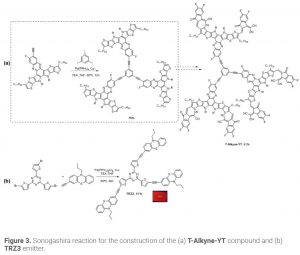
In 2025, Fan Yang and co-workers demonstrated the critical role of the Sonogashira coupling in constructing the core intermediates for a new class of high-performance oligomerized electron acceptors (15). The synthesis implemented the coupling of alkyne-substituted Y-type precursors with multi-substituted iodobenzenes to create alkynyl-linked oligomeric frameworks, such as the intermediate for T-Alkyne-YF. This transformation was catalyzed by Pd(PPh3)4 and CuI in a mixture of TEA and THF at 50 °C for 12 hours, affording the product with 75% of yield (Figure 3 (a)). By using this method, the researchers were able to ensure high molecular planarity and suppress electron-phonon coupling in the final assembled structures. After the final end-capping steps, the resulting T-Alkyne-YF acceptor achieved an outstanding PCE of 19.52%, proving that Sonogashira-mediated intermediate synthesis is an essential strategy for achieving low energy loss in organic solar cells (15).
In the same year, Carlotti et al. demonstrated a strategic molecular design to achieve efficient red TADF by using alkyne-bridged push-pull systems (16). The synthesis of the dipolar emitter TRZ3 achieved via a Sonogashira coupling as the final step to link a phenothiazine donor to a trithienyltriazine acceptor core. The reaction was performed using Pd(PPh3)2Cl2 and CuI in a triethylamine/THF mixture at 60 °C, affording the product with 67% of yield (Figure 3 (b)). The introduction of the rigid triple-bond spacer was crucial, as it increased molecular conjugation and facilitated a small singlet-to-triplet energy gap (ΔEST). These structural features allowed TRZ3 to exhibit a long-lived delayed emission component. This study highlights that the Sonogashira coupling is a powerful tool for constructing compact, high-performance emitters capable of orange-to-deep-red electroluminescence, which remains a significant challenge in third-generation OLED technology (16).
Despite its synthetic versatility and relatively mild reaction conditions, translating Sonogashira methodologies from laboratory-scale synthesis to industrial production requires careful consideration of catalyst management and the efficient removal of residual metal species.
Stille Coupling
The Stille coupling (SC) reaction is a widely utilized palladium-catalyzed cross-coupling methodology involving organic electrophiles and organostannanes (17). It provides a reliable approach for the formation of strong C–C bonds between diverse aryl and heteroaryl building blocks. Owing to its high functional group tolerance and efficiency, SC has been extensively applied in the synthesis of π-conjugated systems. In the context of optoelectronic devices, the reaction is primarily employed to extend π-conjugation, thereby enabling fine control over the electronic and optical properties of the resulting materials (18).
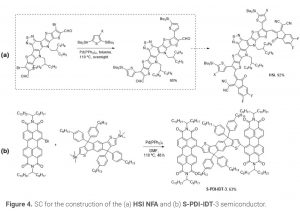
In 2025, Peng et al. reported the development of NFAs through a synthetic strategy involving the SC of bromoaldehyde-functionalized two-dimensional side chains with thiophene derivatives, followed by a Knoevenagel condensation (19). The key C–C bond formation was achieved using Pd(PPh₃)₄ in toluene at 110 °C overnight, affording the intermediate product in high yield (90%) (Figure 4(a)). Subsequent Knoevenagel condensation led to the final NFAs, including HSi compound. When incorporated into organic solar cells, HSi compound exhibited balanced crystallinity and molecular stacking, resulting in reduced non-radiative energy losses (0.172 eV), a high open-circuit voltage (VOC) of 0.940 V, and a PCE of 19.56% (19).
Also in 2025, Yang and coworkers reported the synthesis of PDI–based molecules via a SC strategy involving brominated PDI derivatives and various indacenodithiophene stannanes (20). The key C–C bond formation was carried out using Pd(PPh₃)₄ in DMF at 110 °C for 48 h, affording the target compounds in good yields, up to 63% (Figure 4(b)). The resulting materials were processed as thin films and employed as active layers in OFETs to evaluate their charge-transport properties. All compounds exhibited good thermal stability and typical n-type semiconducting behaviour. Compound S-PDI-IDT-3 exhibited a maximum electron mobility of 2.09 × 10⁻¹ cm² V⁻¹ s⁻¹ (20).
Although the Stille reaction is widely valued for its robustness and broad functional-group tolerance, its application in large-scale synthesis raises important environmental and practical considerations. In particular, the use of organotin reagents generates toxic and environmentally persistent byproducts that require careful handling and disposal (17). Furthermore, purification in many reported protocols relies on silica gel chromatography, which, as discussed previously, represents a significant limitation for industrial implementation.
Kumada-Tamao–Corriu Couplings
The Kumada–Tamao–Corriu cross-coupling (KTCC), first reported in 1972, represents one of the earliest palladium- or nickel-catalyzed cross-coupling reactions (21). This transformation involves the coupling of Grignard reagents with alkyl, vinyl, or aryl halides, typically under nickel catalysis, offering an economically attractive and efficient approach to C–C bond formation. However, the high reactivity of organomagnesium reagents imposes limitations on functional-group compatibility, restricting the substrate scope. Despite these constraints, KTCC has found application in the synthesis of π-conjugated systems, particularly when suitable functional groups are employed. In the field of optoelectronics, the reaction has been utilized to extend π-conjugation, thereby enabling modulation of the electronic and optical properties of organic semiconducting materials (5).
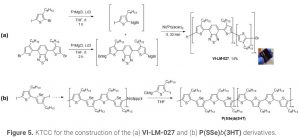
In 2021, De Rossi et al. reported the synthesis of modified poly(3-hexylthiophene)/benzothiadiazole polymers, resorting to the greener Nickel-catalyzed Kumada polycondensation instead of the previously used SC polymerization method (Figure 5(a)) (22). The resulting products were further studied as hole transport layers for flexible perovskite solar cells. The module endowed VI-LM-027 delivered a PCE close to 7% on an active area of 16 cm2 (22).
Later, in 2025, Cheng and coworkers reported the synthesis of sequence-controlled polychalcogenophene polymers via KTCC, employing diiodobichalcogenophene monomers that were first activated through Grignard metathesis, followed by nickel-catalyzed polymerization (Figure 5 (b)) (23). The resulting polymers were processed via spin coating and employed as active layers in OFETs to evaluate their charge-transport properties. All compounds exhibited good thermal stability and typical n-type semiconducting behaviour. Notably, P(SSe)b(3HT) exhibited the highest hole mobility of 4.4 x 10⁻2 cm² V⁻¹ s⁻¹ and an on/off current ratio (Ion/Ioff) of 1.2 x 10² (23).
Notably, in both examples the materials were isolated via simple filtration, representing a practical advantage over chromatographic purification from an industrial perspective. In addition, the use of nickel catalysis offers economic benefits due to the lower cost and greater abundance of nickel compared to palladium-based systems. However, the verification of residual metal levels was not reported, leaving the potential influence of catalytic residues on device performance unclear.
Ullmann Reaction
Ullmann coupling (UC) is a common coupling method, it is a copper-mediated reaction of aryl halides that is traditionally divided into two categories: (a) the classical Ullmann reaction, involving homocoupling of aryl halides to form biaryl compounds, and (b) Ullmann-type couplings, which enable cross-coupling between aryl halides and various nucleophiles to generate C–C and C–heteroatom bonds (24). In optoelectronic applications, UC is particularly valuable for extending π-conjugation, thereby allowing precise tuning of the electronic and optical properties of the resulting materials.
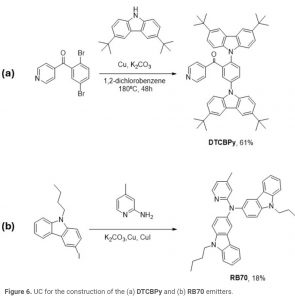
In 2025, Rajamalli and co-workers demonstrated the potential of the UC for the synthesis of TADF emitters, specifically DTCBPy (25). The key synthetic step involved the -arylation of carbazole units onto a (4-bromophenyl)(pyridin-4-yl)methanone core. This transformation was implemented using copper powder and K2CO3. By conducting the reaction at 180 °C, the researchers successfully achieved the target emitter (61% of yield) (Figure 6 (a)), which exhibited exceptional performance in green OLED devices. The resulting DTCBPy-based device reached a record-high EQE of 27.2% (25).
In 2025, Beresnevičiūtė et al. employed this reaction in the synthesis of carbazolyl- and pyridinyl-containing derivatives as potential materials for OLEDs (26). The key C–N bond formation between the pyridinyl and carbazolyl moieties was achieved using CuI and K₂CO₃ in DMF under reflux for 24 hours. This reaction led to the desired compound RB70 in 18% yield (Figure 6(b)). The resulting RB70 compound was tested in OLED devices and presented an EQEmax of 8.1% and a Lmax of 10,800 cd m−2, and green emission (26).
While copper-mediated Ullmann-type couplings represent an attractive alternative to palladium-catalyzed cross-couplings due to the lower cost and greater natural abundance of copper, their application in the synthesis of semiconductor-grade materials requires careful consideration of purification strategies. From an industrial perspective, replacing expensive palladium catalysts and avoiding the toxic organotin byproducts associated with Stille chemistry aligns well with the economic and environmental goals of large-scale manufacturing. However, residual copper species can act as deep charge traps and efficient quenchers within π-conjugated compounds. Unlike palladium, which often precipitates as distinct black particles, copper can remain coordinated to heteroatom-containing motifs, making its complete removal more challenging and often requiring specialized purification strategies beyond simple filtration (like, charcoal, scavenger resins etc).
Industrial Considerations in the Synthesis of Optoelectronic Materials
While transition-metal catalyzed cross-coupling reactions are indispensable for extending π-conjugation and tailoring donor–acceptor architectures, a major challenge in translating these methodologies to industrial applications is the management of metal purity. In the synthesis of materials for optoelectronic devices, such as OLEDs, OPVs, and OFETs, the complete removal of organometallic residues remains a critical obstacle. Trace transition metals, such as the palladium, copper, and nickel catalysts frequently used in the aforementioned methodologies, can remain within the final organic frameworks. If not completely eliminated, these metal residues can act as traps that disrupt the precisely tuned electronic structures and charge-transport properties essential for high device performance (27–29).
Addressing these impurities highlights a significant bottleneck: the disparity between laboratory-scale purification and industrial viability. In academic research, laboratory techniques such as silica gel column chromatography are routinely employed to isolate the synthesized optoelectronic materials and reduce metal contamination (30). However, this methodology does not translate effectively to large-scale industrial processes. Column chromatography is highly labour-intensive, generates massive volumes of solvent waste, and can lead to batch-to-batch inconsistencies (31). Consequently, relying on such techniques poses a severe limitation for the commercial manufacturing of organic electronics, where achieving reproducible, “semiconductor-grade” purity is non-negotiable.
To bridge the gap between laboratory synthesis and commercial application, the design of the next generation of organic optoelectronic materials must explicitly account for these industrial constraints. Future developments must not only focus on precise control over molecular architecture but also prioritize scalable synthetic strategies. This includes the development of easily removable heterogeneous catalysts, ultra-low catalyst loading protocols, and scalable purification techniques, such as the use of functionalized metal scavengers and large-scale vacuum sublimation, to ensure the complete and efficient removal of metal residues (32). In this regard, the field can draw significant inspiration from the pharmaceutical industry, where rigorous controls over residual metals are mandatory. Similar to pharmaceutical manufacturing, where filtration, adsorption, extraction, and scavenging are routinely combined to meet strict safety standards, the organic electronics industry must adopt these combinatorial purification strategies to achieve the semiconductor-grade purity required for high-performance devices (33).
Conclusion
Catalytic reactions remain the cornerstone of synthetic strategies for advanced optoelectronic materials, providing the high functional group tolerance and efficiency required for complex molecular architectures. Throughout this paper, the distinct roles of various methodologies have been highlighted: from the foundational Suzuki–Miyaura and Stille couplings used for robust C–C bond formation to the Buchwald–Hartwig amination and Ullmann reactions essential for constructing nitrogen-containing donor–acceptor systems. Furthermore, the Sonogashira coupling and Kumada–Tamao–Corriu cross-coupling also offer unique advantages in incorporating rigid alkyne spacers and utilizing earth-abundant catalysts (important from an economic standpoint) respectively. As demonstrated by recent reports, these reactions have enabled the synthesis of materials achieving record-high EQE exceeding 40% and PCE near 20%. Nevertheless, the translation of these metal-based catalytic methodologies from laboratory-scale synthesis to industrial production remains an important challenge. In particular, catalyst cost, purification strategies, and the efficient removal of residual metal species must be carefully controlled to ensure the production of semiconductor-grade materials for optoelectronic applications. Metal contamination of optoelectronic devices is an important issue, as metal ions introduce unwanted electronic states inside the bandgap of semiconductors, perovskites, or OLED materials. Even partspermillion levels can cause measurable losses in efficiency. In the case of organic semi-conductors, transition metals quench fluorescence and phosphorescence, and device lifetime drops sharply due to accelerated chemical degradation. Thus, removing metal contaminants will improve: efficiency (higher luminescence, better charge transport), stability, lifetime (less degradation), reproducibility (consistent device performance), safety (reduced heavymetal presence) and regulatory compliance (especially for consumer electronics).
Moving forward, the continued refinement of these catalytic tools will be vital for addressing current challenges in the production of the next generation of optoelectronic devices. With the amazing advances already been made in the field of AI and particularly natural language models it should be possible to select the most efficient and sustainable catalytic routes to these compounds in the coming years.
Acknowledgements
We thank the Fundação para a Ciência e a Tecnologia (FCT) for funding through the project 2022.01391.PTDC (ConChiMOL – New Structurally Contorted and Chiral Molecules for Optoelectronic Applications) (https://doi.org/10.54499/2022.01391.PTDC). We also acknowledge funding from the Coimbra Chemistry Centre (CQC), supported by the FCT through projects UIDB/00313/2025 and UIDP/00313/2025 (national funds), and the Institute of Molecular Sciences (IMS) (LA/P/0056/2020, DOI: 10.54499/LA/P/0056/2020) through special complementary funding from the FCT. Ana C. Amorim acknowledges the FCT for the Ph.D. Grant 2021.04769.BD.
References and notes
- Biffis A, et al. Pd Metal Catalysts for Cross-Couplings and Related Reactions in the 21st Century: A Critical Review. Chem Rev. 2018;118(4):2249–95.
- Kumar S, et al. A Decade of Exploration of Transition-Metal-Catalyzed Cross-Coupling Reactions: An Overview. SynOpen. 2023;07(04):580–614.
- Ayogu JI, Onoabedje EA. Recent advances in transition metal-catalysed cross-coupling of (hetero)aryl halides and analogues under ligand-free conditions. Catal Sci Technol. 2019;9(19):5233–55.
- Biscoe MR, et al. From Established to Emerging: Evolution of Cross-Coupling Reactions. J Org Chem. 2024;89(22):16065–9.
- Zani L, et al. Transition metal-catalyzed cross-coupling methodologies for the engineering of small molecules with applications in organic electronics and photovoltaics. Coord Chem Rev. 2019;392:177–236.
- Miyaura N, Suzuki A. Palladium-Catalyzed Cross-Coupling Reactions of Organoboron Compounds. Chem Rev. 1995;95(7):2457–83.
- Kadu BS. Suzuki–Miyaura cross coupling reaction: recent advancements in catalysis and organic synthesis. Catal Sci Technol. 2021;11(4):1186–221.
- Barman D, Tsuchiya Y, Adachi C. Horizontally oriented MRCT-type TADF emitter achieving EQE over 40% for Sky-Blue OLED. Nat Commun. 2025;16:5023.
- Aivali S, et al. Synthesis and Optoelectronic Characterization of Perylene Diimide-Quinoline Based Small Molecules. Molecules. 2019;24(23):4406.
- Heravi MM, et al. Buchwald-Hartwig reaction: An overview. J Organomet Chem. 2018;861:17–104.
- Chen Q, et al. Highly efficient blue TADF emitters incorporating bulky acridine moieties and their application in solution-processed OLEDs. Dyes Pigm. 2021;188:109157.
- Ghiglietti E, et al. An efficient Buchwald–Hartwig amination protocol enables the synthesis of new branched and polymeric hole transport materials for perovskite solar cells. Energy Adv. 2022;1(6):398–401.
- Wu S, et al. Highly Efficient Green and Red Narrowband Emissive Organic Light‐Emitting Diodes Employing Multi‐Resonant Thermally Activated Delayed Fluorescence Emitters. Angew Chem Int Ed. 2022;61(48):e202213697.
- Kanwal I, et al. Palladium and Copper Catalyzed Sonogashira cross Coupling an Excellent Methodology for C-C Bond Formation over 17 Years: A Review. Catalysts. 2020;10(4):443.
- Yang F, et al. Oligomerized Electron Acceptors with Alkynyl Linkages to Suppress Electron‐Phonon Coupling for Low‐Energy‐Loss Organic Solar Cells. Angew Chem Int Ed. 2025;64(8):e202501302.
- Mancini P, et al. Pursuing red thermally activated delayed fluorescence upon increasing the degree of branching in phenothiazine-trithienyltriazine push–pull compounds. J Mater Chem C. 2026;14:833–44.
- Cordovilla C, et al. The Stille Reaction, 38 Years Later. ACS Catal. 2015;5(5):3040–53.
- Amna B, et al. Recent developments in the synthesis of regioregular thiophene-based conjugated polymers for electronic and optoelectronic applications using nickel and palladium-based catalytic systems. RSC Adv. 2020;10(71):43222–96.
- Wang H, et al. Fine-tuning non-fullerene acceptors with halogenation and silicon incorporation for high-performance organic solar cells. Chem Commun. 2025;61(93):15199–202.
- Cao J, et al. Synthesis, characterization and OFET performance of A–D–A semiconducting small molecules functionalized with perylene diimide groups. J Mater Chem C. 2025;13(31):11427–37.
- Tamao K, Sumitani K, Kumada M. Selective carbon-carbon bond formation by cross-coupling of Grignard reagents with organic halides. Catalysis by nickel-phosphine complexes. J Am Chem Soc. 1972;94(12):4374–6.
- De Rossi F, et al. Modified P3HT materials as hole transport layers for flexible perovskite solar cells. J Power Sources. 2021;494:229735.
- Xue Y, et al. Regioregular Alternating Polychalcogenophenes‐Block‐Poly(3‐hexylthiophene): Synthesis, Structural Characterizations, Molecular Properties, and Transistors. Chem Asian J. 2025;20(3):e202500277.
- Yang Q, Zhao Y, Ma D. Cu-Mediated Ullmann-Type Cross-Coupling and Industrial Applications in Route Design, Process Development, and Scale-up of Pharmaceutical and Agrochemical Processes. Org Process Res Dev. 2022;26(6):1690–750.
- Rajamalli P, et al. A New Molecular Design Based on Thermally Activated Delayed Fluorescence for Highly Efficient Organic Light Emitting Diodes. J Am Chem Soc. 2016;138(2):628–34.
- Beresneviciute R, et al. Carbazolyl Electron Donor and Pyridinyl Electron Acceptor Containing Derivatives as Potential Host Materials for Green Organic Light-Emitting Diodes. Molecules. 2025;30(9):1911.
- Wang W, et al. Revealing the Effect of Ionic Traps on Photovoltaic Performance of Organic Semiconductor Materials. CCS Chem. 2025;7(8):2432–40.
- Kosco J, et al. The Effect of Residual Palladium Catalyst Contamination on the Photocatalytic Hydrogen Evolution Activity of Conjugated Polymers. Adv Energy Mater. 2018;8(33):1802181.
- Sachs M, et al. Tracking Charge Transfer to Residual Metal Clusters in Conjugated Polymers for Photocatalytic Hydrogen Evolution. J Am Chem Soc. 2020;142(34):14574–87.
- Nitti A, et al. Direct Arylation Strategies in the Synthesis of π-Extended Monomers for Organic Polymeric Solar Cells. Molecules. 2016;22(1):21.
- Burke DJ, Lipomi DJ. Green chemistry for organic solar cells. Energy Environ Sci. 2013;6(7):2053–66.
- Grant TM, et al. Synthetically facile organic solar cells with >4% efficiency using P3HT and a silicon phthalocyanine non-fullerene acceptor. Mater Adv. 2021;2(8):2594–9.
- Burke AJ, et al., editors. Active Pharmaceutical Ingredients in Synthesis: Catalytic Processes in Research and Development, Wiley; Weinheim, Germany, 2018.

The evolving role of PGMs: sustainability in the market context

The Algorithmic Antagonist: Why AI is Pharma’s Newest Competitor

THE INTEGRATION IMPERATIVE: ADVANCING TIDES MANUFACTURING THROUGH BIOC...

PEER REVIEWED – Scaling Mechanochemistry via Continuous Bead Mil...

Difamilast

The Role of Workers and their Management Teams in Establishing and Mai...

PEER REVIEWED – Crystallization and Particle Engineering – The H...
A Bird’s-Eye View of Global Chemicals M&A