Introduction
One common theme shared by many pharmaceutical innovators, Contract Manufacturing Organizations (CMO’s) and generic companies, is the possible handling of several different drug substances/products within shared facilities and equipment.
Innovators may handle several different compounds with certain unknown properties that may include a high level of toxicity, which may not be fully understood for many years. CMO’s and generics have access to more information within the public domain, however with the increasingly competitive landscape to be the ‘first to file’ within new commercial markets, they may begin handling products before their toxicological profiles have been adequately characterized.
For those such instances, Health-Based Exposure Limits (HBELs) including the Acceptable Daily Exposure (ADE) and Occupational Exposure Limit (OEL) may not be clearly defined without a significant level of uncertainty (1).
Once a new product is to be manipulated within a shared GMP facility where other products may be handled, a toxicological assessment including HBEL derivation and cross-contamination risk assessment are regulatory requirements (2, 3). According to PIC/S (4), a quality Risk Management process, which includes a potency and toxicological evaluation, should be used to assess and control the cross-contamination risks presented by the products manufactured.
ISPE’s Risk MaPP (5) describes the various modes of cross-contamination. For the purposes of this article, the mode of retention – defined as carry-over on product-contact parts which have not been adequately cleaned, is considered, whereby the ADE is used to help establish cleaning limits, with the following equation (1):

The MSC is then used for the calculation of the maximum safe residue, which takes into account the shared equipment surface areas between products A and B.
Several risk management tools are used within the pharmaceutical industry. ISPE and ICH have published guidelines which describe practical risk assessment tools including Failure Mode and Effects Analysis (FMEA) (5,6).
A possible Cross-Contamination Risk Assessment approach
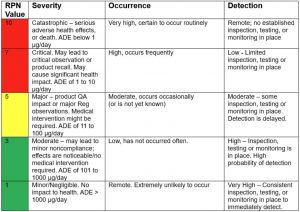
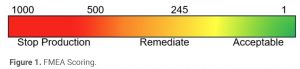
Presented below is a possible scenario of a cross-contamination risk assessment using an FMEA approach, whereby the Risk Priority Number (RPN) is the product of severity, occurrence, and detection. Consider the following proposed scoring (Figure 1).
Consider a simplified hypothetical scenario for a small modern multi-product, shared fill-finish sterile facility, with the following configuration, including (Figure 2):
- a grade C weighing and manufacturing room equipped with the following controls:
– isolator designed for weighing powders, which operates under a negative differential pressure, relative to the room
– a floor-to-ceiling hood within which the compounding step occurs. The hood offers a strong local exhaust ventilation (LEV) and negative differential pressure, relative to the room
– a Personnel Airlock (PAL) shared with a Material Airlock (MAL) with a ‘bubble’ configuration, which is positively pressured relative to the room and to the connecting Grade C corridor
– the room is itself negatively pressured relative to the PAL/MAL - a separate Grade C room within which an aseptic vial filling isolator complete with lyophilizer (Lyo) are located, which also includes an integrated capping station and external vial washer (EVW). The room is also equipped with:
– a shared PAL/MAL IN with a ‘bubble’ configuration, which is positively pressured relative to the room and to the connecting Grade C corridor.
– a shared PAL/MAL OUT with a ‘bubble’ configuration, which is positively pressured relative to the room and to the connecting Grade C corridor.
– the room is itself negatively pressured relative to the PAL/MAL
– The isolator and integrated connections including lyo are Grade A and are thus positively pressured relative to the room
– There is no open handling within the room - A grade C corridor connects the 2 rooms
- There is never more than one product in each room at a time.
The following products are handled within the facility (Table 1).
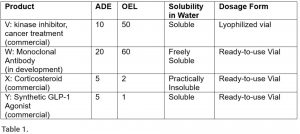
For each product, a formal toxicological assessment has been completed and all products are already commercialized except for biosimilar product W, which is in late-stage development, and is considered comparable to an existing commercially available monoclonal antibody produced by another pharmaceutical company.
For simplicity, consider that the batch sizes and maximum daily doses are all comparable for each of the existing products.
Process Flows
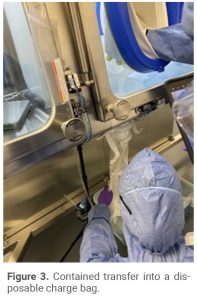
For Products V, X and Y, the Active Pharmaceutical Ingredients (API’s) are all received as non-sterile powders. Weighing of each API is conducted within the weighing isolator using a disposable scoop, to which a disposable charge bag is connected via a single use split butterfly valve (SBV). Weighed API is transferred into the charge bag via a disposable funnel. See image below:
The disposable charge bag is then disconnected from the isolator and connected to a manufacturing vessel using another SBV connection, within the floor-to-ceiling hood, where the API is transferred into the vessel in a contained manner, while undergoing mixing with other excipients and Water for Injection (WFI).
For the steps described above, operators are wearing appropriate PPE, and successful containment performance assessments (7) have already been completed.
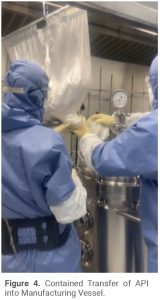
Following transfer of the API, the charge bag is removed from the manufacturing vessel and the rest of the mixing step is completed within the hood.
The vessel is then sealed and all exterior surfaces manually wiped using a cloth soaked with WFI and dilute alcohol, before removing from the hood. Operators remove any possibly contaminated gowning within the PAL/MAL and then bring the vessel into the corridor. They then enter the filling room through the PAL/MAL. The vessel is positioned to the right of the filling isolator. Sterilization by filtration then occurs after single use lines have been connected between the vessel and the interface of the isolator in a contained manner. Filling into vials is done within the isolator, before either entering the lyophilizer or progressing onto capping followed by external vial washing within the isolator, before exiting as sealed vials which are then collected for subsequent downstream activities in another room.
Product W is received as a pre-formulated drug substance in liquid form within a sterile bag. There is no weighing and the API is transferred using aseptic connections into a single use mixing vessel within the hood in a fully contained manner. The vessel is then transported into the filling room and subsequent sterilization by filtration and filling within the isolator as described above. All product-contact parts or equipment are either single-use or product-dedicated.
Robust procedures are in place for line clearance and cleaning in between products.
Risk Analysis
For Products V, X, and Y, consider that the same manufacturing vessel has been used, although other product-contact parts are either single-use or specific product-dedicated. Since products X and Y have the same ADE, a cleaning matrix has been developed whereby product X has been defined as the worst case and the cleaning has been appropriately validated with swabs.
For Product W, although it is a biosimilar monoclonal antibody, since it is freely soluble, there is no open processing, the product is received already in liquid form, and all product-contact parts are either single-use or product dedicated, there are no obvious cross-contamination risks.
Addition of a new worst-case product
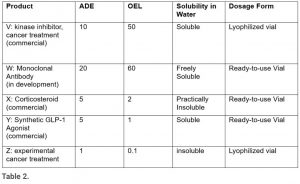
Consider the addition of a new product Z, an experimental new cancer treatment which has shown potential in early-phase clinical studies, however it has also tested positive in an Ames test, implying mutagenicity and possible genotoxicity. There is not enough human clinical data to determine robust HBELs without significant uncertainty. For such a scenario, the Threshold of Toxicological Concern (TTC) approach may be applied whereby the ADE is assigned as 1 µg/day (1,8), at least until robust human clinical data is available. In addition, product Z is insoluble and is being developed as a lyophilized vial and thus represents a new worst case.
The product list now becomes (Table 2),
The company is considering using the same manufacturing vessel as that used for products V, X and Y, however they haven’t yet developed an adequately sensitive analytical method for determining the amount of any residual product Z following cleaning.
Thus a possible cross-contamination risk assessment for retention may be (Table 3).
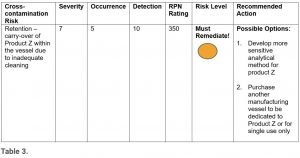
The possible options both have advantages and disadvantages. Option 1 will require significant time and resources, although might be possible to complete before a new manufacturing vessel could be purchased, received, and ready-for use. However, proceeding with Option 1 would still have 2 residual risks:
The method might show unacceptable residues of product Z remaining following cleaning. Additional cleaning will be necessary, and it’s possible that numerous iterations may be required before the equipment could be released for use with other products.
The ADE might end up being revised to be much lower than the TTC of 1 µg/day if future clinical data were to demonstrate significant toxicity at lower doses. This would not only force lower acceptable residual surface limits on the equipment following cleaning, but would also raise concerns that an unacceptable possible cross-contamination may have occurred if the equipment were to have already been used for any of products V, X and Y. The risk assessment then becomes (Table 4).
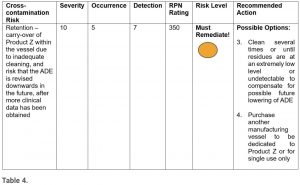
The obvious lowest risk approach would be to acquire a new manufacturing vessel, to be used for Product Z. This would be the best way to reduce the cross-contamination risk to an acceptable level, without impacting the other products produced within the facility.
Conclusion
Although there may be some subjectivity involved when establishing the RPN scoring criteria and assessing risks, the scenario presented above demonstrates how FMEA can be a useful risk management tool, possibly helping drive decision-making and investments, and ultimately lead to safer production through robust cross-contamination control, taking into account the toxicity of the products being handled within a shared facility.
References and notes
- Hayes, E.P. et al. A harmonization effort for acceptable daily exposure application to pharmaceutical manufacturing – Operational considerations. Regulatory Toxicology and Pharmacology, Volume 79, Supplement 1, 15 August 2016
- PIC/S. Guideline on Setting Health Based Exposure Limits for use in Risk Identification in the Manufacture of Different Medicinal Products in Shared Facilities. PI 046-1. Annex. 1 July 2018
- PIC/S. Questions and Answers on Implementation of Risk-Based Prevention of Cross-Contamination in Production and ‘Guideline on Setting Health Based Exposure
- Limits for use in Risk Identification in the Manufacture of Different Medicinal Products in Shared Facilities’. PI 053-1. 1 June 2020
- PIC/S. Guide to Good Manufacturing Practice for Medicinal Products Part I. PE 009-17 (Part I). 25 August 2023
- ISPE. Risk-Based Manufacture of Pharmaceutical Products. 2nd ed., 2017
- ICH. Quality Risk Management Q9(R1). Final version, adopted on 18 January 2023.
- ISPE. SMEPAC: Standardized Method for the Evaluation of Pharmaceutical Airborne Particle Emissions from Containment Systems. 3rd edition. 2024
- Dolan, D. G.; Naumann, B. D.; Sargent, E. V.; Maier, A.; Dourson, M. Application of the threshold of toxicological concern concept to pharmaceutical manufacturing operations. Regulatory Toxicology and Pharmacology, 43, 2005

The Algorithmic Antagonist: Why AI is Pharma’s Newest Competitor

THE INTEGRATION IMPERATIVE: ADVANCING TIDES MANUFACTURING THROUGH BIOC...

PEER REVIEWED – Scaling Mechanochemistry via Continuous Bead Mil...

Difamilast

The Role of Workers and their Management Teams in Establishing and Mai...

PEER REVIEWED – Crystallization and Particle Engineering – The H...
A Bird’s-Eye View of Global Chemicals M&A

The evolving role of PGMs: sustainability in the market context