For three decades, Europe has steadily shifted the production of widely used medicines—and their key ingredients—abroad, mainly to Asia. The result is a supply chain that depends heavily on India and China for generics and, for some biologics inputs, on the United States. It worked when conditions were stable. But persistent shortages, rising dependency, geopolitical tensions and tougher global competition have exposed a strategic vulnerability: Europe’s access to critical medicines can no longer be taken for granted—and that weakens Europe’s ability to build balanced partnerships in a more contested world.
The European Fine Chemicals Group (EFCG), representing European manufacturers of active pharmaceutical ingredients (APIs), excipients and other key inputs, has urged EU institutions to treat medicines security as both health policy and industrial policy. Its message is consistent: rebuild European capacity without compromising worldleading quality standards, strengthen supply chains, and restore strategic autonomy in the interest of patients and health systems.
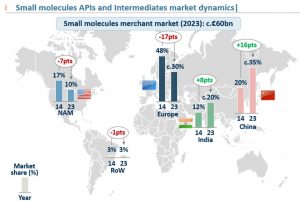
The 2024 AdvancySicos report (1) quantifies the shift. Europe’s share of the smallmolecule merchant market fell from 48% in 2014 to 30% in 2024, turning the region into a net importer while China and India became major net exporters. The United States followed the same trajectory, with its share declining to 10%. Today, roughly threequarters of Europe’s medicines value chain—raw and starting materials (RSMs), GMP intermediates and APIs—depends on imports from Asia (2).
The backdrop has changed—and business is feeling it. The old globalisation playbook is being rewritten: geopolitics, industrial policy and trade friction are reshaping the world order, and yesterday’s assumptions about stable partners and seamless flows no longer hold. For critical inputs, “justintime” has become “justtoorisky.” The answer is not to go it alone, but to upgrade the strategy: keep strong, rulesbased alliances across continents while building more capacity in Europe and pricing resilience into decisions.
Why did Europe lose ground so quickly? In part because it did not match the longterm, statebacked industrial strategies seen elsewhere. Cost is the other structural driver: greenfield investment and operating costs in Europe can be close to four times higher than in India, pushed up by a combination of input, utility and compliance costs (safety, social and environmental). Over time, procurement systems that reward the lowest price have amplified these disadvantages.
The Commission’s response has accelerated. It convened the Critical Medicines Alliance to translate shortage data into policy options—and that work fed directly into the Critical Medicines Act (CMA), the flagship legislative attempting to reduce dependencies and secure timely access to medicines across the EU.
Published by the Commission in May 2025 and strengthened by the European Parliament in January 2026, the CMA is meant to make medicines security less dependent on global luck and more grounded in European capability. Parliament’s amendments explicitly recognise that more than half of reported shortages are linked to manufacturing issues, and they underscore the urgency of rebuilding Europe’s capacity to produce essential pharmaceutical ingredients—especially APIs. The file is now in the final stages of the EU trilogue, the co-decision process involving the Commission, Parliament and Council.
What the CMA actually changes
In practical terms, the CMA uses three levers to shift the market: 1) speed up and derisk investment in EU capacity through faster permitting and more flexible stateaid options for Strategic Projects; 2) modernise procurement by promoting MEAT (3) criteria so reliability, quality and sustainability count alongside price; and 3) introduce a form of “European preference” to reward suppliers with a meaningful EU manufacturing footprint when security of supply is at stake.
Why it matters: resilience, capability and competitiveness
First, the healthsecurity case is straightforward. EFCG estimates that more than 75% of essential APIs used in Europe are manufactured outside the EU, largely in Asia. That concentration increases exposure to export restrictions, plant disruptions, logistics shocks and geopolitical escalation—and it limits crisis preparedness for medicines that hospitals depend on every day. Recent crises—from the pandemic to Russia’s war against Ukraine and renewed instability in the Middle East—made the lesson clear: a region that cannot reliably supply its essential medicines is not resilient.
Second, the industrial base is eroding. When API and intermediate plants close or relocate, Europe loses skills, knowhow and supplier networks—and rebuilding later becomes slower and far more expensive. Importantly, APIs typically represent less than 10% of a medicine’s final price, so strengthening EU production would likely have a limited impact on healthcare budgets but a significant impact on supply resilience.
Finally, the CMA is also an economic play. A competitive medicinesingredients sector underpins highskill jobs, anchors innovation in fine chemicals and advanced manufacturing, and strengthens Europe’s strategic autonomy. But the window is narrowing: global competitors are investing aggressively, procurement pressure is squeezing lowpriced essential medicines, and supply chains remain insufficiently diversified for several key inputs. The CMA is meant to address today’s weaknesses and futureproof the system.
Where the CMA is strong—and where it still needs work
EFCG welcomed Parliament’s January 2026 vote as a decisive political signal: medicines supply is now treated as a strategic file, not a purely technical one. The text also better reflects the role of European manufacturers and begins to connect the CMA with adjacent initiatives on industrial acceleration and public procurement. Yet EFCG has also pointed to gaps that, if left unresolved in trilogue, could reduce the Act to a wellintentioned framework rather than an industrial reset. See below the strengths of the current CMA:
It elevates medicines security to a strategic priority and sets a clearer baseline for governance and transparency.
It recognises that EU manufacturing standards—quality, reliability and sustainability—are part of resilience.
It strengthens the toolbox, including strategic projects, faster permitting and more resilienceoriented procurement principles.
The weaknesses are equally clear. The CMA still lacks some of the hard enablers needed to change investment decisions at scale—especially dedicated funding—and several provisions remain too openended to ensure consistent implementation across 27 Member States. Without stronger, operational resilience mechanisms in procurement, Europe may continue to reward the lowest price rather than the lowest risk—storing up higher costs when shortages hit. And as negotiations continue, the risk of dilution remains real.
What must come next
If policymakers want the CMA to deliver measurable resilience—not just better reporting—three things have to happen in parallel: targets must be specific, funding must be real, and procurement must reward security of supply. EFCG’s recommendations converge on a practical agenda.
Set measurable targets and timelines to reduce dependency on priority APIs, intermediates and starting materials.
Create dedicated EUlevel funding (including a competitiveness instrument) to derisk projects and scale capacity.
Embed resilience in procurement through MEAT criteria, multiaward strategies and a stronger European preference where justified.
Accelerate “strategic projects with simplified permitting and predictable regulatory pathways.
Coordinate implementation across Member States so companies face one clear direction of travel—not 27 different ones.
Conclusion: legislation is only half the job
The Critical Medicines Act is a rare chance to reverse a long slide in Europe’s medicinesingredients capacity. It has moved the debate from diagnosis to action, but its impact will be decided by the final deal and—more importantly—by implementation: funding, procurement reform and rapid execution on strategic projects. Get those elements right, and Europe can rebuild resilient supply chains with limited impact on medicine prices. Get them wrong, and the CMA risks becoming another framework that documents shortages rather than preventing them.
With trilogues under way, the test is whether Europe is willing to pay for resilience, not just argue for it. The CMA can still be a turning point—but only if the EU aligns industrial incentives and procurement rules behind a single goal: secure, highquality supply of critical medicines for European patients.
References and notes
- https://efcg.cefic.org/publication/strengthen-the-api-production-industry-in-france-and-europe/
- Details on page 7-11 of the Sicos-Advancy report: https://efcg.cefic.org/wp-content/uploads/2025/01/Advancy-Sicos-report-extract-protected.pdf
- MEAT : Most Economically Advantageous Tender, intended to move procurement beyond lowest price to determine the best value by assessing a combination of price, quality, technical merit, sustainability, and life-cycle costs
- Critical Medicines Act: The text of the final compromise amendments (Parliament’s comments on the Commission’s text can be found here: https://www.europarl.europa.eu/meetdocs/2024_2029/plmrep/COMMITTEES/SANT/DV/2025/12-15/CriticalMedicinesActCAs1-10_EN.pdf

The data beneath the disruption: why process maturity and data account...

The Renaissance and Industrial (r)Evolution of Peptide and Oligonucleo...

Empowering the Full Lifecycle of Drug Development

Linerixibat (Lynavoy)

Science is not enough: the operational disciplines of venture capital...

Industry 5.0-Ready Laboratories: Beyond Automation Towards Human-Centr...
From trial-and-error to predictive intelligence: How bespark*bio is re...
Patentability of Markush formulae