
Introduction
Biotech companies backed by venture capital or private equity face very different pressures than traditional pharmaceutical organizations. Their timelines are compressed, their resources are constrained, and their survival depends on hitting a sequence of tightly defined scientific and CMC milestones. In these environments, scientific insight alone is not enough; what separates successful leaders from everyone else is their ability to navigate investor expectations, manage uncertainty with discipline, and translate complex development pathways into clear, value-driving decisions.
Yet most executives who enter these settings, whether from big pharma, established CDMOs, or academic research, are unprepared for the operating model that governs investor-backed biotech. They underestimate the speed at which priorities shift, the level of transparency required, and the degree of personal accountability expected.
They assume that the processes that worked in mature organizations will scale down effectively. They rarely appreciate how much time, capital, and organizational behavior must be managed with intention when the runway is measured in months rather than years.
This article explores how individuals, not just companies, must adapt to succeed in venture-backed and private-equity-backed biotech settings. Using real-world operational patterns across early-stage biotech, CROs, CDMOs, and investor-led turnarounds, we highlight the mindsets, disciplines, and behaviors that consistently differentiate top performers. While investors emphasize value creation at the enterprise level, this article concentrates on value creation at the leadership and individual levels: how to think, operate, communicate, and execute in a system where every decision impacts scientific progress, capital efficiency, and long-term valuation.
What follows is a practical framework for preparing yourself to succeed in these high-velocity settings—one that blends strategic clarity with operational rigor and the adaptability required to lead through constant inflection points.
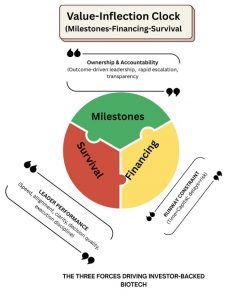
Understanding the Investor Operating Model
Leaders entering a venture-backed or private-equity-backed biotech quickly realize that science is only part of the equation; the real driver of decision-making is the investor operating model. Unlike traditional pharmaceutical settings, where programs go through established governance processes and multi-year budgets, investor-backed biotechs face stricter constraints. The need for capital efficiency shapes every decision, the speed at which the company reaches the next inflection point, and the understanding that the company’s survival depends on disciplined execution.
The primary force shaping this model is the value-inflection clock. Biotech companies financed by venture capital or private equity define success through specific milestones—IND acceptance, GLP toxicology readouts, first-in-human enrollment, or demonstration of phase-appropriate CMC readiness. These milestones determine whether the company can secure the next funding round, establish a partnership, or justify ongoing investment. As a result, leaders are judged not on the sophistication of their plans but on how well they can accelerate progress toward these key points of value creation.
The second force is the runway constraint, a reality that influences behavior more than most newcomers expect. While traditional companies operate on annual or multi-year budgets, early-stage biotechs function with runways measured in months. Even small delays—such as an additional stability study, a late batch, or a method revision—can cause enough shift in timelines to threaten a financing event. This makes time as vital a resource as capital, and individuals must learn to treat both with equal discipline.
The third force is the ownership-and-accountability culture that investors expect. In this environment, leaders are not shielded by hierarchical layers; they are expected to act as owners, making quick decisions, openly reporting risks, and taking responsibility for results rather than just activities. Boards and investors assess leaders based on clarity, transparency, and execution discipline. Those who succeed know how to turn scientific and CMC complexity into simple, investor-ready narratives centered on milestones, risk, and capital use.
Understanding these three forces—value inflection, runway, and ownership—is the starting point for fitting into and excelling within an investor-backed biotech environment. They define the rhythm, expectations, and cultural norms that shape every scientific, operational, and financial decision inside the company.
Shift from Scientific Perfection to Phase-Appropriate Speed
One of the biggest adjustments for leaders entering venture-backed or private-equity-backed biotech is recognizing that perfection is not the goal—progress is. Traditional pharmaceutical companies often pursue exhaustive analytical characterization, highly engineered processes, and layers of documentation built for long-term commercial success. In an investor-backed environment, those instincts can become liabilities. Early-stage biotechs do not have the luxury of fully optimized assays, gold-standard analytical platforms, or multi-year method development pathways. What they need is a disciplined understanding of what matters now versus what can wait until later.
This requires a mindset shift that feels uncomfortable for many experienced scientists and CMC leaders. The instinct to build the “right” process can conflict with the reality that a company may only have enough capital to reach the IND—not commercial launch. Leaders must learn to design analytical strategies, process development plans, and manufacturing approaches that are fit for the next milestone, not for the theoretical future state. In practical terms, this means identifying the minimal set of experiments required to demonstrate safety, quality, and regulatory readiness, while deliberately deferring non-essential optimization until the program has earned additional investment.
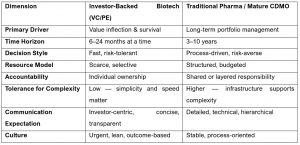
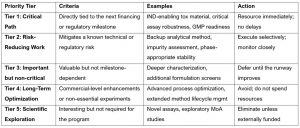
How Investor-Backed Biotech’s Operate vs. Traditional Pharma/CDMOs
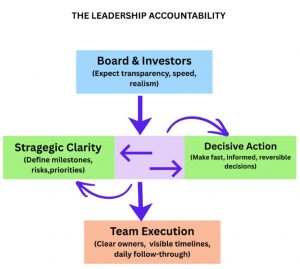
Phase-appropriate decision-making is not about cutting corners; it’s about allocating finite resources to the highest-value activities. A Phase 1 stability protocol does not need the granularity of a commercial stability program. An early analytical method does not need the precision of a fully validated assay. Tech transfer does not require multiple shadow batches if a single well-executed engineering run will answer the core question. Leaders who succeed in investor-backed settings are those who can explain the difference between necessary rigor and premature complexity and defend these choices to boards, auditors, and regulators with clarity and confidence.
Equally important is the ability to communicate these decisions to investors. Boards do not need technical overviews; they need a crisp articulation of what is required to reach the next inflection point and why certain activities have been deferred. Leaders who can frame development decisions in terms of time saved, capital preserved, and risk reduced instantly build credibility.
Ultimately, phase-appropriate execution is a discipline: the ability to choose the essential over the ideal, to move with speed without compromising safety, and to match scientific ambition to financial reality. In a world where every month of delay erodes runway and program value, the leaders who master this balance become indispensable.
Develop a Discipline of Ruthless Prioritization
In investor-backed biotech, the most precious assets are not equipment, talent, or capital—they are focus and sequencing. Companies with limited runway cannot afford to pursue every idea, optimize every method, or explore every scientific hypothesis, even if each one seems valuable in isolation. Leaders who transition from large pharmaceutical organizations often struggle with this shift because they are accustomed to operating in environments where parallel workstreams, redundant pathways, and broad exploration are common and financially sustainable.
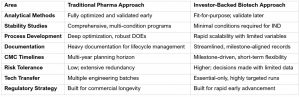
How “Phase-Appropriate” Thinking Differs from Traditional Development
In contrast, investor-backed companies must continually decide what not to do. This requires a level of prioritization that is far more explicit and unforgiving than most leaders are used to. Every project, experiment, and CMC activity must be evaluated through two questions:
Does this move the program closer to its next financing event? Does this materially reduce the scientific, technical, or regulatory risk associated with that milestone?
Activities that fail these tests—even if scientifically interesting, operationally elegant, or aligned with long-term ambitions—must be deferred or eliminated. This is the discipline that separates companies that hit their clinical timelines from those that run out of capital while doing good work that did not change their trajectory.
Ruthless prioritization also reshapes how teams operate. Meetings become shorter and more decisive because each hour spent on low-value topics drains time from critical-path work. Cross-functional alignment becomes non-negotiable; ambiguity in responsibilities, unclear decision rights, or slow consensus-building all create drag that early-stage companies cannot afford. Leaders must learn to simplify workflows, cut unnecessary steps, and ensure that the organization is investing its limited intellectual and operational bandwidth on the few activities that truly matter.
For individuals, this means adopting a new personal operating style. Rather than managing long lists of tasks and projects, high performers in investor-backed environments keep a sharply defined set of weekly, monthly, and quarterly priorities aligned with the company’s milestone plan. They escalate blockers immediately, avoid incremental complexity, and remove activities that create motion without creating progress. This mindset not only increases speed but also builds trust with boards and investors, who quickly recognize leaders who can protect focus and deliver outcomes, not activity.
Ultimately, ruthless prioritization is not a mindset of constraint—it is a strategy of amplification. By eliminating noise, the company amplifies what truly moves the needle. By narrowing focus, it accelerates value creation. And by aligning every activity to the next inflection point, leaders transform limited resources into meaningful scientific and business progress.
Master the Art of External Execution with CROs and CDMOs
In investor-backed biotech, external partners are not optional—they are the operational backbone of the company. Most early-stage biotechs outsource a large portion of their discovery, analytical development, process development, tox studies, manufacturing, and even regulatory support. This makes the ability to manage CROs and CDMOs one of the most decisive skills a leader can bring to a venture-backed environment. Yet it is also one of the most common failure points, especially for leaders transitioning from larger organizations where external vendors operate as long-term partners with well-established structures and buffers.
Investor-backed companies do not have the luxury of slow escalations, loose timelines, or open-ended contracts. Every day lost at a CRO or CDMO directly shortens the company’s runway, delays critical data, and increases burn. As a result, leaders must learn to operate with a level of external-execution discipline that is far more intentional and hands-on than typical industry experience prepares them for.
The first adjustment is proactive engagement. Successful leaders stay ahead of partners rather than waiting for updates. They establish weekly check-ins, request timeline Gantt charts, and anticipate bottlenecks before they surface. They know which assays, batches, or deliverables sit on the critical path and make sure the partner knows it too. In this environment, ambiguity is expensive; the most effective teams make expectations explicit and create constant visibility into progress.
The second adjustment is structuring the work for speed. Many partners, especially CDMOs with large client portfolios, default to their internal processes—which are often optimized for stability, not urgency. Leaders in investor-backed biotech cannot accept default timelines at face value. They must negotiate aggressively, sequence work to match the company’s milestone plan, and push for parallelization wherever scientifically and operationally feasible. The ability to challenge unrealistic timelines or unnecessary complexity is often what distinguishes high-performing biotech leaders from the rest.
The third adjustment is precision in communication. CROs and CDMOs move faster and produce better outcomes when instructions are unambiguous, documentation is complete, and decisions are made quickly. Slow approvals, unclear requirements, or drifting scope all translate into delays that early-stage companies cannot absorb. Leaders must learn to communicate with a level of clarity that minimizes rework, avoids misalignment, and accelerates execution.
Finally, leaders must develop a sophisticated understanding of risk management in outsourced environments. Not every CDMO has the same technical depth; not every CRO has the same rigor. Investor-backed companies must constantly evaluate partner performance—not only on technical quality but also on responsiveness, transparency, and reliability. When a partner underperforms or becomes a bottleneck, decisive action is required. In these settings, the cost of switching partners is often lower than the cost of persistent delays.
In short, managing external partners well is not administrative work—it is strategic leadership. In a world where most of the company’s scientific and CMC output is generated outside its walls, the individuals who can guide, accelerate, and de-risk external execution become indispensable to investor confidence and company survival.
Embrace Extreme Ownership and Transparent Leadership
In investor-backed biotech, the expectations placed on leaders go far beyond scientific expertise or functional competence. The environment demands a level of ownership, transparency, and decisiveness that is not always familiar to those coming from larger, more bureaucratic organizations. In traditional settings, responsibility is often distributed across teams, decisions move through layers of governance, and the consequences of delays or misalignments are usually absorbed by the organization over time. In venture-backed or PE-backed biotech, those buffers do not exist. The cost of ambiguity is measured in runway lost and milestones missed.
Extreme ownership begins with the recognition that leaders are accountable for outcomes, not activities. A method failed, a batch slipped, a timeline changed — in investor-backed environments, these are not “team problems,” they are signals of leadership gaps. Boards and investors expect leaders to anticipate risks before they materialize, escalate issues early, and create clarity around what is needed to maintain forward momentum. Silence, delay, or passive communication erodes trust more quickly than any technical failure.
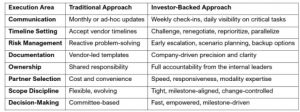
“Good External Execution” Looks Like in Investor-Backed Biotech
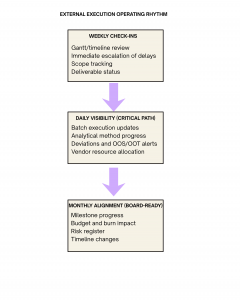
This culture of ownership also requires a higher standard of information transparency. In more mature companies, it is common to soften issues, delay bad news, or refine internal messaging until a problem is fully understood. In investor-backed biotech, this approach can be detrimental. Investors expect real-time visibility into risks, particularly those that threaten milestone progress or burn-rate assumptions. Leaders who openly communicate uncertainty — and pair it with mitigation strategies — demonstrate credibility, not weakness. Transparency, when paired with action, becomes a strategic asset.
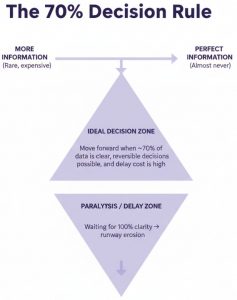
Equally important is decisiveness under uncertainty. Early-stage companies rarely have complete data, perfect models, or the comfort of validated processes. Leaders must make forward decisions despite ambiguity. Waiting for perfect clarity can stall programs for weeks or months — an unacceptable outcome in an environment where financing cycles depend on timely execution. The best leaders adopt a 70-percent rule: move when the data is sufficient to make an informed, reversible decision, rather than waiting for exhaustive confirmation.
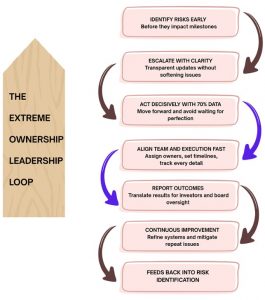
Extreme ownership also reshapes how leaders participate in board interactions. Investor meetings are not technical deep-dives; they are decision briefings. Boards expect leaders to speak in terms of risk, capital, timeline, and probability of success. Leaders who translate scientific complexity into a clear, milestone-oriented narrative quickly become trusted operators. Those who default to technical detail without strategic framing risk losing investor confidence.
Finally, extreme ownership requires leaders to foster the same mindset within their teams. When accountability cascades through the organization, execution becomes sharper, delays are caught earlier, and cross-functional alignment becomes easier to maintain. This cultural shift is often the difference between companies that consistently deliver milestones and those that constantly operate in crisis mode.
In short, investor-backed biotech rewards leaders who act like owners — decisive, transparent, responsible, and relentlessly aligned to the value-creation path. This leadership model not only drives stronger performance but also builds the trust required to navigate the unpredictable trajectory of scientific and clinical development.
Treat Time as a Form of Capital—and Manage It with the Same Rigor
In most corporate environments, time is an operational consideration. In investor-backed biotech, time is a financial asset, and how leaders allocate it has a direct impact on the company’s valuation, burn rate, and probability of reaching the next inflection point. This is a fundamental shift that many leaders underestimate. They are accustomed to calendars filled with recurring meetings, extensive internal reviews, and long decision cycles—structures that larger organizations can absorb without jeopardizing their trajectory. Venture-backed and private-equity-backed biotechs cannot.
To operate effectively in this environment, leaders must adopt the mindset that every hour has an opportunity cost. A one-week delay in a tox batch is not simply a schedule slip; it may impact the timing of a financing round. An inefficient meeting is not a minor inconvenience; it draws time away from the critical-path work needed to preserve runway. The connection between time, capital, and valuation becomes explicit, and leaders must manage their calendars as intentionally as their budgets.
This begins with rigorous time auditing. High-performing leaders regularly analyze where their time is being spent—by topic, by project, by stakeholder—and compare it against the company’s strategic priorities. This exercise often reveals a stark mismatch: internal meetings that absorb 50–70% of the week, little time allocated to CRO/CDMO oversight, delayed reviews of critical decisions, and limited availability for board preparation or investor engagement. The leaders who excel in investor-backed environments immediately rebalance their time, eliminating low-value activities, delegating operational tasks, and prioritizing execution, risk management, and milestone clarity.
Equally important is protecting deep-work capacity. Investor-backed companies move quickly, but not everything can be handled reactively. Leaders must carve out uninterrupted time to solve technical problems, develop mitigation plans, interpret data, and prepare strategic narratives for the board. Without these blocks of focused work, decision quality deteriorates, and key issues surface too late.
Another hallmark of effective time management is calendar clean-sheeting—a practice increasingly common in PE operating models and now emerging in venture-backed biotech. Leaders rebuild their schedules from scratch every quarter, eliminating legacy meetings, compressing discussions into shorter windows, and restructuring their calendars around the company’s evolving priorities. This approach acknowledges that the pace and demands of early-stage biotech shift constantly, and leadership time must shift with them.
Finally, leaders must create organizational norms that respect time as capital. This means clear decision rights, concise communication standards, short agenda-driven meetings, and escalation pathways that bypass unnecessary layers. When teams understand that timelines drive valuation and survival, behaviors align quickly. Time becomes a shared strategic resource rather than an individual inconvenience.
In early-stage biotech, capital burn is visible on a balance sheet, but time burn is often harder to quantify—yet just as consequential. Leaders who manage both with equal rigor create an execution advantage that directly influences the company’s ability to progress through clinical and CMC milestones, secure investment, and ultimately deliver on its scientific mission
Conclusion
Investor-backed biotech—whether funded by venture capital or private equity—does not operate like traditional pharma, established CDMOs, or well-resourced corporate research organizations. It is a system built on compressed timelines, finite capital, rapid decision cycles, and a relentless focus on value inflection. In this environment, scientific strength alone is not enough. Success depends on a leader’s ability to align their thinking, behavior, and execution rhythm with the expectations of investors who view time and capital as interchangeable constraints.
The sections in this article outline a practical plan for that alignment. Understanding the investor operating model provides the context for decision-making. Shifting from scientific perfection to phase-appropriate speed focuses effort on what matters today — not what may matter years from now. Ruthless prioritization conserves scarce resources and keeps teams focused on the next milestone. Effective external execution with CROs and CDMOs ensures progress continues even when most of the work occurs outside the company’s physical walls. Extreme ownership builds trust, reinforces accountability, and reduces the risk of surprises. Finally, treating time as capital disciplines leaders to manage their calendars with the same rigor as they do their budgets.
What emerges is not just a set of tactics but a way of operating—one that blends clarity, decisiveness, transparency, and an unwavering focus on value. Leaders who internalize these principles don’t merely survive in venture-backed biotech; they become the steady hands that investors rely on, the problem-solvers who keep programs on track, and the catalysts who accelerate the journey from promising science to meaningful outcomes.
In a sector defined by uncertainty, the ability to navigate the investor-backed environment with discipline and confidence is what ultimately separates companies that reach their milestones from those that fall short. And it is this leadership behavior—more than any platform, modality, or technology—that determines which organizations move from concept to clinic to commercial reality.

The Renaissance and Industrial (r)Evolution of Peptide and Oligonucleo...

Empowering the Full Lifecycle of Drug Development

Europe’s Critical Medicines Act: A Test of Health Sovereignty—and Indu...

The data beneath the disruption: why process maturity and data account...

Linerixibat (Lynavoy)

Industry 5.0-Ready Laboratories: Beyond Automation Towards Human-Centr...
From trial-and-error to predictive intelligence: How bespark*bio is re...
Patentability of Markush formulae