Context/Overview
Breakthrough therapies often fail to reach patients. Not because biology doesn’t work, but because manufacturing cannot keep pace.
Viral vectors, monoclonal antibodies, and gene therapies transform modern medicine. Yet the development of robust, scalable production processes remains one of the most complex and costly bottlenecks.
For decades, bioprocess development has relied on empirical experimentation: running bioreactors, adjusting parameters, analyzing outcomes, and repeating the cycle. While functional, this approach is slow and resource-intensive. Biological systems are nonlinear and highly interconnected; running more experiments does not automatically create deeper understanding.
Addressing this complexity requires a paradigm shift – from empirical iteration toward predictive design. bespark*bio was founded on this principle.
State of the art/Analogs
Digitalization has entered process development, but integration remains fragmented.
Modeling platforms operate without laboratory validation. Consultancies provide expertise but don’t execute experimentally. CDMOs focus on scale-up, while process development remains neglected. Machine learning is frequently applied retrospectively, analyzing datasets after experiments have been performed.
What is missing is a continuous workflow that guides experimentation from the outset by combining prior knowledge, hybrid modeling, and laboratory validation.
AIM – Fill in the gap
The concept behind bespark*bio emerged from industrial experience. Across decades in biopharmaceutical development, the three founders repeatedly observed promising therapeutic programs delayed by Chemistry, Manufacturing and Controls (CMC) bottlenecks. The science was sound, but process complexity slowed progress and increased risk.
This revealed a systemic challenge: in modern biotherapeutics, manufacturing frequently defines the critical path.
The biotherapeutics sector is among the fastest-growing areas in healthcare, with viral vectors and gene therapies showing double-digit annual growth rates. At the same time, development of commercial-ready manufacturing processes require investments reaching tens or even hundreds of millions of euros. The need for predictive, risk-reducing process strategies is evident.
bespark*bio replaces empirical trial-and-error with predictive process intelligence by integrating three elements:
- Structured prior knowledge
- Advanced data-modeling
- In-house laboratory execution
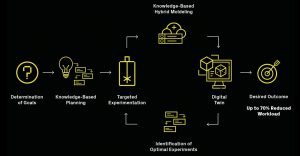
Design spaces are defined early. Process behavior is simulated in silico before resources are committed. Experiments are executed selectively. Models guide experimentation, experimental data refines models. Each iteration strengthens predictive capability.
Artificial intelligence does not replace experimentation – it makes experimentation more targeted and efficient.
Your start-up: who are you
Founded in 2023 and based in Vienna’s Life Science Cluster, bespark*bio operates a dedicated 110 m² process development facility where modeling and laboratory execution are fully integrated.
Since market entry in 2024, the company has grown to 8 team members and has delivered multiple projects for biotech, pharmaceutical companies and CDMOs across Europe.
More information: www.bespark.bio.
What do you offer
bespark*bio operates within the broader bioprocess development ecosystem, supporting both therapy developers as well as technology and raw material innovators.
For developers of viral vectors, biologics, and advanced therapy medicinal products, the company provides advanced process development based on prior knowledge, hybrid modeling, and experimental validation. Digital twins – dynamic in-silico representations evolving with experimental data – allow scenario testing before laboratory execution.
This enables simulation of process trajectories, identification of critical parameter interactions, and multi-objective optimization, such as balancing yield and impurity levels.
In a viral vector case study, this bespark*bio’s workflow reduced experimental workload up to 70% percent, significantly reducing development timelines and costs while increasing process understanding.
Technology and raw material providers are equally critical to modern biomanufacturing. Innovations in media, analytics, and process tools directly influence manufacturing performance.
bespark*bio provides a neutral, application-driven validation environment in which new technologies can be tested under realistic process conditions and benchmarked against established standards.
Why you
The key differentiator is integration.
Unlike software providers, bespark*bio validates experimentally. Unlike consultancies, it executes. Unlike traditional pathways, development begins with structured knowledge and predictive modeling rather than broad empirical exploration.
The closed-loop architecture – simulation, selective experimentation, data feedback, model refinement – creates cumulative learning. Each project enhances the predictive system.
Artificial intelligence is embedded within a scientifically rigorous structure that connects biology, engineering, and data science.
Challenges
The adoption of predictive, AI-embedded development requires trust.
The biopharmaceutical industry operates under strict regulatory expectations and demands transparency and robustness.
Demonstrating that modeling enhances reliability – rather than introducing uncertainty – is essential.
Biological systems will always retain variability. The objective is not to eliminate uncertainty, but to reduce it earlier and more systematically.
Perspectives
As next-generation therapies increase in complexity and regulatory scrutiny intensifies, predictive process understanding will become a competitive necessity rather than an optional enhancement.
The vision of bespark*bio is to establish AI-integrated, predictive bioprocessing as an industry standard – enabling faster and more affordable innovation, reduced development risk, and more efficient translation from discovery to scalable manufacturing.
Ultimately, the goal is straightforward: ensuring that life-changing therapies reach patients faster and more reliably.

The Renaissance and Industrial (r)Evolution of Peptide and Oligonucleo...

Empowering the Full Lifecycle of Drug Development

Europe’s Critical Medicines Act: A Test of Health Sovereignty—and Indu...

The data beneath the disruption: why process maturity and data account...

Linerixibat (Lynavoy)

Science is not enough: the operational disciplines of venture capital...

Industry 5.0-Ready Laboratories: Beyond Automation Towards Human-Centr...
Patentability of Markush formulae