
Introduction
The manufacture of medicinal products in shared facilities is an established industrial practice, but it requires a scientifically justified control strategy to prevent cross contamination. If an active substance is unintentionally transferred into another product, it provides no therapeutic benefit to the patient or target animal receiving that product and may therefore represent a safety concern. This is particularly relevant for HPAPIs, which may exert pharmacological or toxicological effects at very low doses and may therefore pose potential health risks if not adequately controlled. The European Medicines Agency (EMA) guideline on Health Based Exposure Limits (HBELs) (1) was developed to support a risk-based approach for deriving safe threshold values for individual active substances in this context. The same principle is further reflected in the subsequent EMA questions and answers on implementation (2).
Specifically, HBELs define the daily amount of a substance that is not expected to cause adverse effects in the exposed patient or target animal under the relevant exposure scenario. In pharmaceutical manufacturing, the HBEL is translated into operational control limits, such as the Maximum Allowable Carryover (MACO), to support cleaning validation for shared equipment and to ensure appropriate protection of patient and target animal.
The terminology used for HBELs may vary depending on the regulatory framework. In the EU context, the term Permitted Daily Exposure (PDE) is commonly used, whereas Acceptable Daily Exposure (ADE) is frequently applied in the United States. Although the terminology differs, both concepts refer to a substance specific, health-based exposure limit and are generally derived using the same principles. In specific cases, such as certain mutagenic impurities, the Threshold of Toxicological Concern (TTC) may also be applied. Overall, PDE, ADE and TTC represent health-based approaches used to define exposure levels considered acceptable for the protection of patients or target animals.
The EMA guideline adopts the PDE as the central approach, while also recognizing that alternative scientifically justified methodologies may be acceptable (1). Similarly, ICH Q3C and ICH Q3D apply the PDE concept to residual solvents and elemental impurities, respectively, confirming that this methodology is well established in regulatory toxicology (3,4). For DNA reactive mutagenic impurities, ICH M7 introduces acceptable intakes and the TTC approach, comprising the lifetime acceptable intake of 1.5 µg per day for mutagenic impurities (5). Importantly, HBELs should be established by a suitably qualified expert with adequate training and experience in toxicology and pharmacology, familiarity with pharmaceutical substances and manufacturing contexts, and specific expertise in the derivation of health-based exposure limits, including Occupational Exposure Limits (OELs) and PDE values (2). In this article, the derivation of a PDE will be discussed as a representative approach for establishing HBELs.
The issue of calculating HBELs becomes more complex when the substance under assessment is a highly potent active pharmaceutical ingredient (HPAPI). Since there is no single harmonized legal definition of HPAPI across the European Union, identification is generally based on industry practice, expert judgement, and manufacturer experience. A compound is often classified as “potent” when it has OEL below 10 µg/m³, and as “highly potent” when the OEL is below 0.05 µg/m3. Highly potent drugs have relevant biological activity at very low doses, generally ≤150 µg/kg body weight or a daily therapeutic dose below 1 mg, or specific toxicological properties such as carcinogenicity or mutagenicity. Oncology drugs, hormonal treatments, synthetic opioids, immunosuppressants, and some antibody drug conjugate payloads are typical examples.
Due to the absence of a harmonised definition, APIs that would more appropriately be described as potent may sometimes be classified as highly potent, potentially leading to unnecessary concern or overclassification. This risk can be mitigated through the appropriate use of Occupational Exposure Banding (OEB), which supports hazard communication, containment strategy and industrial hygiene decision making. OEB systems generally classify compounds from band 1, representing lower hazard substances, to band 5, representing higher hazard substances, based on their OEL value. However, OEB systems are not formally regulated, and each company may define its own banding criteria, although the band limits are often broadly comparable across industry practice. Care should also be taken to avoid excessive or poorly justified banding schemes, such as the introduction of OEB 7 or OEB 8 categories without a clear scientific or operational basis (6).
PDE derivation process
A robust PDE derivation begins with a comprehensive hazard identification. The toxicologist should critically review all relevant pharmacological, toxicological and clinical information, including pivotal repeated dose toxicity studies, reproductive and developmental toxicity data, genotoxicity and carcinogenicity findings, safety pharmacology, clinical dose limiting toxicities and post marketing experience. For veterinary medicinal products, the assessment may also need to address target animal safety and, where food producing animals are involved, potential consumer exposure through the food chain (1).
The aim of this assessment is to identify the Point of Departure (PoD), defined as the dose or exposure level selected from the available toxicological or clinical database as the basis for HBEL derivation. The PoD is generally selected in relation to the critical adverse effect of the API, considering its relevance, severity, dose response relationship, reversibility, biological plausibility, exposure duration and human relevance. Importantly, the critical effect is not necessarily the first effect observed at the lowest dose, but rather the adverse effect considered most appropriate for protecting the exposed population under the relevant exposure scenario. Depending on the available data, the PoD may correspond to a no observed adverse effect level (NOAEL), a lowest observed adverse effect level (LOAEL), a benchmark dose, where available, or a human clinical dose when clinical data provide the most relevant basis for the assessment. The classical PDE equation can therefore be expressed as the PoD multiplied by an appropriate body weight or scaling term and divided by the product of the selected adjustment factors, as shown in Figure 1 below.

Adjustment factors, indicated as F in Figure 1 and also referred to as Assessment Factors (AFs) or Safety Factors (SFs), are applied to account for uncertainties when extrapolating from the available toxicological or clinical data to the exposed human or target animal population. These factors address interspecies extrapolation (F1), interindividual variability (F2), study duration (F3), severity of toxicity (F4), the nature of the selected Point of Departure, for example NOAEL, LOAEL or lowest therapeutic dose (F5), and any additional residual uncertainties in the data package (F6). Different ICH guidelines, including Q3C, Q3D and the draft Q3E, provide examples of the numerical values that these factors may assume depending on the nature and robustness of the available data, generally ranging from 1 to 10 (3,4,7). However, adjustment factors should not be applied mechanically. Their selection should always be scientifically justified in relation to the overall dataset, the critical endpoint, the selected Point of Departure and the relevant exposure scenario.
Pharmacokinetic and route considerations
Pharmacokinetic correction, also referred to as toxicokinetic correction (TK) is another area where expert judgement is essential. The route of administration of the residue may differ from the route used in the pivotal toxicity study or from the authorised therapeutic route. If systemic exposure is the driver of toxicity, relevant differences in bioavailability should be considered. A route to route correction may be justified when reliable data show an important difference between oral, inhalation, dermal or parenteral absorption. However, such corrections should preferably be based on human data, or on target animal data for veterinary products, because absorption and metabolism can vary markedly between species.
When a standard PDE is not enough EN_DASH Abemaciclib
Some HPAPIs challenge the standard PDE paradigm. Abemaciclib provides a useful example of a non-genotoxic HPAPI for which identification of the critical effect requires integrated toxicological judgement.
Abemaciclib is an ATP competitive, reversible kinase inhibitor selective for CDK4 and CDK6, with demonstrated antitumour activity as a single agent in hormone receptor positive metastatic breast cancer (8). Publicly available product information indicates that abemaciclib is not mutagenic in bacterial reverse mutation assays and is not clastogenic in either in vitro or in vivo chromosomal damage assays. Therefore, genotoxicity does not appear to represent the critical driver for HBEL derivation (9).
However, reproductive and developmental toxicity, together with repeat dose systemic toxicity, are relevant for the overall assessment. Nonclinical data indicate effects on the male reproductive system, including decreased organ weights, tubular degeneration, hypospermia and impaired spermatogenesis. Male reproductive toxicity was observed in rats and dogs at exposures approximately 2 times and 0.02 times the human clinical exposure (equal to ≥10 mg/kg in rats and ≥0.3 mg/kg in dogs, respectively, 13-week studies), although no effects on male or female fertility were identified in dedicated rat fertility studies. Developmental toxicity was also reported in rats, where doses ≥4 mg/kg during organogenesis caused decreased fetal body weight and increased incidences of cardiovascular and skeletal malformations and variations, in the absence of maternal toxicity. At this dose level, maternal systemic exposure was similar to human exposure, based on AUC, at the maximum recommended clinical dose. Additional repeat dose toxicity findings included severe gastrointestinal and haematological toxicity in dogs, with early mortalities observed at 10 mg/kg, as well as renal toxicity in rats at doses ≥10 mg/kg. Conversely, animal toxicology studies did not show evidence of thromboembolic events or increased ALT and AST levels, which have been reported in clinical trials (10,11).
Overall, the available toxicological database for abemaciclib can be considered sufficiently comprehensive to support the derivation of a substance specific PDE. In this case, the most appropriate PoD was identified as the LOAEL of 0.3 mg/kg bw/day, established in the 13-week oral toxicity study in dogs. This value represents the lowest relevant PoD available within the dataset and is associated with histological alterations in male reproductive system. By applying the standard assessment factors recommended in the relevant ICH guidelines, the following oral PDE value can be derived for abemaciclib:
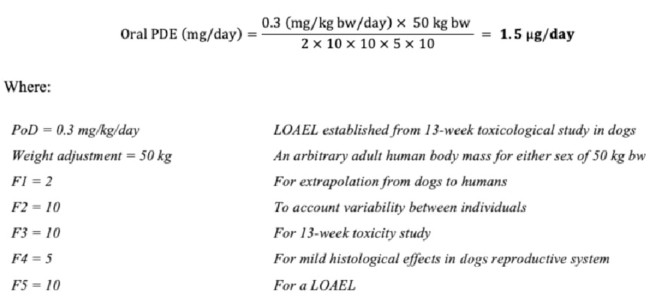
However, an oral PDE of 1.5 µg/day appears highly conservative from a toxicological perspective for a non-genotoxic HPAPI such as abemaciclib. Although this value is only numerically comparable to the TTC generally applied to many DNA reactive mutagenic impurities, such comparison does not reflect the actual toxicological profile of abemaciclib, for which genotoxicity does not appear to be the critical driver. Therefore, considering the overall dataset, the application of less conservative adjustment factors may be scientifically justified, provided that the rationale is clearly documented.
In particular, the severity factor, F4, could be reduced if the selected critical effect is limited to minor histopathological findings, without evidence of severe or life-threatening toxicity at the Point of Departure. However, some uncertainty remains, since the available nonclinical information does not clearly specify whether these mild histological findings were fully reversible. This uncertainty should be acknowledged in the assessment and may justify retaining a certain degree of conservatism.
The factor related to the nature of the Point of Departure, F5, should also be considered carefully. Since the selected PoD is a LOAEL rather than a NOAEL, ICH based approaches generally allow the application of an additional factor, which may be up to 10 depending on the quality of the dose response information and the nature of the effect. In the case of abemaciclib, a lower F5, for example 5, may be justified if the LOAEL is associated with limited and non-severe findings, and if the overall dataset provides sufficient confidence in the dose response relationship.
Alternatively, F5 could be retained at 10, while a lower interindividual variability factor, F2, could be considered, but only if the manufacturing context supports such an approach. This may be relevant where abemaciclib is manufactured in dedicated oncology manufacturing lines, together with other oncology products. In this scenario, potential cross contamination would most likely involve patients already affected by severe disease and receiving cytotoxic or antiproliferative therapies, rather than healthy individuals or particularly sensitive populations. These patients are generally treated under controlled clinical conditions, where a certain degree of pharmacological and toxicological burden may be acceptable within the overall benefit risk balance.
By applying this refinement, the final oral PDE value for abemaciclib would be equal to 15 µg/day, as reported in the calculation below:
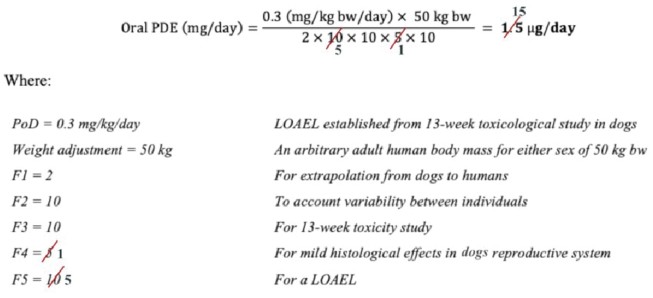
This approach is consistent with the risk-based principles described in EMA guidance for HBEL and PDE derivation, where the nature of the exposed population, the therapeutic context, the severity of the underlying disease and the relevance of the critical effect may influence the selection of adjustment factors and the overall level of conservatism applied. On this basis, the final oral PDE of 15 µg/day is considered toxicologically justified for abemaciclib. This value remains protective, as it is derived from the most sensitive relevant PoD identified in the available dataset and incorporates appropriate uncertainty factors, while avoiding an excessive level of conservatism that would not be consistent with the non-genotoxic profile of the compound, the nature of the critical effect and the expected oncology manufacturing context.
Conclusions
Health based exposure limit derivation for HPAPIs represents a critical interface between toxicology, GMP requirements, occupational hygiene, cleaning validation and pharmaceutical quality risk management. The derivation of a PDE or other HBEL should be grounded in a comprehensive evaluation of the available toxicological, pharmacological, clinical and pharmacokinetic evidence, with explicit consideration of the relevant exposure scenario and the population potentially exposed through cross contamination.
For highly potent compounds, a purely formula-based approach is not sufficient. The final HBEL should reflect expert toxicological judgement, including the selection of the most appropriate Point of Departure, the identification of the critical effect, the scientific justification of adjustment factors and the evaluation of residual uncertainties. This is particularly important for oncology products and other HPAPIs, where potency, mechanism of action, therapeutic context and patient population may substantially influence the overall risk assessment.
A scientifically robust HBEL should therefore be protective, transparent and proportionate. It should ensure patient and, where relevant, target animal and consumer safety, while avoiding unnecessary over conservatism that is not supported by the toxicological evidence. For this reason, HBEL derivation should be performed by experienced professionals able to integrate regulatory expectations with sound toxicological interpretation and practical manufacturing considerations.
References and notes
- European Medicines Agency. Guideline on setting health based exposure limits for use in risk identification in the manufacture of different medicinal products in shared facilities. EMA/CHMP/CVMP/SWP/169430/2012. London: European Medicines Agency; 2014. Available from: https://www.ema.europa.eu/en/setting-health-based-exposure-limits-use-risk-identification-manufacture-different-medicinal-products-shared-facilities-scientific-guideline
- European Medicines Agency. Questions and answers on implementation of risk based prevention of cross contamination in production and guideline on setting health based exposure limits for use in risk identification in the manufacture of different medicinal products in shared facilities. EMA/CHMP/CVMP/SWP/246844/2018. London: European Medicines Agency; 2018. Avilable from: https://consultations.tga.gov.au/tga/proposed-adoption-of-international-scientific-guid/user_uploads/ema-chmp-cvmp-swp-246844-2018.pdf
- International Council for Harmonisation. ICH Q3C(R9): impurities, guideline for residual solvents. Geneva: ICH; 2024. Available from: https://database.ich.org/sites/default/files/ICH_Q3C%28R9%29_Guideline_MinorRevision_2024_2024_Approved.pdf
- International Council for Harmonisation. ICH Q3D(R2): guideline for elemental impurities. Geneva: ICH; 2022. Available from: https://database.ich.org/sites/default/files/Q3D-R2_Guideline_Step4_2022_0308.pdf
- International Council for Harmonisation. ICH M7(R2): assessment and control of DNA reactive mutagenic impurities in pharmaceuticals to limit potential carcinogenic risk. Geneva: ICH; 2023. Available from: https://database.ich.org/sites/default/files/ICH_M7%28R2%29_Guideline_Step4_2023_0216_0.pdf
- Farris, J.P., Ader, A.W., and Ku, R.H. (2006). History, Implementation and Evolution of the Pharmaceutical Hazard Categorization and Control System. Chimica Oggi, Chemistry Today, 24(2), 5, 10.
- International Council for Harmonisation. ICH Q3E (Draft): Extractables and leachables. Geneza, ICH; 2025. EMA/CHMP/ICH/236669/2025. Available from: https://www.ema.europa.eu/en/ich-q3e-extractables-leachables-scientific-guideline
- Torres-Guzmán R, Calsina B, Hermoso A, Baquero C, Alvarez B, et al. Preclinical characterization of abemaciclib in hormone receptor positive breast cancer. Oncotarget. 2017 May 10;8(41):69493-69507. doi: 10.18632/oncotarget.17778. PMID: 29050219; PMCID: PMC5642494.
- Abemaciclib Summary of Product Characteristics (SmPC). Available from: https://www.ema.europa.eu/en/documents/product-information/verzenios-epar-product-information_en.pdf.
- U.S. Food and Drug Administration. VERZENIO, abemaciclib tablets, prescribing information. Silver Spring: U.S. Food and Drug Administration; 2025. Available from: https://www.accessdata.fda.gov/drugsatfda_docs/label/2025/208716s019lbl.pdf
- Center For Drug Evaluation And Research (CDER), US FDA. Multi-discipline review, Application number: 208716Orig1s000. Available from: https://www.accessdata.fda.gov/drugsatfda_docs/nda/2017/208716Orig1s000MultidisciplineR.pdf
HPAPI Management: From Categorization to Prevention – Practical...

Becoming the “Customer of Choice”: A Strategic Imperative for CDMOs an...

Intelligence Amplified: A CDMO Perspective on Integrating R&D and...

Scaling, Adapting and Partnering: How Europe’s Chemical Sector Can Sta...

Regulatory affairs as the connective tissue of pharmaceutical product...

Advancing Antibody–Peptide Conjugates Through Controlled Conjugation a...

Baxdrostat (Baxfendy)