

Introduction
Supply chains in the chemical and pharmaceutical industries are becoming increasingly volatile, complex and regulated. Recent geopolitical tensions and trade policy shifts have added pressure to pharmaceutical supply chains, including active pharmaceutical ingredient (API) sourcing and availability. Disruptions such as natural disasters and localized shocks can affect supply continuity elsewhere (1), (2).
These pressures are compounded by the highly globalized, multi-tiered nature of modern supply chains. APIs may be produced in one region, formulated in another, and then packaged and distributed worldwide—often with limited end-to-end visibility (3). Overlaying this complexity is the imperative of regulatory compliance, which is embedded in every operational step.
Artificial intelligence (AI) presents a significant opportunity to enhance supply chain resilience while improving efficiency and transparency (4). AI is now transitioning from experimental pilots to delivering measurable operational impact, including in supply chain management. However, adoption remains uneven across the industry.
This article explores where AI can create value in chemical and pharmaceutical supply chains, outlines practical implementation considerations, and shares use cases from our own transformation journey.
Foundations, constraints and opportunities for AI in chemical and pharmaceutical supply chains
The adoption of AI in the chemical and pharmaceutical supply chain is a progression shaped by digital maturity, regulatory constraints and organizational readiness. While the potential of AI is now widely recognized, its realization depends on how effectively companies can bring these dimensions together in a coherent transformation journey.
Establishing the digital foundation
Over the past decade, many organizations have made significant progress in digitizing core operations. Enterprise resource planning (ERP) systems, advanced process control and digital twins—virtual representations of physical assets and processes—have become increasingly embedded in manufacturing and supply chain environments. These capabilities form the essential backbone for AI, enabling the structured, high-quality data required for advanced analytics.
Digital twins, in particular, illustrate the shift from static monitoring to dynamic decision-making. When integrated into operational workflows, they allow companies to simulate conditions, anticipate disruptions and optimize performance in near real time. In leading organizations, this creates a closed loop between physical operations and digital insight, laying the groundwork for more autonomous, data-driven supply chains.
Navigating regulatory complexity
At the same time, AI adoption is shaped—and often constrained—by the industry’s regulatory environment. Compliance with frameworks such as REACH, TSCA and GHS requires digital systems to be auditable, transparent and governed by rigorous controls. Rather than simply slowing adoption, these requirements fundamentally influence how AI solutions are designed, implemented and scaled.
In pharmaceuticals, the bar is even higher. Good Manufacturing Practice (GMP) standards and validation requirements mean that even foundational digital systems must be fully verified before deployment. This results in a more cautious pace of digital transformation, but also ensures that implemented solutions are robust, reliable and trusted.
Emerging AI use cases
Despite growing interest, AI adoption remains concentrated in specific, high-impact domains. In supply chain management, applications such as demand forecasting, inventory optimization and production planning are leading the way, delivering measurable improvements in service levels and working capital (4), (5).
Beyond operations, AI is also gaining traction in commercial and customer-facing functions, supporting areas such as customer segmentation, pricing and automated order management. These targeted deployments reflect a pragmatic approach: rather than attempting large-scale transformation upfront, organizations are prioritizing use cases where value can be demonstrated quickly.
However, even these focused applications rarely exist in isolation. AI initiatives often cut across supply chain, IT, commercial and finance functions, requiring alignment on data models, processes and decision rights. This cross-functional dependency highlights both the opportunity and the challenge of scaling AI: success depends on breaking down silos and creating integrated, end-to-end capabilities.
Strengthening organizational readiness
Ultimately, the limiting factor in AI adoption is rarely technology alone. While tools and platforms are becoming more accessible, embedding AI into everyday decision-making requires a shift in how organizations operate. Trust in data, clarity in governance and the willingness to adapt established processes are critical preconditions for success.
This places a strong emphasis on leadership and capability building. Organizations must invest not only in technology, but also in upskilling their workforce and fostering a culture that embraces data-driven thinking. Without this alignment, even technically sound solutions risk remaining underutilized.
Companies that align their digital strategies with clear business objectives, and approach transformation as both a technological and organizational effort, are beginning to move beyond experimentation. Their experience shows that when digital foundations, regulatory discipline and organizational readiness come together, AI can deliver tangible and scalable impact across the value chain.
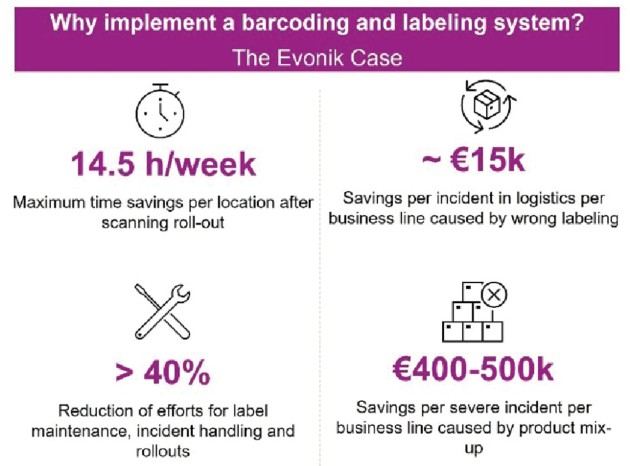
Figure 1. Benefits of implementing a barcoding and labeling system at Evonik – Sample benefits based on pilot.
Building the digital supply chain ecosystem
AI creates value when it connects functions and enables end-to-end decision-making. In chemical and pharmaceutical supply chains, this requires a broader digital ecosystem that integrates visibility, compliance and sustainability.
Technologies such as QR and barcode scanning significantly improve traceability and reduce manual errors. Pilot implementations at Evonik have shown up to a 40% reduction in label-related incidents, particularly in environments with high product variation and manual handling steps (see Figure 1). By introducing standardized QR and barcode scanning at key process points, manual data entry was significantly reduced, improving both accuracy and traceability. In healthcare supply chains, such visibility is essential to ensure full traceability from raw materials to patient delivery.
Figure 1. Benefits of implementing a barcoding and labeling system at Evonik – Sample benefits based on pilot.
Digitizing compliance processes
Highly regulated, data-intensive processes—such as duty drawback management—benefit significantly from digitalization. At Evonik, a previously manual and fragmented process for managing customs refunds on imported or exported goods involved more than 16 data sources. By digitizing data validation, integrating broker data and using AI-powered tools, the team identified annual savings potential of up to US$4 million.
Embedding sustainability
Digital platforms are increasingly used to track CO2 emissions, costs and reduction measures across the value chain. At Evonik, the CARM3N App provides a transparent view of CO2 reduction measures across business lines, from raw materials to logistics. The app tracks estimated savings, costs and progress, helping align ESG goals and support more consistent decision-making.
The integrated dashboards enable the visualization and analysis of ideas in an Abatement Cost Curve, allowing different emissions-reduction measures to be compared and business line-specific reduction potential to be identified relative to the baseline.
Data, systems and integration
AI success depends on data quality and system connectivity. However, many organizations in the chemical and pharmaceutical industry have grown through M&A or operate through regional setups with fragmented legacy systems. As a result, data silos, inconsistent master data, poor data quality and governance gaps can prevent companies from establishing a reliable single source of truth.
Practical approaches
Focusing on data governance and harmonization is essential. This means cleaning and standardizing data, defining clear ownership and establishing governance mechanisms. It may not be the most visible part of digital transformation, but it is essential for reliable AI and analytics.
A second step is smarter system integration. Rather than replacing all legacy systems at once, organizations can connect established platforms with newer digital tools. At Evonik, for example, real-time planning tools now write back to SAP, enabling faster and more accurate decisions.
Tracking data quality through KPIs and dashboards is also critical. This creates visibility into what is working, where improvements are needed and whether AI models and planning tools are being fed with usable data.
Finally, investing in people is paramount. Teams need the skills and confidence to work with digital tools and data, because even the best systems will not deliver value if people do not trust or use them.
In the pharmaceutical industry, one of the biggest challenges is integrating GMP-regulated data, such as batch records or stability data, with non-GMP systems for analytics without compromising compliance. Data harmonization must consider traceability and audit trails, not just consistency, which adds complexity but is essential for regulatory approval. Master data quality is especially important because errors can affect product release decisions and patient safety.
Driving adoption: from pilots to daily impact
Digital tools deliver value only when embedded in daily workflows. Treating them as standalone IT initiatives often limits their impact. To drive adoption, three aspects are critical:
- Co-creation with users: involving end users early ensures that tools reflect real workflows and increases adoption.
- System integration: embedding solutions into platforms such as SAP, LIMS and quality systems reduces friction and duplication.
- Targeted upskilling: scalable training formats, such as modular learning, build confidence and accelerate adoption.
Use case: Upskilling
At Evonik, a digital learning platform with short modules, or “nuggets,” helps teams build data skills and become more confident using new tools. To date, more than 1,000 employees have completed digital literacy modules, and adoption of new tools has increased across teams.
In regulated industries, adoption also depends on validation and compliance. Involving quality and regulatory teams early in the process ensures that solutions are scalable and audit-ready.
Leadership in a digital supply chain era
Digital transformation is ultimately a leadership challenge. Success depends on aligning technology with organizational change.
Core leadership capabilities include:
- Data fluency: leaders must be able to interpret data and make evidence-based decisions.
- Change leadership: building trust and guiding teams through new ways of working is critical.
- Agility and curiosity: leaders must remain adaptable and empower decentralized decision-making.
In the pharmaceutical industry, these capabilities must be combined with a strong understanding of regulatory requirements, ensuring that decisions are both data-driven and compliant.
Transforming use cases into value
The following use cases illustrate how Evonik has implemented AI in its supply chain.
Use case 1: Demand forecasting and integrated business planning (IBP)
Machine learning is significantly enhancing demand forecasting and planning accuracy, particularly in volatile markets. At Evonik, AI models support more precise forecasts and dynamic “what-if” scenario analysis within S&OP and IBP processes by combining historical data with real-time signals.
The real value lies in integration. By aligning commercial, supply chain and finance functions around a consistent view of demand, the organization can move from reactive planning to coordinated decision-making. Since implementing machine learning in IBP, we have improved forecast accuracy by up to 10%, helping reduce inventory levels, improve service and respond faster to market shifts.
Use case 2: Customer service excellence through automation (CSX)
AI-driven automation is transforming operational efficiency in customer service. At Evonik, a KPI-driven framework uses AI to automate routine tasks such as available-to-promise (ATP) checks, order confirmations and document generation.
This allows teams to focus on higher-value activities, including managing exceptions and strengthening customer relationships. The result is not only improved efficiency, but also enhanced service quality and responsiveness.
Conclusion
AI is reshaping supply chains in the chemical and pharmaceutical industries. Organizations that successfully embed AI into daily operations take a holistic approach: they connect functions, integrate AI into core processes, and align digital initiatives with business priorities and regulatory realities. In doing so, they move beyond isolated improvements toward more resilient, transparent and sustainable supply chains.
As AI continues to mature, the competitive advantage will shift from experimentation to execution. Companies that can translate data into decisions—at scale and in real time—will be best positioned to navigate uncertainty and capture long-term value.
References and notes
- PharmaSource. “How geopolitical tensions disrupted pharma supply chains in Q3 2025” [Internet]. PharmaSource; 2025 Jul 25 [cited 2026 Jul 9]. Available from: PharmaSource.
- Lesmeister F, Kwasniok T, Peters D. “A strategy to make pharma supply chains more resilient” [Internet]. Bain & Company; 2020 Nov 19 [cited 2026 Jul 9]. Available from: Bain & Company.
- Coates R. “The complexity of the pharma supply chain” [Internet]. Supply Chain Management Review. 2026 Mar 6 [cited 2026 Jul 9]. Available from: Supply Chain Management Review.
- Fatorachian H, Kazemi H. “Optimizing supply chains with AI: a systematic review through the lens of systems theory.” Cogent Eng. 2026;13(1):2639206. https://doi.org/10.1080/23311916.2026.2639206.
- Ning L, Yao D. “The impact of digital transformation on supply chain capabilities and supply chain competitive performance.” Sustainability. 2023;15(13):10107. https://doi.org/10.3390/su151310107.
AI at Enterprise Scale: Inside Pharma’s Manufacturing Transformation

Artificial Intelligence in the Biopharma Industry

Becoming the “Customer of Choice”: A Strategic Imperative for CDMOs an...

Intelligence Amplified: A CDMO Perspective on Integrating R&D and...

Deriving health-based exposure limits for highly potent APIs: from reg...

HPAPI Management: From Categorization to Prevention – Practical...

Scaling, Adapting and Partnering: How Europe’s Chemical Sector Can Sta...

Regulatory affairs as the connective tissue of pharmaceutical product...