Artificial intelligence is reshaping pharmaceuticals industry-not through generic algorithms alone, but by addressing real scientific and manufacturing challenges with unprecedented speed and precision. At Asymchem, AI is to integrate across the R&D continuum, from synthetic route design and process development to analytical science and knowledge, and knowledge management. Rather than replacing scientists, AI serves as a co-pilot: accelerating decision-making, reducing experimental workloads, and transforming accumulated experience into scalable digital intelligence. Together, these capabilities form Asymchem Intelligence: a practical AI ecosystem that translates deep scientific expertise into faster and more reliable innovation. By combining proprietary datasets, domain knowledge, high-throughput experimentation, machine learning, molecular simulation, and specialized AI models, Asymchem is building an industrial AI ecosystem designed to enhance efficiency, quality, and innovation across drug development and manufacturing.
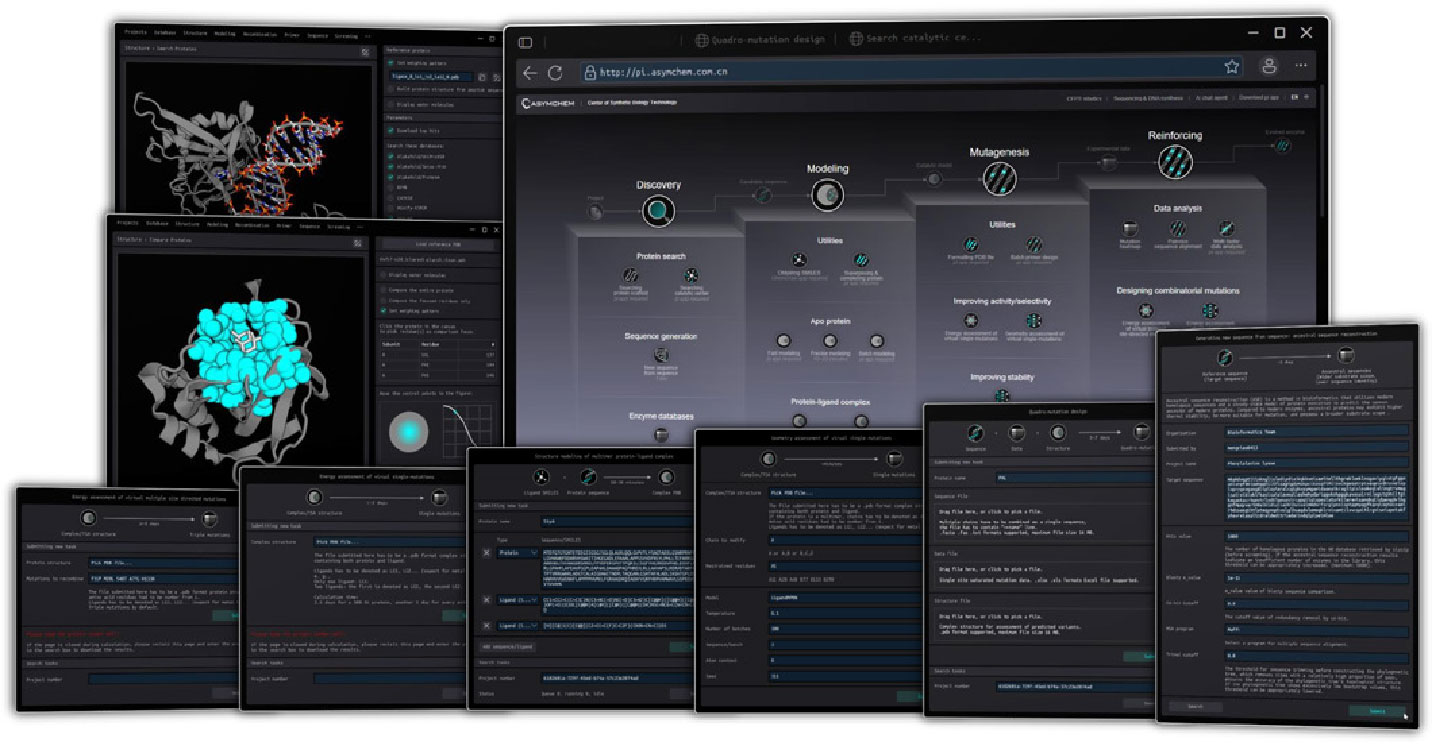
AI-Powered Enzyme Design
Enzyme engineering is often among the most time-consuming stages of process development, making it natural target for AI-enabled innovation. Traditional optimization typically requires multiple rounds of directed evolution and extensive high-through screening. Meanwhile, general-purpose protein foundation models may struggle to address industrial requirements including non-natural substrates and harsh conditions. Asymchem addresses these challenges through vertical AI models built specifically for industrial enzyme engineering. These models integrates proprietary knowledge, experimental data, mechanistic understanding, and extensive project experience. By combining foundation models with industrial fine-tuning, AI can identify promising variants more rapidly than conventional methods. This approach has demonstrated strong results in peptide ligase engineering: In an initial study, over 100 candidates initially showed conversion rates below 10%. With AI-guided design, Asymchem generated artificial peptide ligases with less than 30% sequence identity to natural enzymes while achieving conversion rate over 80%. Similar successes have been achieved with ketoreductases, hydrazone reductases, and oxidative cleavage enzymes, shortening timelines from concept development to ton-scale production.
This marks a shift from predominantly experience-driven engineering toward intelligence-assisted design. By combining scientific expertise with AI-enabled prediction, Asymchem can reduce uncertainty, focus resources on the most promising candidates, and accelerate the transition from discovery to manufacturing.
Machine Learning for Process Development
Chemical process development often involves evaluating thousands of possible combinations of temperature, pressure, solvent, catalyst, reagent, and other process parameters. In peptide synthesis, coupling reactions alone may yield tens of thousands of potential permutations. Exhaustive testing these combination is both costly and time-consuming. To address this challenge, Asymchem has established a machine learning-assisted high-throughput reaction design platform supported by extensive datasets and quantum-chemistry-derived molecular descriptors. In peptide synthesis, this platform has been used to investigated and predict amino acid racemization during coupling. Machine learning analysis identified three key contributors: the properties of the activated ester, base strength, and solvent polarity. Gradient Boosting Models, Random Forests, and Bayesian Neural Networks achieved classification accuracies of approximately 86–90% in predicting racemization outcomes under different coupling conditions, while providing interpretable insights into the underlying reaction mechanisms. Across multiple projects, AI-guided optimization improved yields above 90%, reduced impurity formation and product racemization, and lowered cost through the identification of optimal reaction conditions.
Computational Modeling and Green Chemistry
One of the major inefficiencies in pharmaceutical development is extensive experimental screening required to identify suitable solvents and other reaction conditions. Asymchem integrates Molecular Dynamics, Molecular Mechanics, Quantum Mechanics, and machine learning into virtual screening workflows, enabling evaluation of molecular behavior before lab work begins. In peptide manufacturing, AI-assisted solvent screening is used to assess aggregation, solubility, stability, and purification performance. Poorly performing candidates can therefore be eliminated computationally. The same strategy is applied to the design of Tag molecules for Tag-assisted Peptide Synthesis (TAPS). Machine Learning enables the rapid screening of large molecular libraries, while quantum mechanical calculations provide high-accuracy predictions for selected candidates. By combining computational speed with scientific validation, this approach has reduced screening cycles, shortened development timelines, and promoted green chemistry objectives through optimized solvent and reagent choices.
AI-Driven Impurity Annotation
Modern analytical platforms generate large volumes of complex data that traditionally require extensive interpretation by experts. To improve the speed and consistency of this work, Asymchem developed LC-MS impurity annotation platform that integrates sequence prediction, rule-based candidate generation, de novo sequencing, MS/MS spectrum prediction, retention time prediction, and automated scoring. Once analytical data is uploaded, the platform standardizes formats, generates potential impurity – candidates, predicts spectra, compares those predictions with experimental results, and ranks the most likely matches – Scientists receives prioritized recommendations rather than having to evaluate every possibility manually. This system has increased impurity identification efficiency by approximately fivefold, reducing analysis time from hours to minutes. In one application, the resulting analytical and process insights supported a purity upgrade from 60% to 98%. Importantly, each completed annotation feeds to a growing knowledge base, converting individual expertise into reusable institutional intelligence.
Building an Intelligence Ecosystem for the Future
As a core principle of its business operations, Asymchem considers the protection of client intellectual property and data privacy to be a fundamental obligation and the foundation of its business practices. Through secure data governance and a fully internal closed-loop framework for core AI and R&D activities, Asymchem continues to advance trusted AI capabilities while maintaining industry-leading standards of confidentiality and security.
Industrial AI demands more than advanced algorithms – It depends on data integrity, systematic knowledge capture, scientific governance, and effective integration across the organization. At Asymchem, this foundation has been developed over decades in the making.
This is where the distinction between artificial intelligence and Asymchem Intelligence become critical. Artificial Intelligence provides the computational engine – the ability to learn, predict, classify and optimize. However, that engine requires fuel. At Asymchem, the fuel is the intelligences we have acquired over decades in the industry: cumulative scientific rigor, process understanding, manufacturing expertise, proprietary data, and institutional memory embedded in our people and system.
Asymchem Intelligence transforms general-purpose algorithms into domain-relevant tools. It helps ensure that machine-generated insights remain grounded in chemical reality, practical process constraints, and the requirements of pharmaceutical development and manufacturing. The integration extends across Asymchem’s broader digital ecosystem, including scientific knowledge bases, secure AI platforms, intelligent agents, predictive maintenance tools, EHS assistants, and AI-enabled scientific writing. Each capability draws upon decades of CDMO experience while contributing new knowledge back into the organization.
Looking ahead, we view this integration of Al with scientific and manufacturing expertise not as incremental improvement, but as a fundamental evolution in pharmaceutical R&D and manufacturing. The ultimate measure of success is not the complexity of the model, but the clarity and value of the outcome: faster development, more robust processes, improved quality, and more sustainable pathways to safe and effective therapies.
At Asymchem, we build AI not simply because technology is available, but because it can make a meaningful difference for our customers, for the future development of medicines and ultimately for the patients.


Becoming the “Customer of Choice”: A Strategic Imperative for CDMOs an...
Deriving health-based exposure limits for highly potent APIs: from reg...

HPAPI Management: From Categorization to Prevention – Practical...

Scaling, Adapting and Partnering: How Europe’s Chemical Sector Can Sta...

Regulatory affairs as the connective tissue of pharmaceutical product...

Advancing Antibody–Peptide Conjugates Through Controlled Conjugation a...

Baxdrostat (Baxfendy)