Introduction
Polymorphism, defined as the capacity of a chemical substance to crystallize in more than one solid-state form, has major consequences for pharmaceutical and fine-chemical development. Differences in lattice structure may affect solubility, dissolution, hygroscopicity, filtration and drying behavior, as well as long-term stability (1).
These attributes are routinely investigated and optimized during the development process.
Polymorphs are not merely alternative “appearances” of a molecule. In the domain of solid-state chemistry, a single molecular entity has the capacity to crystallize into a variety of lattices, hydrates, solvates, salts with distinct crystalline modifications, or mixtures of crystalline phases.
For active pharmaceutical ingredients (API), these distinctions can govern manufacturability (filterability, drying, flowability, compaction), quality (propensity to convert during storage, moisture uptake), and performance (solubility and dissolution behavior that may influence bioavailability). Consequently, the screening of polymorphisms and the selection of solid forms have become integral components of the pharmaceutical development process (2).
Polymorphic compounds claimed in a patent application often straddle the line between a substantial technical contribution and a conventional screening evaluation.
Novelty and inventive step are the main requirements for assessing the patentability of an invention.
The establishment of these two requirements is achieved through a prior art search, which is conducted using patent and scientific literature databases. Patent searches are carried out using a variety of methods. One approach involves the use of keywords, while another utilizes classification symbols or a combination of both of them (3).
Additionally, the structure formula of the compound can be employed as a means of searching (4).
While both elements are of significance, the inventive step frequently emerges as the pivotal validity issue in the context of pharmaceutical and chemical patents.
European patent law must address a persistent tension. From a scientific perspective, the emergence of a new polymorph can be considered non-trivial. This is due to the fact that the existence of a polymorph, as well as its properties, cannot be predicted with certainty in advance. From another perspective, the process of identifying polymorphs frequently entails systematic experimentation that skilled teams commonly undertake. Granting a patent for the outcome may inadvertently capture routine optimization rather than significant technical progress. (5, 6) The Boards of Appeal (BoA) at the European Patent Office (EPO) address this tension through conventional patentability concepts, albeit with a distinctive evidentiary emphasis.
Methods and results
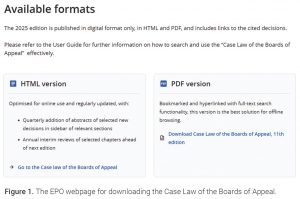
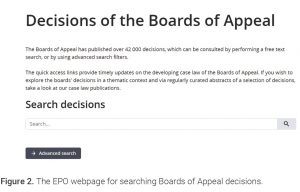
There are two methods for retrieving the main decisions of the EPO Board of Appeals. The first method is to consult the Case Law (7), which is available on the EPO website in two formats (HTML and PDF, see Figure 1). The second method is to perform a free text search or use advanced search filters in a database provided by the EPO, as depicted in Figure 2. (8) The advanced search is arguably the optimal option due to the extensive array of search fields available, including but not limited to Case number, IPC, Applicant, and other relevant criteria. The results can be further refined through the use of additional fields, such as “Decision Type” and “Date of Decision,” among others.
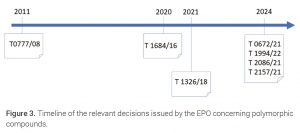
A total of seven EPO decisions (T 777/08, T 1684/16, T 1326/18, T 672/21, T 1994/22, T 2086/21, and T 2157/21) were identified that addressed the subject in question.
Discussion
Novelty
The concept of novelty is fundamentally factual in nature. To be considered novel, a claim must not have been previously disclosed in the state of the art. The state of the art is defined broadly as everything made available to the public before the filing date of the patent application, whether through written publication, oral description, public use, or any other means of communication.
The concept of novelty is evaluated in accordance with the “direct and unambiguous disclosure” standard, encompassing both explicit and implicit disclosures. Given the significance of public availability, the necessity of maintaining confidentiality until filing is paramount. Disclosures made under a confidentiality agreement are not typically considered to be part of the state of the art.
Conversely, information may qualify as prior art simply because it was accessible to the public, even if it was unlikely to be found or read. A document could undermine novelty even if written in a rare language and misplaced in an unexpected part of a public library; what matters is accessibility, not practical discoverability. The novelty assessment involves a comparison of each claim with individual items of prior art.
The novelty assessment involves a comparison of each claim with individual items of prior art. The novelty of an invention is not satisfied by a prior-art disclosure that encompasses all the features of the claimed invention. It is not permissible to combine elements from different disclosures to construct an anticipation case (so-called “mosaicking”); that kind of aggregation belongs to inventive step rather than novelty. If the prior art differs by even one feature—however minor—the claim is novel and the focus typically shifts to whether the difference is obvious.
T 1326/18: inherent anticipation
In T 1326/18 (10), the Technical Board of Appeal evaluated the novelty of a claim pertaining to a specific polymorph, designated as the “α2 crystalline form” of Imatinib mesylate, in accordance with Article 54 of the European Patent Convention (EPC).
The claim delineated the solid form by an XRPD peak pattern and also recited functional attributes (stability at elevated temperature and free solubility in water).
The Board applied the established EPO novelty standard, which stipulates that a claim lacks novelty if the prior art renders the claimed subject-matter accessible to the skilled person in a clear and unambiguous manner. In the context of product claims, this can encompass implicit (or inherent) disclosure, wherein an antecedent teaching invariably gives rise to the claimed product, despite the absence of explicit characterization in the antecedent document. The primary novelty prior art cited was Document D2 (corresponding to PCT application No. WO 2004/074502 A2), which is pertinent under Article 54(3) EPC.
The Board determined that the execution of Example 3 of D2 invariably results in the α2 polymorph. This finding led the Board to conclude that D2 discloses the claimed subject matter through inherent disclosure, despite the absence of an explicit XRPD fingerprint in D2 itself.
Inventive step
The inventive step is evaluated through the problem-solution approach. In polymorph cases, it is often decisive whether the claimed form provides an unexpected technical advantage over the closest prior art, as opposed to merely an alternative solid form.
The evaluation of inventive step is a process that requires additional consideration with respect to novelty (11).
A claim may be deemed unpatentable, despite its novelty, if it appears to represent a development that an ordinary skilled person would naturally arrive at without the need for inventive skills.
The primary function of patents is to provide protection and incentives for high-cost research and development (R&D). However, it is crucial that the patent system does not inadvertently grant monopolies over predictable or routine variants that do not contribute significantly to the advancement of the relevant technical field.
A core benchmark is the “person skilled in the art.” According to the prevailing jurisprudence of the European Patent Office (EPO), the hypothetical practitioner in question is characterized by an average degree of competence, adequate information, and the capacity to execute routine tasks. However, this practitioner is not regarded as being particularly inventive or imaginative.
The inventive-step assessment must be conducted from this standpoint at the filing date of the patent application and should avoid hindsight. The relevant question is whether the prior art would have made the claimed solution a realistic and motivated step for that skilled person.
To make the inventive step analysis more structured, the EPO developed the “problem-solution approach.”
In summary, the examiner (i) identifies a closest prior-art disclosure as the most realistic starting point, (ii) delineates an objective technical problem that the invention credibly solves from that initial point, and (iii) asks whether a skilled person would have arrived at the claimed solution. A distinguishing feature is the “would not could” logic, which asserts that the technical feasibility of a modification alone is not sufficient to establish the lack of inventive step. Instead, the prior art must provide a rationale or an incentive that would guide the skilled individual toward the specific solution in question (12).
In the domain of polymorph disputes, the distinguishing feature is frequently the crystalline form itself. The pivotal question, therefore, is whether the form solves a technical problem beyond providing an alternative and whether the prior art would have led the skilled person, with a reasonable expectation of success, to that solution.
The Case Law of the Boards of Appeal (CLBA) reflects the prevailing perspective on the subject, stating that “polymorphs can generally be obtained by known methods” and that “methods of screening for polymorphs” are considered part of the skilled person’s routine activities. The CLBA also underscores the counterweight: it is generally not possible to predict the existence of polymorphs or the properties they might display. Therefore, a new polymorph may be inventive if it exhibits unexpectedly advantageous properties.
Decision T 777/08: routine screening and the absence of unexpected advantage
Decision T 777/08 (13) is frequently cited due to its establishment of a seminal baseline for the concept of polymorph inventive step. The Board of Appeal stated that, “in the absence of any technical prejudice and in the absence of any unexpected property,” “the mere provision of a further crystalline form of a known pharmaceutically active compound cannot be regarded as involving an inventive step.”
The proposition should be interpreted as a fundamental principle that governs the problem-solution approach.
In the absence of a credible technical advantage, it is probable that the objective technical problem will be reformulated as the provision of an alternative solid form. Routine screening will generally render this solution apparent.
The decision’s practical implications are evidentiary in nature. The patentee must identify a plausible closest prior art form, demonstrate a technical effect over that form, and show that the effect is attributable to the polymorph as claimed. Absent these elements, the patent is treated as capturing the output of routine screening rather than a non-obvious technical contribution.
Decision T 1684/16: unpredictability and “reasonable expectation of success”
In the 1684/16 case (14), the standard has been refined by way of a clarification of the circumstances in which routine screening alone is insufficient to establish inventive step. The Board acknowledged that prior art taught polymorph investigation “in order to isolate the crystalline form having the most desirable properties,” but held that this “in itself is not sufficient to deny inventive step.” The patent’s validity may be contested on the basis of inventive step only in the event that the prior art clearly indicates the claimed solution or creates a “reasonable expectation” that the suggested investigation will successfully address the objective problem.
The Board grounded this reasoning in solid-form unpredictability, including the additional complexity associated with solvates/hydrates.
From a doctrinal perspective, unpredictability serves as a constraint on the “obvious to try” inference, which posits that the mere fact that a skilled person performs screening does not inherently imply that said person anticipates obtaining the specific advantageous form claimed. T 1684/16 underscores that the prior art must indicate, at least in a directional sense, that the relevant property can be achieved and that the claimed form is a plausible route to it.
Decision T 672/21
The subject of T 672/21 decision (15) was Selexipag Form III. The Board acknowledged that the claimed polymorph exhibited enhanced industrial processability, characterized by superior control of particle size distribution and the absence of inadequate particle size distribution control. This property enabled the development of production routes of practical relevance.
The decision is of doctrinal significance because it provides a framework for understanding the technical contribution in concrete manufacturing terms. In this sense, the polymorph is not merely “another” form but rather a form that resolves process limitations.
Decision T 1994/22
In the case of T 1994/22 (photostable Form II), the Board determined that a polymorph may be considered inventive if it exhibits “unexpectedly advantageous properties,” such as enhanced photostability coupled with good solubility. This decision (16) indicates that a favorable combination of properties can itself be the unexpected advantage when the prior art does not suggest that the claimed form will deliver that profile.
Decision T 2086/21
T 2086/21 (Apalutamide Form B) represents a progression from the preceding concepts, implementing them within the problem-solution framework (17).The Board rejected the opponent’s characterization of the invention as a routine “try and see” exercise yielding only a “bonus effect.” It was emphasized that the claimed polymorph’s purportedly advantageous profile—namely, solubility, stability, filterability, and drying—could not be reliably achieved through conventional experimentation. Consequently, it was deduced that this profile might constitute a non-obvious technical contribution. The decision also integrates the post-published evidence framework [including discussion of plausibility after G 2/21 (18)] when assessing whether the asserted advantage can be relied upon in the inventive-step analysis.
In the context of the preceding three decisions, the “unexpected advantage” requirement is not disregarded. Instead, it is adapted to development realities in which the value of a polymorph often lies in a multi-parameter performance profile that supports stable manufacture and use. The Board of Appeal appears willing to recognize inventiveness in such profiles, but only where the patentee can demonstrate, with claim-faithful evidence, that the profile is attributable to the claimed form and not something the skilled person would expect to obtain as a routine consequence of screening.
T 2157/21: failure by lack of attribution
The decision rendered in T 2157/21 (19) serves as a cautionary example, demonstrating the limitations of the inventive step when the claimed advantage of the polymorph cannot be substantiated. The case in question pertained to crystalline “Form II” of trisodium Valsartan Sacubitril. The Board determined that the patent failed to disclose whether the samples evaluated for enhanced properties were obtained in accordance with one of two distinct preparation methods. Additionally, there was an inability to confirm that the purported form (as delineated by the pertinent diffractogram/table) corresponded to the examined material.
As the superiority of the claimed form over the closest prior art was not demonstrated, the objective technical problem was reformulated as the provision of a further crystalline form of the known compound. The Board then applied the routine-screening default, which states that in the absence of a technical prejudice and of a proven technical advantage, the mere provision of a further crystalline form cannot involve an inventive step. Therefore, T 2157/21 emphasizes that the objective of the inventive-step inquiry is not to determine whether the patentee can demonstrate the efficacy of “Form II”; rather, it is to ascertain whether the claim, as articulated, is substantiated by evidence that validates the claimed form’s possession of the requisite advantage.
Conclusions
According to the prevailing EPO case law, the categorization of polymorph patents as inherently suspect is not a prevailing legal stance. Instead, it employs a structured, evidence-centered doctrine that differentiates routine discovery from a non-obvious technical contribution. The determination of novelty hinges on the direct and unambiguous disclosure of the same solid form, whether explicitly or implicitly through inevitable reproduction. For the purpose of determining inventive step, the critical issue is whether the polymorph delivers an unexpected technical advantage—or a non-predictable balance of beneficial properties—over the closest prior art, and whether that advantage can be credibly attributed to the form as claimed. If the technical problem is formulated in terms of providing an alternative crystalline form, the solution is likely to be considered obvious. Inventive step is more likely where the claimed polymorph solves a different problem by providing an unexpected technical advantage (or an unexpected balance of beneficial properties) that the skilled person could not reasonably predict from the prior art.
- Raza K, Kumar P, Ratan S, Malik R, Arora S (2014) Polymorphism: The Phenomenon Affecting the Performance of Drugs. SOJ Pharm & Pharm Sci. 2017; 1(2), 10. DOI: http://dx.doi.org/10.15226/2374-6866/1/2/00111
- Kesisoglou F, Wu Y. Understanding the Effect of API Properties on Bioavailability Through Absorption Modeling. AAPS J 2008; 10, 516–525 https://doi.org/10.1208/s12248-008-9061-4
- Barbieri, M. Hydrogen Peroxide Industrial Production: A Patent Landscape Study. Eng. Proc. 2024; 67, 88. https://doi.org/10.3390/engproc2024067088
- Barbieri M. Searching for patent information on chemical compounds using open access public sources. Chemistry Today 2025; 43(6)
- Chung H M, Matharu B, Pownall J. Polymorphs: Clearing the Inventive Step Hurdle at the European Patent Office (EPO). 2025 Available at: https://www.hgf.com/knowledge-hub/polymorphs-clearing-the-inventive-step-hurdle-at-the-european-patent-office-epo/ (accessed on 3 January 2026)
- Ash E. Polymorphs at the European Patent Office. (2025) Available at: https://www.gje.com/resources/polymorphs-at-the-european-patent-office/ (accessed on 3 January 2026)
- Case Law of the Board of Appeal. Available at: https://www.epo.org/en/legal/case-law (accessed on 3 January 2026)
- Database of the EPO Board of Appeal decisions. Available at: https://www.epo.org/en/results?filters=%5B%5D&sortField=&sortDirection=&q=&tab=boa (accessed on 3 January 2026)
- Atkinson J, Jones R. Novelty in Chemical and Pharmaceutical Patents: A Concise Overview, Future Med Chem. 20113:3, 253-255, DOI: 10.4155/fmc.10.268
- Decision T 1326/18 22-04-2021. Available at the EPO website: https://www.epo.org/en/boards-of-appeal/decisions/t181326eu1 (accessed on 4 January 2026)
- Atkinson J, Jones R. Determining an Inventive Step for Chemical Patents, Future Med Chem. 2011 3:15, 1851-1854, DOI: 10.4155/fmc.11.146
- Guidelines for Examination in the European Patent Office (April 2025 Edition), Problem-solution approach. Available at: https://www.epo.org/en/legal/guidelines-epc/2025/g_vii_5_1.html (accessed on 3 January 2026)
- Decision T 0777/08 (Atorvastatin polymorphs/WARNER-LAMBERT) 24-05-2011. Available at: https://www.epo.org/en/boards-of-appeal/decisions/t080777ex1 (accessed on 3 January 2026)
- Decision T 1684/16 03-03-2020. Available at the EPO website: https://www.epo.org/en/boards-of-appeal/decisions/t161684eu1 (accessed on 3 January 2026)
- Decision T 0672/21 15-04-2024. Available at the EPO website: https://www.epo.org/en/boards-of-appeal/decisions/t210672eu1 (accessed on 3 January 2026)
- Decision T 1994/22 15-04-2024. Available at the EPO website: https://www.epo.org/en/boards-of-appeal/decisions/t221994eu1 (accessed on 3 January 2026)
- Decision T 2086/21 14-05-2024). Available at the EPO website: https://www.epo.org/en/boards-of-appeal/decisions/t212086eu1 (accessed on 3 January 2026)
- Decision G 0002/21 (Reliance on a purported technical effect for inventive step (plausibility)) 23-03-2023. Available at the EPO website: https://www.epo.org/en/boards-of-appeal/decisions/g210002ex1 (accessed on 3 January 2026)
- Decision T 2157/21 20-06-2024. Available at the EPO website: https://www.epo.org/en/boards-of-appeal/decisions/t212157eu1 (accessed on 3 January 2026)

The Algorithmic Antagonist: Why AI is Pharma’s Newest Competitor

THE INTEGRATION IMPERATIVE: ADVANCING TIDES MANUFACTURING THROUGH BIOC...

PEER REVIEWED – Scaling Mechanochemistry via Continuous Bead Mil...

Difamilast

The Role of Workers and their Management Teams in Establishing and Mai...

PEER REVIEWED – Crystallization and Particle Engineering – The H...
A Bird’s-Eye View of Global Chemicals M&A

The evolving role of PGMs: sustainability in the market context