Synthetic Oligonucleotides and the oligonucleotide Space
Synthetic oligonucleotides lie at the very core of progress in biotechnology and pharmaceutical R&D. Their properties and functionalities are unparalleled, spanning a broad spectrum of applications: from short, unmodified DNA oligonucleotides for routine PCR workflows, to long, highly purified sequences for cloning, extensively modified oligonucleotides for diagnostic use, and oligonucleotides employed as therapeutic agents.
A wide range of parameters define an individual oligonucleotide, including:
- Sequence
- GC content
- synthesis scale
- sugar backbone chemistry
- phosphate backbone type
- chemical modifications
- purification level
Taken together, these parameters constitute what is commonly referred to as the oligonucleotide space—a highly multidimensional representation capturing the full complexity and diversity of synthetic oligonucleotides (Scheme 1).
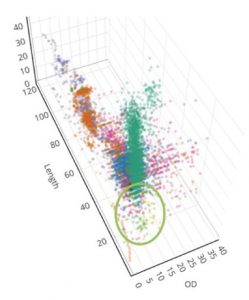
Scheme 1. a) Representation of Oligonucleotide space by real-life data from the Microsynth manufacturing process. Dark green: Desalted non-modified Oligos, Pink: HPLC purified non-modified Oligos, Blue: 5’ and 3’ modified Oligos (Probes), violet: PAGE purified Oligos, Orange: IEX-HPLC purified Oligos, light green (Therapeutic Oligonucleotides, ASO, siRNA).
Therapeutic oligos within the oligonucleotide space
Within the oligonucleotide space, therapeutic oligonucleotides—such as antisense oligonucleotides (ASOs) and siRNA—represent an own, defined molecular class. Also in this domain, the effective space is huge and expanding with the emergence of new therapeutic approaches, including CRISPR- and ADAR-based technologies, as well as increasingly advances conjugation chemistries.
Classical ASOs and siRNA are typically characterized by oligonucleotide lengths of approximately 15–23 nucleotides, the incorporation of 2′-modified sugar chemistries, and optional modifications to further optimize molecular properties, for example with respect to delivery, stability, or cellular uptake.
When focusing specifically on the therapeutic oligonucleotide space, the overall oligonucleotide space can be structured along a set of key modalities shown in Scheme 2.
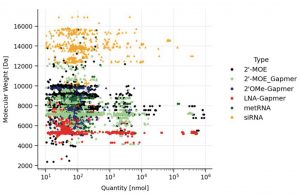
Scheme 2. Color-coded representation of different classes of therapeutic oligonucleotides. Grouped on a molecular weight vs. yield axis. Dots represent full PTO molecules, triangles represent partial PTO oligonucleotides.
Therapeutic oligonucleotide space represents different therapeutic modalities which can be grouped into:
- LNA gapmers (red), which are deliberately shorter than most other therapeutic oligonucleotides. This reduced length is enabled by the high binding affinity conferred by LNA modifications, allowing potent target engagement with fewer nucleotides.
- Full MOE or Full 2′Omethylmodified antisense oligonucleotides (ASOs) are more diverse in length (black, green and blue) and average longer than LNA Gapmers.
siRNAs (orange), which are typically modified with 2′Omethyl and 2′fluoro substitutions to enhance stability and performance.
Data represents, that nearly all LNA-Gapmers exhibit full PTO Backbones (full PTO Backbone by dots). Full MOE or 2’ OMe Oligonucleotides at a majority use full PTO backbone. In contrast, the siRNA compounds almost exclusively use partial PTO backbones (triangles).
Each Therapeutic modality is seen to come as distinct clusters of targeted or non-targeted molecules (higher mass by GalNAc clusters or further conjugation i.e. Lipids…)
Besides visualizing the clustering on the individual therapeutic modalities within the Oligonucleotide space, Scheme 2 shows data representing aspects of quantities (nmol, mg) used for typical discovery and development trajectories. Early discovery efforts are characterized by lownanomole screening experiments, enabling the parallel evaluation of many sequences and modification patterns, which are then narrowed down to the lead candidates. As projects progress, material requirements increase to the fewmilligram to tensofmilligram range for in vivo efficacy studies. Ultimately, substantially higher quantities are required for in vivo toxicology and advanced preclinical studies, resulting in distinct clustering along the yield dimension.
BLEEDnFIRE Therapeutics has implemented and launched a discovery program that closely follows this exact development scheme. This program is described below as a case study, highlighting key aspects and decision points at each stage of the discovery workflow.
Case study: Development of siRNA therapeutics for rare bleeding disorders – walking the oligonucleotide space
Rare bleeding disorders
Inherited rare bleeding disorders comprise a heterogeneous group of diseases with widely varying prevalence, clinical severity, and molecular etiology. Von Willebrand disease (VWD) is the most common inherited bleeding disorder, while many others are rare or ultrarare. Despite significant advances in therapy, there remains no broadly applicable, longacting, subcutaneously administered treatment that can be used across different bleeding disorders with low dosing frequency.
Hemophilia and coagulation factor deficiencies
Hemophilia A and B are Xlinked bleeding disorders caused by deficiencies of coagulation factor VIII or IX. Severe cases are characterized by spontaneous bleeding, particularly into joints, leading to progressive joint damage and longterm disability. Current management relies on factor replacement therapy or nonfactor approaches, which have markedly improved outcomes but remain limited by treatment burden, inhibitor development, and incomplete protection of joint health.
Beyond hemophilia, a spectrum of factor deficiencies—including factor XI deficiency—results in variable bleeding phenotypes. In many of these disorders, bleeding risk is poorly predicted by factor activity levels or routine laboratory tests, complicating individualized management. Treatment options are often empirical and focus on bleed control rather than longterm prophylaxis.
Von Willebrand Disease
VWD encompasses quantitative and qualitative defects of von Willebrand factor and ranges from mild to severe phenotypes. Standard therapies improve hemostasis but do not fully alleviate disease burden, as reflected by persistent qualityoflife impairments. Recent approaches aim to enhance endogenous coagulation capacity or rebalance hemostasis rather than simply replacing the missing protein.
Platelet disorders
Inherited platelet function disorders represent another heterogeneous category, ranging from defects in platelet adhesion to impaired aggregation. Bleeding severity varies widely, and treatment is largely supportive, relying on local measures, antifibrinolytics, or transfusionbased approaches. New strategies aim to bypass defective platelet function by amplifying thrombin generation at sites of vascular injury.
Rational
Hemostatic rebalancing as a unifying concept
Across bleeding disorders, a central therapeutic challenge is insufficient thrombin generation. This has led to the development of hemostatic rebalancing therapies, which restore clot formation by partially inhibiting endogenous anticoagulant pathways rather than replacing missing procoagulant factors. Such approaches offer the potential for broader applicability across diseases and reduced treatment burden (Scheme 3) (1).
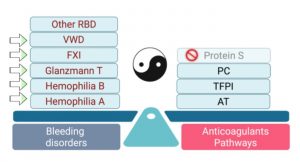
Scheme 3. The hemostatic balance. Maintaining a precise equilibrium between procoagulant and anticoagulant forces is essential to ensure unobstructed blood flow under normal conditions while allowing effective clot formation when needed. Inherited bleeding disorders-such as hemophilia A and B, von Willebrand disease (VWD), factor XI deficiency (FXI), and Glanzmann thrombasthenia (Glanzmann T) are characterized by insufficient production or function of specific coagulation factors or platelet receptors. These defects disrupt normal hemostasis and shift the balance toward bleeding. Conversely, when natural anticoagulant pathways are impaired, the equilibrium tilts toward thrombosis. Targeted inhibition of natural anticoagulants such as protein S in bleeding disorders offers a promising strategy to restore hemostatic balance and prevent both bleeding and thrombotic complications. AT, antithrombin; PC, protein C; RBD, rare bleeding disorders; TFPI, tissue factor pathway inhibitor.
Protein S (PS), encoded by PROS1, has emerged as a key regulator of thrombin generation and a promising rebalancing target. PS acts as a cofactor for activated protein C and tissue factor pathway inhibitor and, modulates coagulation through APCindependent mechanisms. Partial inhibition of PS has been shown preclinically to reduce bleeding without abolishing physiological anticoagulation, supporting its potential as a therapeutic target (2, 3).
Early clinical experience with PStargeting strategies indicates sustained pharmacodynamic effects after infrequent subcutaneous dosing and activity across multiple bleeding phenotypes. These findings support the concept that modulating central anticoagulant regulators may enable more universal, lowfrequency treatment paradigms (4).
BLEEDnFIRE Therapeutics discovery program
A successful discovery program has been built around protein S as a promising target. The discovery program following a three step discovery pattern was applied, progressing from broad screening to the selection of target lead candidates, followed by advancement into toxicology and preclinical studies (Scheme 4).
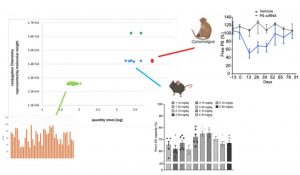
Scheme 4. Schematical representation of the discovery program of BnF-001 – including the compounds used for the study plotted as nmol quantities (log scale) in x-axis as well as conjugated vs. non conjugated compounds displayed by molecular weight (y-Axsis). Screening started with a large library (<250 candidates). A refined selection of 96 unconjugated siRNA (light blue) yielded 5 lead candidates which were GalNAc conjugated (orange) and were used for in vivo studies (red). Reference siRNA (dark green). KD: knockdown, PS: protein S (4).
BnF-001 (PS-siRNA)– successful GalNAc-conjugated siRNA lead candidate
Our protein S siRNA BnF-001 is a promising rebalancing therapy for hemophilia and related inherited bleeding disorders, including HA and HB, VWD, FXI deficiency and Glanzmann thrombasthenia while other RBD are being explored. These conditions share a common feature such as excessive bleeding due to insufficient clotting factors or platelet receptors. By selectively reducing the natural anticoagulant protein S, BnF-001 restores hemostasis, improves clot formation and prevents bleeding, offering the potential for a universal treatment across multiple disorders (4, 5).
BnF-001 (PS-siRNA), a GalNAc-conjugated siRNA, targets hepatocytes—the main source of protein S—while preserving protrein S production elsewhere, helping avoid thrombotic complications seen with other rebalancing strategies. BnF-001 administration to hemophilia A mice has also shown joints and bone health improvements, a benefit not observed with current therapies (2, 4).
As a cost-effective and scalable RNA therapeutic, BnF-001 modulates disease pathways not easily addressed by traditional modalities and may be especially valuable in low-income settings. Classified as an ATMP, it may benefit from an accelerated authorization process, and as a rare disease therapy.
Screening and lead selection
From large siRNA library, a lead sequence was selected and tested in 96 modification variants. These 96 siRNA were tested in hepatocytes for in vitro PROS1 knockdown. Twenty-five leads achieved >40% knockdown.
The five most efficient modification patterns were selected for further studies in vivo in mice. The five leads were then synthesized with the selected GalNAc and linker for in vivo testing. Wild-type (WT) mice received either 10 or 30 mg/kg S.C. dose. Pros1 knockdown and tolerability were evaluated after fourteen days. All five leads showed similar in vivo performance, were well tolerated with no signs of disseminated intravascular coagulation and achieved 65–90% Pros1 knockdown (Fig. 1A-B) (4).
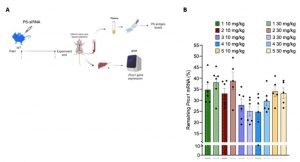
Figure 1. ln vivo testing of five siRNA leads in WT mice.. (A) schematic of the experimental design. (B) WT mice received a single dose of 10 or 30 mg/kg leads siRNA on day 1 and monitored for 14 days. At day 14, mice were sacrificed and blood collected. After full blood count, plasma was isolated for measurement of PS antigen levels. Liver biopsies were collected for quantitative real-time PCR analysis for Pros1 mRNA expression normalized to ApoB.
Testing in hemophilia A:
The proof-of-concept for using anti protein S strategies to rebalance hemostasis in hemophilia was first established in transgenic mouse models. Genetic targeting of Pros1 in HA and HB mice significantly reduced bleeding, with the most pronounced effects observed in intra-articular hemorrhage models (3).
To translate these genetic findings in HA mouse models, subcutaneous BnF-001 administration produced sustained reductions in plasma protein S levels and robust protection in multiple bleeding challenges, including induced hemarthrosis (Fig. 2A) and saphenous vein puncture (Fig. 2B). These effects were accompanied by normalization of global hemostatic parameters, such as rotational thromboelastometry profiles and thrombin-generation kinetics (4).
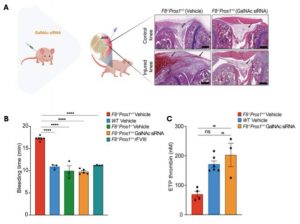
Figure 2. Protein S (PS) inhibition as a potential therapy for bleeding disorders: preclinical evidence in mice. (A) Microscopic evaluations (hematoxylin and eosin stain) of the knee intra-articular space of a representative, uninjured knee (control knee) and injured knee; arrowheads indicate red blood cell extravasation. Scale bar, 200 μm. (B) PS-siRNA corrects the bleeding tendency in F8−/−Pros1+/+ mice. F8+/+Pros1+/+ and F8−/−Pros1−/− mice received only the vehicle. F8−/−Pros1+/+ mice were treated on day 1 with 10 mg/kg PS-siRNA, vehicle or, on day 7, 15 minutes before the end of the experiment, with 25 U/kg recombinant factor VIII (rFVIII). Saphenous vein bleeding puncture was conducted on day 7 in all 5 mice groups. The total duration of bleeding observed over a 20-minute period was very long in F8−/−Pros1+/+ mice treated with the vehicle, with bleeding persisting throughout most of the observation period. In contrast, F8−/−Pros1+/+ mice treated with PS-siRNA or 25 U/kg rFVIII had much shorter bleeding times, which were comparable with those observed in F8+/+Pros1+/+ and F8−/−Pros1−/− mice. (C) In another set of experiments, blood was drawn for thrombin generation assay. Thrombin generation was measured with the calibrated automated thrombography assay in presence of 1 pM tissue factor and 10 nM soluble thrombomodulin to enable protein C activation and full assessment of all protein S anticoagulant functions. Shown is endogenous thrombin potential (ETP). P values: ns, not significant; **P < .01; ****P < .0001, Brown-Forsythe analysis of variance, Dunnett T3 multiple comparisons test (2, 4).
Non-human primate (NHPs) studies demonstrated comparable hemostatic responses. In NHPs, PS-siRNA administered at 3 mg/kg achieved maximal reductions in total and free protein S (≈50% and 55%, respectively) between days 14–21, with sustained suppression through day 42 (Fig. 3A). In an NHPs model of acquired hemophilia, 3 or 10 mg/kg PS-siRNA restored thrombin generation to levels observed in healthy controls (Fig. 3B). Importantly, treatment was well tolerated, with no clinical or laboratory signs of coagulopathy or hypercoagulability, stable D-dimer levels, and no thrombotic events reported.
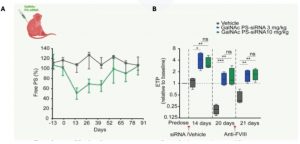
Figure 3. Effects of protein S targeting in non-human primate.
The pharmacological activity of PS-siRNA was assessed in a Cynomolgus monkey model of acquired hemophilia A. To induce acquired hemophilia, an anti-factor VIII (FVIII) antibody (PAHFVIII, 20,000 BU/kg) was administered intravenously on day 20. Twelve days prior to subcutaneous administration of PS-siRNA (3 or 10 mg/kg) or vehicle, a baseline blood sample was collected to determine free protein S plasma levels. Free protein S levels were subsequently measured on days 15, 29, 43, 71, and 85 after PS-siRNA or vehicle treatment. Endogenous thrombin potential (ETP) was determined from thrombograms and expressed relative to baseline values. Thrombin generation was measured by calibrated automated thrombography using 1 pM tissue factor and 3.5 nM soluble thrombomodulin to activate protein C and fully assess protein S anticoagulant function, P values: ns, not significant; *P < .05; **P < .01; ***P < .001; Brown-Forsythe anova, Dunnett’s T3 multiple comparisons test) (4).
Conclusion
Therapeutic oligonucleotide discovery programs operate within a highly complex and dynamic design space, in which biological functionality, chemical modalities, and manufacturability are intrinsically linked. As illustrated throughout this article, the oligonucleotide space provides a powerful conceptual framework to systematically describe this multidimensional landscape and to contextualize different therapeutic modalities, and development trajectories.
Structuring oligonucleotide space is not merely a descriptive exercise but can be a strategic tool that supports efficient therapeutic development and manufacturing. Particularly, in straight forward discovery programs in academic, near-academic and start-up environment where step-by-step proof of concepts can be achieved with limited financial, time and screening resources.
The work of BLEEDnFIRE Therapeutics showcases a successful siRNA discovery program starting from screening dozens of different compounds which are then narrowed down to 5 lead candidates which were conjugated for cellular uptake and further evaluated for in vivo efficacy and toxicology. Additionally, manufacturability has been evaluated. Ongoing work aims to select a lead and backup and produce a GMP-like batch for early CMC and dose-finding studies. PK/PD modeling will guide dose selection, followed by early toxicology to establish the therapeutic index. Pivotal efficacy studies will assess bleeding prevention and long-term bone outcomes, defining how controlled expression of PS by PS-siRNA delivers therapeutic benefit and supporting its nomination as the clinical candidate.
References and notes
- Cedric Hermans, Quentin Van Thillo , Glenn F Pierce, Maria Elisa Mancuso Balancing the benefits and risks of rebalancing coagulation in haemophilia, Lancet Haematol 2026; 13: e261–66
- Raja Prince Eladnani, Rim Diab, Anne Angelillo-Scherrer, Protein S as a therapeutic target, Journal of Thrombosis and Haemostasis, 2025.
- Raja Prince, Luca Bologna, Mirko Manetti, Daniela Melchiorre, Irene Rosa, Natacha Dewarrat, Silvia Suardi, Poorya Amini, José A. Fernández, Laurent Burnier, Claudia Quarroz, Maria Desiré Reina Caro, Yasuhiro Matsumura, Johanna A. Kremer Hovinga, John H. Griffin, Hans-Uwe Simon, Lidia Ibba-Manneschi, François Saller, Sara Calzavarini, Anne Angelillo-Scherrer, Targeting anticoagulant protein S to improve hemostasis in hemophilia, Blood, 2018.
- Prince Eladnani R, Schaeper U, Diab R, Aretz J, Vrotniakaite-Bajerciene K, Çaku S, Yasmin R, Li B, Reina Caro MD, Dames S, Eisermann M, Löffler K, Martinez A, de Laat B, Brodard J, Casini A, Kremer Hovinga JA, Allam R, Fernández JA, Griffin JH, Laffan MA, Majumder R, Ahnström J, Angelillo-Scherrer A, Enhancing hemostasis potency in hemophilia with a small interfering RNA targeting protein S, Journal of Thrombosis and Haemostasis, 2025. https://pubmed.ncbi.nlm.nih.gov/40154791/
- Rim Diab, Tanja Knopp, Mathieu Fiore, Sonia Avoue-celerier, Léonard Julien Simon Schacher, Raja Prince-Eladnani, Anne Angelillo-Scherrer,Enhancing hemostasis in glanzmann thrombasthenia via protein S inhibition Blood (2025) 146 (Supplement 1): 3025.

Novel Approaches to the Manufacturing of AOCs and Oligo-Peptide Conjug...

The Renaissance and Industrial (r)Evolution of Peptide and Oligonucleo...

Empowering the Full Lifecycle of Drug Development

Europe’s Critical Medicines Act: A Test of Health Sovereignty—and Indu...

The data beneath the disruption: why process maturity and data account...

Linerixibat (Lynavoy)

Science is not enough: the operational disciplines of venture capital...

Industry 5.0-Ready Laboratories: Beyond Automation Towards Human-Centr...