Introduction
The majority of chemical reactions are sequential processes, involving a series of steps, resulting in the formation of one or more intermediates.
An intermediate structure may be considered a distinctive feature of a chemical process, with the purpose of providing a specific end product.
Consequently, in addition to pursuing patent protection for a new chemical compound or a process, it may be particularly relevant to obtain protection for intermediate compounds.
In accordance with the European Patent Convention (EPC), chemical intermediates are to be regarded as autonomous chemical entities. It is important to underline that there is no general prohibition against the patenting of an intermediate compound. For an invention to be considered patentable, it is necessary that the criteria for patentability are met. These criteria include the presence of a technical character, the requirement of novelty, inventive step, and industrial applicability. It is evident from the jurisprudence of the European Patent Office (EPO) that while an intermediate may be considered patentable even if the final product is already known, it is essential that it provides a non-obvious technical contribution. This contribution is frequently identified in the role of the intermediate within an inventive synthetic route or its specific structural contribution to the final product.
Method and results
The landmark EPO decisions were retrieved both consulting the case Law of the EPO Boards of Appeal (1) and carrying out a search in a database provided by the EPO (2).
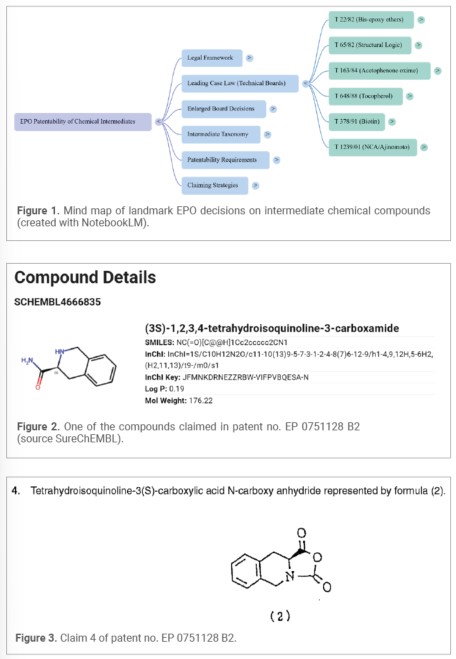
A total of six EPO decisions (T 22/82, T 65/82, T 163/84, T 648/88, T 378/91 and T 1239/01) were identified as leading cases that addressed the subject in question (see Figure 1).
The patents referenced in the Boards of Appeal (BoA) decisions can be retrieved by means of patent databases such as Espacenet or SureChEMBL (3).
Discussion
EPO decisions regarding chemical intermediates focus predominantly on inventive step (Article 56 EPC), although rulings on novelty and unity of invention have also been subject to some landmark decisions.
Novelty
Novelty is assessed using standard chemical invention rules: specific disclosures destroy generic claims, while generic disclosures do not necessarily anticipate specific species. A significant recent development was achieved with the G 1/23 decision (4). This decision clarified that a product placed on the market before the filing date constitutes prior art, even if its internal structure or composition could not be analyzed and reproduced by a skilled person at that time. This effectively establishes prior commercial availability as a substantial impediment to the novelty of an intermediate, even if it was not readily “reverse-engineerable.”
Inventive step
The EPO’s approach to assessing inventive step in the context of intermediate compounds has been shaped by a series of seminal decisions.
T 22/82 (Bis-epoxy ethers) is widely regarded as the classic starting point (5). It established that a new intermediate is considered to be inventive if its availability opens the way to the development a novel chemical process for preparing known products, provided that the process itself involves an inventive step (e.g., a surprising yield or a simplified synthesis route).
The T 163/84 (Acetophenone derivatives) decision was instrumental in effecting a necessary correction (6). The Board ruled that an intermediate does not inherently become inventive merely by being involved in an inventive multi-stage process. The inventive step must be assessed for each claim category based on its specific purpose and effects.
T 65/82 (Cyclopropane) is focused on structural logic. An intermediate must make a structural contribution to the final product. It is not inventive if it is an obvious “stop-over” or if another suitable compound was already available in the prior art for the same purpose. (7)
T 648/88 ((R,R,R)-Alpha-tocopherol) formulated a general principle often cited today, that the patentability criteria for an intermediate are the same as for any other substance. It is inventive if its availability enhances the state of the art in a non-obvious way, whether through its manufacture, transformation, or role in an overall inventive process. (8)
The Board stated that the intermediates exhibited inventiveness due to their incorporation within a novel six-stage process, which markedly diminished the number of steps required when compared to the existing state of the art (which necessitated 15 to 17 steps). This simplification of the overall process was regarded as an inventive enhancement of the prior art, thus justifying the patentability of the intermediates used within it.
The decision T 378/91 (Intermediates/SUMITOMO) is a key ruling by the EPO Technical Board of Appeal that established a new standard for assessing the inventive step of chemical intermediates, particularly those leading to known end products. (9)
The Board reaffirmed a fundamental principle established in earlier case law (specifically T 648/88): a chemical intermediate must be judged by the same criteria as any other chemical substance under Article 56 EPC.
There is no “preferential lane” or different yardstick for intermediates; the sole determination factor is whether the preparation of the compound enriches the art in a non-obvious way.
In applying the problem-solution approach, the Board determined that for an intermediate to be inventive, it is necessary to ascertain whether it is evident that:
- the skilled person had a non-obvious incentive to prepare that specific intermediate.
- the existence of prior art is instrumental in imparting the necessary knowledge to the skilled person, thereby enabling them to successfully achieve the claimed result.
The invention pertains to optically active intermediates (monoesters) employed in the synthesis of (+)-biotin.
The closest prior art described the racemate (a 50/50 mixture of enantiomers) of the claimed intermediate.
The technical problem pertained to the resolution of the racemate into its optically active forms, with a particular focus on the form necessary for biotin synthesis.
The opposition party advanced the argument that, given the existence of another document which detailed the resolution of analogous complex esters (cyclohexyl or cholesteryl esters), it would have been evident to implement the same resolution techniques with regard to the simpler alkyl esters claimed by Sumitomo.
The Board determined that the opponents’ arguments were founded upon hindsight, a practice known as ex post facto analysis. It was noted that in “real life,” the researchers who had written the prior art documents had relied on sterically hindered, complex alcohols for resolution despite being aware that simpler alcohols (such as those claimed) react more easily.
The Board concluded that:
- It is evident that no compelling incentive existed in the prior art to transition from the complex esters that had been utilized previously to the simpler ones that were claimed for the purpose of enantiomer resolution.
- Notwithstanding the apparent simplicity of the resolution, the specific provision of these optically active monoesters was not evident at the time of filing, as evidenced by the absence of prior art.
The most recent decision T 1239/01 (NCA/AJINOMOTO) confirmed that for in situ intermediates, the key question is whether the skilled person would have expected an improved conversion using that specific sequence (10).
The invention concerned a process for producing optically active amides (see Figure 2). A key technical feature of the process (Claim 1) was the formation of an N-carboxy anhydride (NCA) intermediate, which was then reacted with tert-butylamine “without its being isolated or purified”. The application also included a separate product claim (Claim 4) for the specific NCA intermediate itself (See Figure 3).
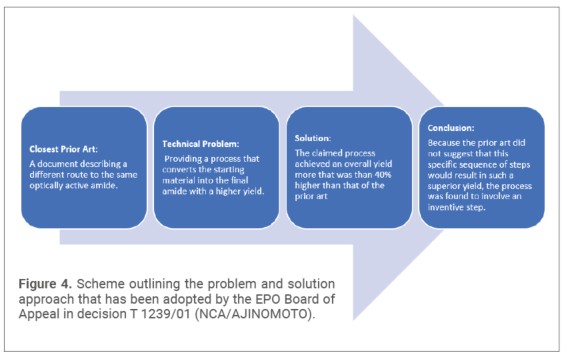
The Board assessed the inventive step of the complete process using the problem-solution approach (illustrated in Figure 4).
The Board then conducted an independent evaluation of the inventiveness of the NCA intermediate (Claim 4), which resulted in a known end product. The ruling established two critical points:
- The “Inventive Complete Process” Rule: Reaffirming principles set out in T 22/82 and T648/88 the Board held that an intermediate for a known end product is deemed inventive if it is prepared as part of a complete synthetic process that is itself inventive.
- The Test for Non-Obviousness: The Board clarified that the relevant question was not merely whether it was obvious to prepare that specific chemical structure. Instead, it asked whether a skilled person would have had reason to expect an improved conversion to the final product by using a sequence in which that specific NCA was formed as an intermediate.
- Result: Since the improvement in conversion could not be expected, the intermediate product claim was deemed to be inventive.
Patent strategies
Three categories of intermediates can be identified in EPO practice: isolated intermediates transient/reactive intermediates and intermediates for known/new final products.
Compounds that can be characterized as autonomous entities are considered to be the primary candidates for product claims.
In the event that the generation and consumption of short-lived species occurs in situ, these are typically protected via process claims (e.g., “forming intermediate X and converting it, without isolation, into product Y”).
Different strategies apply depending on whether the downstream product is already part of the state of the art or is novel.
In order to avoid the need for costly divisional applications, intermediates and final products should be claimed together by demonstrating a single general inventive concept.
Conclusions
The patentability of a chemical intermediate under the European Patent Convention (EPC) is determined by applying the same criteria that apply to any other invention; the classification as an “intermediate” does not entail stricter requirements or preferential treatment.
An intermediate chemical product may be patentable even if the final product is already known, provided that it makes a non-obvious technical contribution.
It is evident from the jurisprudence of the European Patent Office that there are multiple methods by which to demonstrate such a contribution.
An intermediate is considered inventive if:
- its availability facilitates a novel synthesis process for recognized end products that itself constitutes inventiveness, for instance due to unexpected yields, enhanced selectivity, or streamlined sequences.
- it contributes an essential structural element to the final product, thus differentiating it from prior art.
- its preparation or subsequent transformation enriches the state-of-the-art in a non-obvious manner.
References and notes
- Case Law of the Boards of Appeal. Available at https://www.epo.org/en/legal/case-law (Accessed on 7 June 2026)
- Decisions of the Boards of Appeal. Available at https://www.epo.org/en/case-law-appeals/decisions (Accessed on 7 June 2026)
- Barbieri, M. Searching for patent information on chemical compounds using open access public sources. Chem. Today 2025; 43(6): 60-63.
- Decision G 0001/23 of 02.07.2025. Available at: https://www.epo.org/en/boards-of-appeal/decisions/g230001ex1 (Accessed on 7 June 2026)
- T 0022/82 (Bis-epoxy ethers) of 22.06.1982. Available at: https://www.epo.org/en/boards-of-appeal/decisions/t820022ep1 (Accessed on 7 June 2026)
- T 163/84, Available at https://www.epo.org/boards-of-appeal/decisions/pdf/t840163dp1.pdf (Accessed on 7 June 2026)
- T 0065/82 (Cyclopropane) of 20.04.1983. Available at: https://www.epo.org/en/boards-of-appeal/decisions/t820065ep1 (accessed on 7 June 2026)
- T 0648/88 ((R,R,R)-Alpha-tocopherol) of 23.11.1989. Available at: https://www.epo.org/en/boards-of-appeal/decisions/t880648ep1 (Accessed on 7 June 2026)
- T 0378/91. Available at: https://www.epo.org/boards-of-appeal/decisions/pdf/t910378eu1.pdf (Accessed on 7 June 2026)
- T 1239/01 (NCA/AJINOMOTO) of 07.01.2004. Available at: https://www.epo.org/en/boards-of-appeal/decisions/t011239eu1 (Accessed 7 June 2026)

Becoming the “Customer of Choice”: A Strategic Imperative for CDMOs an...

Intelligence Amplified: A CDMO Perspective on Integrating R&D and...

Deriving health-based exposure limits for highly potent APIs: from reg...

HPAPI Management: From Categorization to Prevention – Practical...

Scaling, Adapting and Partnering: How Europe’s Chemical Sector Can Sta...

Regulatory affairs as the connective tissue of pharmaceutical product...

Advancing Antibody–Peptide Conjugates Through Controlled Conjugation a...

Baxdrostat (Baxfendy)