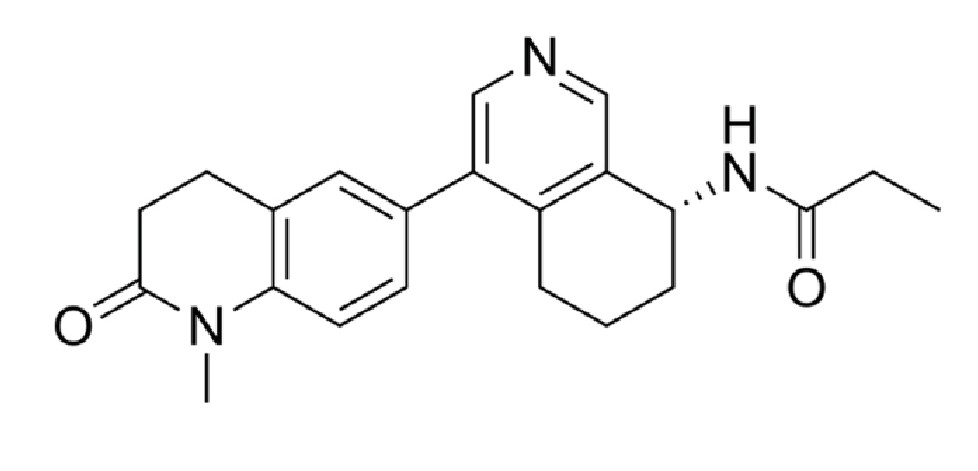
Selectively blocking aldosterone production has been one of the harder problems in cardiovascular medicinal chemistry. For decades, hyperaldosteronism and resistant hypertension were managed with mineralocorticoid receptor antagonists, which work but carry systemic side effects such as hyperkalemia and off-target hormonal disruption. The obvious next target was aldosterone synthase (CYP11B2) itself, and that is where the difficulty begins: CYP11B2 shares 93% amino acid sequence homology with CYP11B1, the enzyme responsible for cortisol synthesis. Earlier inhibitors could not separate the two, suppressing cortisol along with aldosterone and causing life-threatening adrenal insufficiency. Baxdrostat came out of structure-based drug design (SBDD). Researchers at Hoffmann-La Roche mapped the small conformational differences between the two active sites and engineered steric hindrance into the molecule to exploit them, reaching an in vitro selectivity of roughly 100:1 for CYP11B2 over CYP11B1.
The compound still had a long way to go clinically. It sat in Roche’s archive until investors built a company around it, CinCor Pharma, founded in 2018 as a clinical-stage biopharmaceutical. CinCor licensed the molecule, renamed it CIN-107, and ran it through Phase 1 and Phase 2, where the selectivity predicted in silico held up in patients without blunting cortisol. That is what drew AstraZeneca, which acquired CinCor in early 2023 and carried baxdrostat through its Phase 3 program.
Clinically, the target is treatment-resistant and uncontrolled hypertension, where existing options often fall short. Aldosterone is a major driver of target-organ damage and fluid retention, so shutting down its overproduction gives a new mechanism of action to patients who stay hypertensive on standard multidrug regimens.
The FDA approved baxdrostat in May 2026. Marketed by AstraZeneca as Baxfendy, it is the first and only aldosterone synthase inhibitor cleared for adults with uncontrolled hypertension, with trials still running in primary aldosteronism and chronic kidney disease. The whole effort turned on one problem: telling CYP11B2 apart from CYP11B1. Once that was solved, a target that had resisted inhibitors for decades became druggable.
The synthesis of baxdrostat starts from a ketone that already carries the isoquinoline skeleton, 4-bromo-6,7-dihydroisoquinolin-8(5H)-one (1), and follows a convergent logic: the tetrahydroisoquinoline fragment is built up with its stereocenter set, the dihydroquinolinone is prepared separately, and the two pieces only meet later, in a cross-coupling.
The opening strategic move is installing the C8 nitrogen with control of configuration. The ketone is condensed with (S)-tert-butanesulfinamide (2), the Ellman sulfinamide, in THF, using titanium(IV) ethoxide as both Lewis acid and dehydrating agent. It takes 48 h at 65 °C to close the (S,Z)-sulfinyl imine (3), which is obtained crude and carried into the next step without purification.
The reduction is the step that actually creates the stereocenter. At −45 °C, sodium borohydride delivers hydride to the less hindered face, with the sulfinyl group dictating diastereoselectivity. After 18 h warming back to room temperature and a column, the sulfinamide (4) is obtained with the desired configuration in 38%. The modest yield is the price of running an asymmetric induction on a bulky cyclic substrate.
With the amine protected, the C4 bromide becomes the handle for coupling. A Miyaura borylation, using bis(pinacolato)diboron, KOAc, and Pd(dppf)Cl₂ in toluene at 130 °C, converts the halide into the pinacol boronate ester (5, 60%).
The two fragments come together in a Suzuki coupling with 6-bromo-1-methyl-3,4-dihydroquinolin-2(1H)-one (6), catalyzed by PdCl₂(PPh₃)₂ with CuI as co-catalyst and triethylamine as base, in DMF at 90 °C overnight. This is where the molecule gains its full biaryl architecture (74%), and the product name now spells out both stereocenters explicitly: the (S) of the sulfinyl, inherited from the Ellman auxiliary, and the (R) at C8, set back in the reduction.
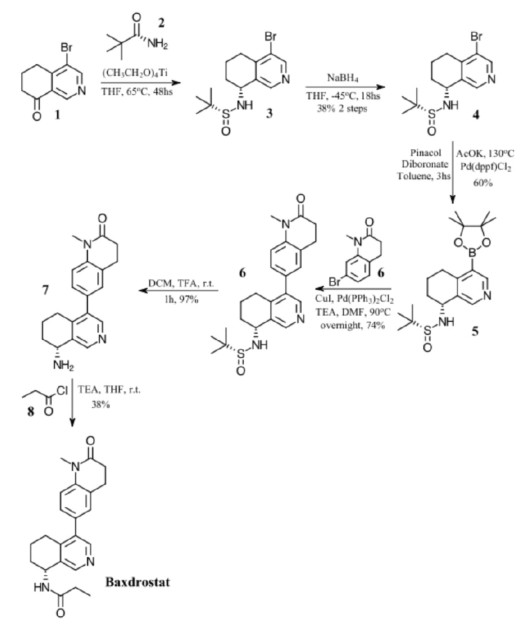
What’s left is removing the auxiliary and finishing the nitrogen. The tert-butanesulfinyl group comes off with TFA in dichloromethane in 1 h, releasing the primary amine almost quantitatively (7, 97%). Finally, acylation with propionyl chloride and triethylamine in THF, under an ice bath, gives the propionamide, which is baxdrostat itself (38%), confirmed by m/z 363.1 [M+H]+ and ¹H NMR. Taken together, it’s six steps with a single point of asymmetric induction (the Ellman sulfinamide doing all the stereochemical work) and two palladium couplings back to back: one to place the boron, the other to join the rings.

Becoming the “Customer of Choice”: A Strategic Imperative for CDMOs an...
Intelligence Amplified: A CDMO Perspective on Integrating R&D and...
Deriving health-based exposure limits for highly potent APIs: from reg...
HPAPI Management: From Categorization to Prevention – Practical...

Scaling, Adapting and Partnering: How Europe’s Chemical Sector Can Sta...
Regulatory affairs as the connective tissue of pharmaceutical product...
Advancing Antibody–Peptide Conjugates Through Controlled Conjugation a...