

Introduction: The Digital Maturity Paradox
The global pharmaceutical and biopharmaceutical manufacturing sectors stand at a critical crossroads in 2026. Capital investment in digital transformation, machine learning, and cloud analytics has reached historic levels, yet the vast majority of these initiatives remain confined to isolated pilot programs. Individual production suites build highly customized, ring-fenced “smart” systems that cannot communicate with the rest of an enterprise network. Sophisticated analytical engines are being deployed without the unified nervous system required to feed them clean, contextualized data.
This structural failure runs deeper than IT architecture. Since the adoption of ICH Q9 in 2005, the industry has operated under a “risk-to-quality” paradigm that assumes patient safety follows automatically once manufacturing specifications are met. Real-world evidence increasingly contradicts this assumption. A dangerous gap persists between regulatory checklist compliance and actual patient outcomes, one that is especially pronounced for narrow therapeutic index (NTI) drugs and complex dosage forms such as transdermal delivery systems (1, 6).The Digital Maturity Paradox, in other words, is not merely an infrastructure problem. It is a scientific and governance failure: systems optimized to satisfy regulators rather than to protect patients (Figure 1).
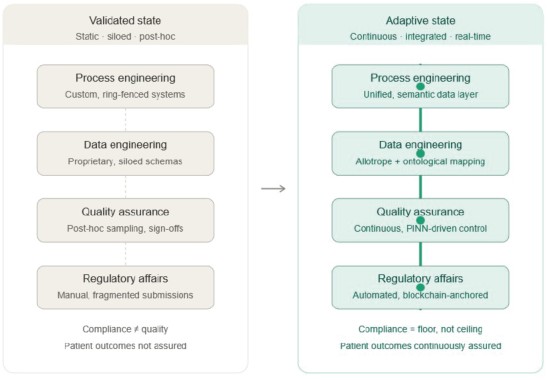
Figure 1. The digital maturity gap: from validated state to adaptive state.
Achieving true enterprise-scale AI requires a transition from a static “Validated State”, where quality and compliance are treated as snapshots, achieved through post-hoc sampling and human sign-offs, to a dynamic, continuous “Adaptive State.” In this paradigm, process engineering, data engineering, quality assurance, and regulatory affairs cease to operate as functional silos, instead bound together by an unbroken, automated, and immutable Digital Thread that transforms scientific data directly into compliant, auditable commercial outcomes.
Diagnosing the Stagnation: Three Structural Failures
The stagnation of enterprise AI is not a limitation of algorithms or cloud capacity. It is a structural infrastructure failure driven by three compounding flaws.
The Semantic Chasm: Lab Data Silos vs. Lifecycle Workflows
A modern pharmaceutical development group relies on a sprawling ecosystem of proprietary software. Chromatography data is managed within Thermo Fisher’s Chromeleon or Waters’ Empower; method data is tracked in custom Laboratory Information Management Systems (LIMS); and experimental protocols, scale-up variables, and formulation parameters are recorded in Electronic Lab Notebooks (ELNs). Each of these systems functions as an isolated digital canyon, writing data in proprietary, non-interoperable schemas.
When an enterprise machine learning model attempts to ingest this information to optimize a commercial manufacturing run, it encounters a “data swamp.” There is no unified semantic layer, no common framework that maps a specific chromatographic peak in an analytical lab to a Critical Quality Attribute (CQA) on a commercial bioreactor floor. The deeper cause of this fragmentation is a regulatory framework that defines a drug product as a bundle of discrete legal descriptors, API, inactive ingredients, dosage form, rather than as an integrated engineered system. Excipients are a telling example: classified as “inactive ingredients,” they are treated as static compliance checkboxes, when in reality they are dynamic variables with direct mechanistic roles in product performance and patient safety. An AI model trained on this reductionist data architecture inherits its blind spots (1, 6).
The Allotrope Foundation, an international consortium of pharmaceutical and biopharmaceutical companies, has spent over a decade developing the Allotrope Framework, a vendor-agnostic standard data format and ontology, specifically to address this fragmentation (1). Despite its value, broad industry adoption remains incomplete, and proprietary silos persist across most enterprise networks.
The Black-Box Trap and Its Regulatory Consequences
A second failure is ideological: the dangerous misconception that large language models or generative AI can function as fully autonomous, ungrounded regulatory or operational experts. The practical risk is not hypothetical. When AI systems operate as probabilistic text generators rather than as mechanistically grounded reasoning engines, they produce outputs that are confident, plausible, and potentially wrong in ways that no human reviewer ever flagged, because no human reviewer was in the loop.
This over-reliance has now produced real regulatory consequences. On April 2, 2026, the FDA issued Warning Letter 320-26-58 to Purolea Cosmetics Lab of Livonia, Michigan, the first warning letter in U.S. CGMP history to include a section explicitly titled “Inappropriate Use of Artificial Intelligence in Pharmaceutical Manufacturing (2).” Investigators found that Purolea had used AI agents to generate drug product specifications, standard operating procedures, and master production and control records without human quality unit review. When confronted with a complete absence of process validation, the firm’s owner stated she had not known validation was required because the AI system had never informed her.
The FDA’s response was unambiguous. Citing 21 CFR 211.22(c), the agency stated that any output from an AI agent must be reviewed and cleared by an authorized human representative of the firm’s quality unit before use. Notably, the firm had already ceased drug production by the time the letter was issued. The warning nonetheless codified the agency’s position on AI governance for the entire industry.
The Absence of an Immutable Audit Trail
The third structural flaw is technological: standard relational databases are alterable by design. Data can be overwritten, appended, or backdated by users with administrative privileges. In a GxP environment, this creates a validation hurdle when applying real-time AI to manufacturing equipment. If a Process Analytical Technology (PAT) system makes an autonomous, real-time decision to adjust a Critical Process Parameter (CPP) mid-run, how does the manufacturer demonstrate to an inspector, years later, that this adjustment was justified and stayed within the validated design space? Without an unalterable, cryptographically secured, and timestamped log, the AI’s interventions look like unvalidated process drift to an auditor. This forces quality units back to hyper-conservative static recipes.
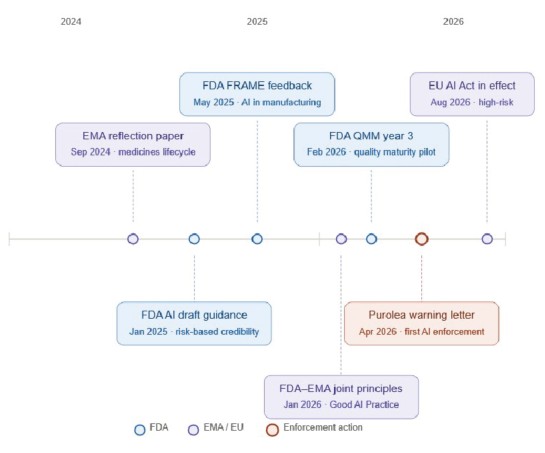
Figure 2. The regulatory AI landscape: key milestones in pharmaceutical manufacturing governance, 2024–2026
The Regulatory Landscape: Enforcement Has Arrived
FDA: FRAME, QMM, and Converging Policy
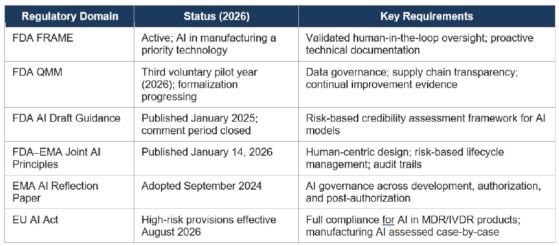
The FDA’s Framework for Regulatory Advanced Manufacturing Evaluation (FRAME) initiative was established by CDER to prepare regulatory frameworks for advanced manufacturing technologies. FRAME has explicitly prioritized AI in pharmaceutical manufacturing as one of its four core technology focus areas (3). In May 2025, FDA published formal public feedback on regulatory considerations for AI in drug manufacturing through the FRAME initiative (4).
Complementing FRAME is the Quality Management Maturity (QMM) program. In February 2026, the FDA announced the third year of its voluntary QMM Prototype Assessment Protocol Evaluation Program, opening participation to up to nine drug manufacturing establishments (5). The program evaluates quality management practices across five key domains, including data governance and supply planning, and aims to formalize a rating system that rewards manufacturers demonstrating advanced quality culture and proactive risk mitigation.
In January 2025, the FDA published its first-ever draft guidance on AI in drug development: Considerations for the Use of Artificial Intelligence to Support Regulatory Decision-Making for Drug and Biological Products (6). This guidance proposes a risk-based credibility assessment framework for AI models used to generate data supporting regulatory decisions on safety, efficacy, or product quality.
The Joint FDA–EMA Milestone: Good AI Practice Principles
The most significant convergence event of early 2026 was the joint publication, on January 14, by the FDA and the European Medicines Agency (EMA), of the Guiding Principles of Good AI Practice in Drug Development (7). This document sets out ten high-level principles for the safe and responsible use of AI across the full medicines lifecycle. The principles emphasize human-centric design, risk-based lifecycle management, data governance, explainability, and auditability.
The EMA’s foundational position had been established in its September 2024 Reflection Paper on the Use of Artificial Intelligence in the Medicinal Product Lifecycle (EMA/CHMP/CVMP/83833/2023), adopted jointly by CHMP and CVMP (8). This paper provides considerations for AI use throughout development, authorization, and post-authorization phases.
The EU AI Act: Scoped, Not Sweeping
The EU AI Act (Regulation (EU) 2024/1689), with full compliance requirements for high-risk systems taking effect in August 2026, applies a risk-based classification system. AI used internally for pharmaceutical R&D or manufacturing process optimization does not automatically qualify as “high-risk (9).” High-risk classification is triggered primarily for AI systems embedded in products regulated under the EU MDR or IVDR. Manufacturers should assess their specific AI applications against Annex III of the Act rather than assume blanket high-risk status.
The Solution: The Unified Digital Thread
Upstream: The Ontological Core
The foundation begins in the development laboratory. The Allotrope Foundation’s data standards, the Allotrope Data Format (ADF) and the Allotrope Simple Model (ASM), provide a pharmaceutical industry-developed, vendor-agnostic framework that translates the output of any analytical instrument or laboratory notebook into a context-rich, machine-readable format, tagging each result with standardized metadata and streaming it into an enterprise data layer where scientific relationships are preserved (10).
Standardizing the data format, however, is a necessary but not sufficient condition. Raw data, however well-tagged, does not reason. A complete ontological layer must also encode the mechanistic relationships between ingredients, process variables, and quality outcomes, so that AI systems operating downstream are reasoning from pharmaceutical science rather than pattern-matching against historical text. This means treating excipients not as inert label entries but as active engineering variables, and representing each manufacturing step not as a compliance checkpoint but as a causally connected node in a larger system model. Where the Allotrope Framework standardizes the format of data at its source, the semantic layer above it determines whether that data is ever truly understood (16).
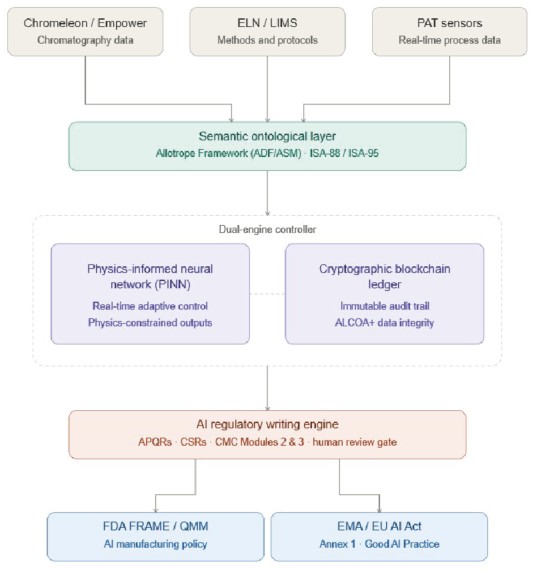
Figure 3. The Unified Digital Thread: From Laboratory Data to Regulatory Submission.
Midstream: Real-Time Adaptive Control via Edge Computing
Once a molecule enters commercial production, the digital thread transitions to active, closed-loop optimization through the Manufacturing OODA Loop (Observe, Orient, Decide, Act). High-frequency process analytical sensors stream data to edge computing platforms at millisecond intervals. Rather than reactive statistical process control charts, these edge nodes run Physics-Informed Neural Networks (PINNs): hybrid models that combine classical first-principles chemical engineering equations with deep learning (11).
Because PINNs are constrained by the laws of physics, they cannot produce the arbitrary or hallucinatory outputs that characterize unconstrained LLMs. If a raw material variance causes a CQA to drift toward a specification boundary, the PINN calculates the necessary course-correction and sends a validated override command back to the process controller. Recent peer-reviewed work has demonstrated PINNs achieving online optimization in continuous biopharmaceutical manufacturing (12).
Downstream: Blockchain Provenance and Automated Regulatory Writing
The architectural link that transforms this automation loop into a fully validated GxP system is the integration of a private, high-throughput cryptographic blockchain ledger. Every component of the real-time control loop is cryptographically secured as events occur, sensor deviations, PINN decision logic, and resulting parameter shifts are locked into the same cryptographic block. This process embodies the ALCOA+ principles (Attributable, Legible, Contemporaneous, Original, Accurate, Complete, Consistent, Enduring, and Available) that govern GxP data integrity (13).
This blockchain-secured infrastructure provides the ideal foundation for AI-powered regulatory writing platforms. Because the underlying data lineage is cryptographically verified, a downstream writing engine can autonomously extract verified process data, analytical results, and deviation-handling logs to generate high-fidelity first drafts of APQRs, CSRs, and CMC Modules 2 and 3. The critical distinction from the Purolea failure is grounding: the AI writing engine organizes and articulates cryptographically verified data, with human review as the final, mandatory gate before submission.
The same provenance infrastructure that protects a manufacturer during a regulatory inspection has a longer-term value that the industry is only beginning to recognize. When real-world product performance data, adverse events, dissolution failures, patient-reported outcomes, is anchored to the same immutable ledger as the manufacturing record that produced it, the feedback loop between post-market experience and process design closes in a way that periodic APQR reviews never could. Quality assurance stops being a backward-looking audit function and becomes a continuous, evidence-driven signal that informs the next manufacturing cycle (16).
Modality-Specific Applications
Small Molecules: Formulation Stability and Scale-Up
In solid oral dosage manufacturing, subtle variations in raw material physical properties, particle size distribution, moisture content, excipient lot variability, can disrupt transitions from API synthesis to commercial formulation. By implementing an unbroken semantic link between formulation development ELNs and commercial LIMS environments, manufacturers can build predictive blend-uniformity models that dynamically adjust compression force and feed ratios at the tablet press based on real-time NIR and particle-size data, reducing costly empirical trial-and-error stability testing campaigns.
Biologics: Reclaiming Capacity in Legacy Bioreactor Suites
Monoclonal antibodies and other large-molecule biologics are highly sensitive to minor fluctuations in nutrient feeding, dissolved oxygen, and metabolic waste accumulation. A “Wrapper Strategy” overlays high-fidelity digital twins directly onto legacy distributed control systems via secure edge gateways. The digital twin ingests real-time bioreactor data, forecasts cell growth and glycosylation trajectories in advance, and automatically fine-tunes nutrient and gas feed setpoints. Peer-reviewed literature has demonstrated that such hybrid approaches substantially improve prediction accuracy and enable proactive process control (14).
Vaccines: mRNA Lipid Nanoparticle Precision
Modern lipid nanoparticle (LNP) mRNA vaccines depend on exceptional microfluidic precision. Real-time edge-to-cloud synchronization enables Bayesian optimization models to continuously adjust flow-rate ratios based on dynamic light scattering data. Peer-reviewed work by Li et al. (2025) confirmed that Bayesian active-learning loops can navigate competing formulation goals, potency, viscosity, and shelf stability, with substantially fewer experiments than conventional factorial design approaches, directly applicable to the 100-day vaccine readiness agenda (15).
The consistent message from both the FDA and EMA is that AI adoption is not merely permitted, it is encouraged, provided the underlying architecture is built on transparency, documented human oversight, and absolute data integrity.
Conclusion: Beyond Compliance Theatre
The era of treating enterprise AI as an IT pilot program is over. The sharp dividing line between market leaders and legacy operations will be determined by their architectural approach to data.
Organizations that continue to deploy ungrounded AI text generators on top of fragmented data silos will face the regulatory consequences now codified by the Purolea enforcement action. Conversely, organizations that execute the strategic vision of bridging the data gap, from the laboratory bench to regulatory submission, will establish a durable competitive advantage.
By building an integrated, unbroken digital thread, grounded in the laboratory core through standards like the Allotrope Framework, optimized by real-time edge intelligence through physics-constrained neural networks, and protected by cryptographic blockchain provenance, modern pharmaceutical networks can achieve the ultimate goal of advanced manufacturing: delivering high-fidelity, life-saving medicines with unprecedented scale, speed, and regulatory certainty.
But the technical architecture alone is not the finish line. The manufacturers who lead the next decade will be those who close the loop entirely, connecting the immutable manufacturing record not just to the regulatory submission, but to the patient outcome on the other end. That is what transforms compliance into quality, and quality into trust.
References and notes
- Allotrope Foundation. Data Standards and the Allotrope Framework. https://www.allotrope.org/
- U.S. Food and Drug Administration. Warning Letter 320-26-58: Purolea Cosmetics Lab, April 2, 2026. https://www.fda.gov/inspections-compliance-enforcement-and-criminal-investigations/warning-letters/purolea-cosmetics-lab-722591-04022026
- U.S. Food and Drug Administration. CDER’s Framework for Regulatory Advanced Manufacturing Evaluation (FRAME) Initiative. https://www.fda.gov/about-fda/center-drug-evaluation-and-research-cder/cders-framework-regulatory-advanced-manufacturing-evaluation-frame-initiative
- Das J, O’Connor TF, Fisher AC, et al. (2025). Public feedback to FDA on regulatory considerations for AI in drug manufacturing. AAPS Open, 11(1), 1–8. https://doaj.org/article/b43a702894cc420c8065d5655dea6a83
- U.S. Food and Drug Administration. Voluntary Quality Management Maturity Prototype Assessment Protocol Evaluation Program Notice, Federal Register, February 11, 2026. https://www.fda.gov/drugs/pharmaceutical-quality-resources/cder-quality-management-maturity
- U.S. Food and Drug Administration. Considerations for the Use of Artificial Intelligence to Support Regulatory Decision-Making for Drug and Biological Products: Draft Guidance for Industry, January 2025. https://www.fda.gov/regulatory-information/search-fda-guidance-documents/considerations-use-artificial-intelligence-support-regulatory-decision-making-drug-and-biological
- U.S. Food and Drug Administration & European Medicines Agency. Guiding Principles of Good AI Practice in Drug Development, January 14, 2026. https://www.ema.europa.eu/en/documents/other/guiding-principles-good-ai-practice-drug-development_en.pdf
- European Medicines Agency. Reflection Paper on the Use of Artificial Intelligence (AI) in the Medicinal Product Lifecycle (EMA/CHMP/CVMP/83833/2023), September 2024. https://www.ema.europa.eu/en/use-artificial-intelligence-ai-medicinal-product-lifecycle-scientific-guideline
- 9. IntuitionLabs. EU AI Act High-Risk Compliance: Pharma & Medical Devices, 2026. https://intuitionlabs.ai/articles/eu-ai-act-pharma-medical-device-compliance
- Millecam T, Jarrett AJ, Young N, et al. (2024). Growing value of data standardization: Allotrope Foundation Connect Workshop Proceedings. Drug Discovery Today, 29(6), 103988. https://pubmed.ncbi.nlm.nih.gov/38642701/
- Raissi M, Perdikaris P, Karniadakis GE. (2019). Physics-informed neural networks: A deep learning framework for solving forward and inverse problems. Journal of Computational Physics, 378, 686–707. https://doi.org/10.1016/j.jcp.2018.10.045
- Tang SY, Yuan YH, Sun YN, et al. (2025). Developing physics-informed neural networks for model predictive control of periodic counter-current chromatography. Journal of Chromatography A, 1739, 465514. https://pubmed.ncbi.nlm.nih.gov/39566288/
- Madhanraj, et al. (2025). Data Integrity in Pharmaceuticals. International Journal of Drug Regulatory Affairs, 13(4), 26–36. https://www.ijdra.com/index.php/journal/article/download/816/424
- Thirugnanasambandam M, et al. (2025). A Physics-Informed Neural Network (PINN) framework for generic bioreactor modeling. Computers and Chemical Engineering, 203, 109354. https://biolamer.eu/wp-content/uploads/2025/09/1-s2.0-S0098135425003564-main_compressed.pdf
- Li L, Back SI, Ma J, et al. (2025). Bayesian optimization and machine learning for vaccine formulation development. PLOS ONE. https://www.ncbi.nlm.nih.gov/pmc/articles/PMC12157168/
- Hussain AS, Morris K & Gurvich VJ. (2026). NIPTE 2030: The Nation’s Digital Trust Anchor for Pharma 5.0. Pharmaceutical Research. https://doi.org/10.1007/s11095-026-04118-z

From data to decisions: How AI is transforming supply chains in chemic...

Artificial Intelligence in the Biopharma Industry

Becoming the “Customer of Choice”: A Strategic Imperative for CDMOs an...

Intelligence Amplified: A CDMO Perspective on Integrating R&D and...

Deriving health-based exposure limits for highly potent APIs: from reg...

HPAPI Management: From Categorization to Prevention – Practical...

Scaling, Adapting and Partnering: How Europe’s Chemical Sector Can Sta...

Regulatory affairs as the connective tissue of pharmaceutical product...